Best 72 Volt Motor Controller Options for E-Bikes and Go-Karts in 2026
Answer: No matter your build, a 72V motor controller is essential for reliable power delivery, protection, and customization. This guide highlights five well-suited controllers for 72V systems, helping riders choose based on motor type, use case, and protection features. Whether you’re upgrading an electric bike, scooter, go-kart, or dirt bike, these options cover universal compatibility, temperature sensing, sine wave control, and programmable features. The buyers below are best for DIY enthusiasts, performance riders, and those seeking safer, cooler operation under load.
| Product | Voltage Range | Best For |
|---|---|---|
| ChongXiao Intelligent Brushless Sine Controller | 36-84V | Budget-friendly, universal voltage, learning line for auto-detection |
| Electric DC Motor 72V 3000W Motor Kit (Kunray) | 72V | High-power setups, temperature sensing for protection |
| Dual Mode 12-Tube 48V-72V Controller (KH866) | 48-72V | Wide compatibility, dual-mode operation, strong heat dissipation |
| Silscvtt Brushless Motor Speed Controller | 48-72V | Square wave or sine wave compatibility, stable control |
| Fardriver Controller 72V 80A (Doinal) | 72V | Programmable, sine-wave focused for advanced users |
ChongXiao Intelligent Brushless Sine Controller

Voltage range spans 36V to 84V, with a maximum current of 50A and a power range from 1000W to 2000W. The controller uses a learning line to identify voltage from the connected battery, making it suitable for mixed systems. It is best for riders building or upgrading light-to-moderate e-bikes and scooters who want automatic voltage recognition and straightforward setup. A limitation is the absence of explicit warranty details in the description, so users should verify compatibility with their motor model before purchase.
Electric DC Motor 72V 3000W Motor Kit (Kunray)

Best for high-performance builds requiring robust temperature sensing to prevent overheating. The kit includes a sine-wave FarDriver controller with IP67 waterproofing and a 72V rating, suitable for 2-3 kW motors. The controller features self-learning and hall sensor compatibility, which helps maintain stable performance on varied terrains. The main caveat is potential complexity during setup for users unfamiliar with programming or motor-tuning workflows.
Dual Mode 12-Tube 48V-72V Controller (KH866)

Best for riders seeking broad motor compatibility with 1000W-1500W classes and automatic mode switching between hall and non-hall sensors. The enclosure uses aluminum for heat dissipation and offers stable braking and speed control. It’s a solid universal replacement for high-power e-bikes and scooters. A downside is that some users may need to confirm specific motor hall sensor compatibility before pairing.
Silscvtt Brushless Motor Speed Controller
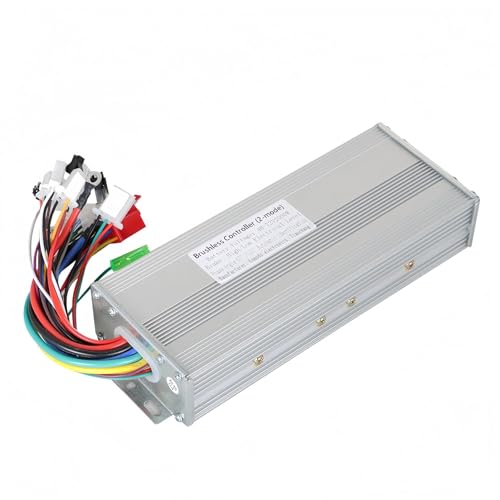
Best for flexible motor types, including sine-wave and square-wave motors, with stable control and quieter operation. The dual-mode design supports higher power and reduces motor noise during heavy load. It is not a plug-and-play solution for every motor, so confirmation of electrical compatibility is advised before wiring into a custom build.
Fardriver Controller 72V 80A Programmable Sine Wave

Best for experienced builders who want a programmable sine-wave controller. This unit is rated for 72V and up to 80A, with downloadable app support and detailed parameter tuning. It is not ideal for first-time users due to programming requirements and a need to verify motor compatibility with the preset MY1020 72V 3000W profile. It is best used where advanced customization is needed.
Dilomber EM50-4 Programmable Controller
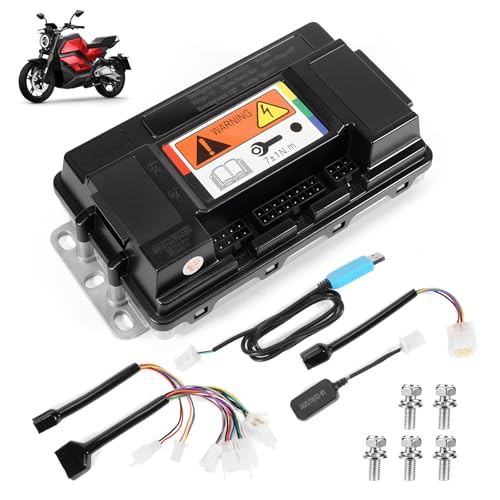
Best for diverse 48V-72V dirt bikes, scooters, and motorcycles with plug-and-play components and USB data cable. The EM50-4 core supports 80A peak and 170A current peaks, making it suitable for mid-to-high power builds. A potential limitation is the emphasis on EM50-4 compatibility; ensure your motor model is within supported lists to avoid mismatches.
Waltyotur Replacement 48-72V Controller

Best for replacement projects needing steady speed control and good heat dissipation. The Waltyotur controller emphasizes protection against thermal overload and reliable braking-direction response. It is a practical option for standard e-bike or scooter builds but may lack some advanced programmable features found in higher-end models.
Buying Guide: Key Considerations For 72V Motor Controllers
- Voltage compatibility: Ensure the controller voltage range matches your battery pack (72V is common, but check peak voltages and rated voltage).
- Current rating and peak current: Match to motor wattage and peak demands; higher current often means better acceleration and torque but more heat.
- Control type: Sine-wave controllers provide smoother torque and quieter operation; square-wave can be cheaper but may feel harsher.
- Temperature handling: Temperature sensing or IP65/IP67 waterproofing helps prevent overheating in hot or wet conditions.
- Sensor compatibility: Hall sensor vs. non-Hall, and compatibility with your motor hall wiring.
- Programmability: Some controllers require software and app access; assess whether you need advanced tuning or a plug-and-play setup.
- Heat management: Aluminum housings and heat sinks improve reliability under load; consider additional cooling for 3kW+ kits.
- Ease of wiring: Look for clear wiring diagrams and included harnesses to simplify installation.
Frequently Asked Questions
- What is a sine-wave motor controller? It uses smoother current waveforms to provide stable torque and reduced motor noise, especially under varying loads.
- Do I need a programmable controller for a 72V build? Programmable controllers are helpful for advanced tuning and specific motors, but not always required for basic operation.
- Can I mix controllers with different motors? Compatibility depends on voltage, current limits, sensor type, and hall wiring; mismatches can cause damage or poor performance.
- What should I consider for heat protection? Look for temperature sensing, IP ratings, and a robust heatsink or active cooling, especially with 3kW-class motors.
- Is 72V safe for my ride? With proper protection features and correct installation, 72V systems are commonly used and manageable, but always follow motor and controller manufacturer guidance.
- How do I choose between dual-mode and single-mode controllers? Dual-mode controllers offer automatic mode switching for hall vs. non-hall sensors, improving versatility across motors.