Best 70 Amp Battery Chargers for Fast, Safe 12V LiFePO4 and Automotive Battery Recharging
Answering the question “which 70 amp battery charger should I buy?” this guide highlights five reliable options that deliver strong current while prioritizing safety and ease of use. These chargers are best for users needing quick top-ups on 12V LiFePO4 packs, automotive batteries, and small to mid-size battery banks. They’re suitable for RVs, off-grid setups, garages, and marine applications. The quick-reference table below compares key aspects to help buyers decide.
| Product | Max Current | Best For | Notable Advantage | Limitations |
|---|---|---|---|---|
| VATRER POWER 14.6V 70A Charger | 70A | Large LiFePO4 packs, up to 140–460Ah | Built-in cooling fan with comprehensive protection | Requires compatible LiFePO4 system |
| Stetsom Infinite Black 70A | 70A | 12V automotive and power supply needs | Versatile 127-200VAC input | Lacks broader charging modes in description |
| Stetsom Bravo Charger 70A PRO | 70A | Automotive and marine use with smart charging | Three charging modes and smart control | Limited detail on temp/overvoltage protection |
| LiTime 80A LiFePO4 Charger | 80A | Fast LiFePO4 charging for RVs and off-grid | 0V activation and multi-stage safety | 80A max; slightly above 70A category |
| Taramp’s Smart Charger 90A | 90A | Dynamic car audio systems and battery banks | Automatic bivolt operation | Not strictly 70A, but close and relevant |
VATRER POWER 14.6V 70A Fast Charging Charger

The VATRER POWER charger is a 14.6V unit delivering up to 70A, designed for 12V LiFePO4 batteries, including large packs up to 140Ah and beyond. It emphasizes all-round safety, including overtemperature, short-circuit, overvoltage, and reverse polarity protections. A built-in cooling fan supports heat management for extended charging sessions. Best for buyers who need rapid charging for sizable LiFePO4 banks and require robust protection features. A potential limitation is the need for compatible battery chemistry to ensure optimal performance.
Schumacher DSR Pro 100A Heavy-Duty Charger
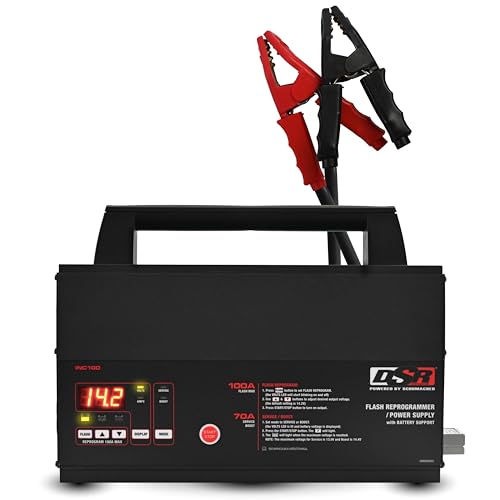
This charger delivers 70–100A depending on the mode, with service and boost options and a professional-grade build suitable for automotive and marine batteries. It’s best for technicians or enthusiasts performing ECU reprogramming or needing continuous power for engine work. Choose this if you require steady high-current output with configurable voltage during servicing; avoid if you primarily need a compact, low-current daily charger for small packs.
Taramp’s Smart Charger 90A Dynamic

The Taramp’s unit provides up to 90A with dynamic charging tailored for car audio systems and battery banks. It supports automatic bivolt operation (127V/220V) and automatic adjustment to optimize charging. Best for users with mixed voltage infrastructure who want fast charging without manual voltage selection; better for those who value automatic optimization, and less ideal for users needing a fixed 70A output only.
Stetsom Bravo Charger 70A PRO

The Bravo Charger line emphasizes energy efficiency with three charging modes: FAST CHARGE, SLOW CHARGE, and FIXED VOLTAGE. It’s designed to power automotive equipment with smart regulation to maximize battery longevity. Best for users who need flexible charging profiles across different cycles; avoid if you require a 70A fixed-mode charger without multi-mode functionality.
Buying Guide
Key considerations when selecting a 70A charger include battery chemistry compatibility (LiFePO4 vs lead-acid), voltage accuracy, safety protections (overtemp, short circuit, reverse polarity), and heat management (cooling fans, thermal sensors). If charging large LiFePO4 packs, prioritize units with high current capacity and robust protection. For automotive and marine uses, look for bivolt ability, fast recharge modes, and stable, programmable charge voltages. Consider the physical size, connector type, and whether the charger supports 0V activation for deeply discharged cells. A dynamic charger (like Taramp’s) can offer benefits when power systems vary in voltage, but a fixed 70A model provides predictability for standard batteries.
FAQs
- What is the advantage of a 70A charger? It provides rapid charging for mid-sized 12V battery banks without excessive heat, improving overall recharge times for LiFePO4 and automotive batteries.
- Is 0V activation important? For deeply discharged LiFePO4 cells, 0V activation helps wake the battery for more reliable charging initiation.
- Should I choose bivolt or fixed voltage? Bivolt can adapt to 127V/220V sources, which is useful in mixed power environments; fixed voltage offers simplicity and predictability in a controlled setting.
- Are safety protections essential? Yes. Overtemperature, short-circuit, overvoltage, and reverse polarity protections help prevent damage to batteries and equipment.
- Can these chargers power RV or marine systems? Yes, several models (including LiTime and Stetsom lines) are suitable for RV/marine use when connected to appropriate battery banks and circuitry.
- Do these units require special cables? Most require standard 12V battery connections with appropriate clamps or Anderson connectors as specified by the model.