Best 6kW Solar System With Battery: Complete Kits for Home Power Independence
The best 6kW solar system with a battery combines robust solar generation with reliable battery storage to back up home power. This guide highlights five top all-in-one kits that fit American homes, cabins, or small- to mid-sized offices. Each option is best suited for off-grid readiness, backup during outages, or reducing grid dependence. The following quick overview helps you compare capacity, battery type, and inverter strength at a glance.
Product overview (selected kits):
| Product | Battery Capacity | Solar Panels Total | Inverter | Best For |
|---|---|---|---|---|
| 10KWH Hybrid Home Solar Power Storage System | 10 kWh LiFePO4 | 550W x 10 | 6 kW with MPPT | Homes seeking all-in-one solution |
| Dawnice 6KW With 10kWh LiFePO4 Battery | 10 kWh LiFePO4 | 600W x 10 | 10 kW Inverter | Larger energy demand, backup |
| 3000W 24V System With 5.12KWh Battery | 5.12 kWh LifePO4 | 1440W total | 3 kW Inverter | Compact off-grid setup |
| 3000W 24V System With 960W Panels | 2.56 kWh LifePO4 | 960W total | 3 kW Inverter | Budget-friendly starter |
| Dawnice 6KW With 12KW Inverter | 12 kW Hybrid Inverter system | 600W x 10 | 12 kW Inverter | High-load home or workshop |
10KWH Hybrid Home Solar Power Storage System Complete Kit

Best for: Homeowners seeking a fully integrated kit with battery storage and grid-connectivity. Why selected: The kit combines a built-in MPPT inverter, 10kWh lithium battery, and 550W solar panels in one package, simplifying installation and maintenance. Caution: As an all-in-one solution, upgrading components later may require compatibility checks with the existing system.
- All-in-one design includes inverter, MPPT controller, solar panels, and battery.
- Provides independence from the grid while allowing grid connection.
- 12V/48V options supported by the included components are not specified; verify system voltage compatibility with your locale.
Dawnice 6KW Solar Power System With 10kWh LiFePO4 Battery

Best for: Homes needing regular daily power with ample storage. Why selected: A solid 6 kW system paired with a 10 kWh LiFePO4 battery supports daily loads and nighttime use. Caution: The kit emphasizes high storage; ensure panel area and roof support match installation needs.
- 10 kWh LiFePO4 battery for safer, longer-lasting storage.
- High-power 6 kW inverter supports common appliances and devices.
- Includes 51.2V battery configuration suitable for longer cycles; confirm compatibility with local electrical codes.
3000W 24V System With 5.12KWh LifePO4 Battery
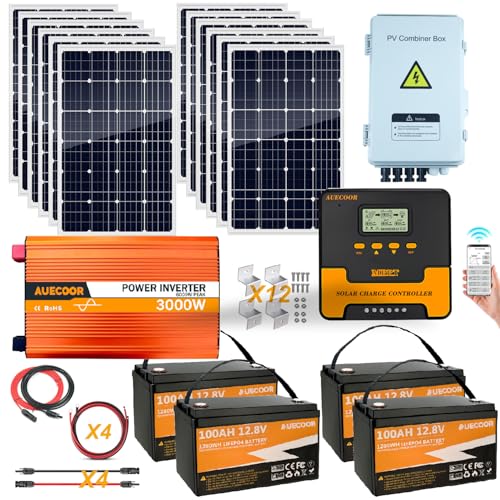
Best for: Small households or RV users needing dependable backup with manageable storage. Why selected: A balanced mix of 1440W solar input, 5.12 kWh battery, and a 60A MPPT controller supports reliable off-grid operation. Caution: System capacity is on the lower end for larger daily loads; consider future expansion possibilities.
- MPPT controller with smart app control for monitoring.
- LifePO4 battery with built-in BMS for safety and longevity.
- Support for up to 1440W future PV add-ons without hardware swaps (verify installer compatibility).
3000W 24V System With 960W Panels

Best for: Budget-conscious buyers needing a compact off-grid solution. Why selected: This kit provides a practical 3 kW inverter and a 2.56 kWh LifePO4 battery, with MPPT charge controller and room for future expansion. Caution: Lower battery capacity may require more frequent recharging or smaller loads during outages.
- 960W solar input pairs with 2.56 kWh battery for lighter daily use.
- LifePO4 battery with strong BMS protection.
- Includes MPPT controller and PV combiner box for efficient charging.
Dawnice 6KW Solar Power System With 12KW Inverter

Best for: Homes needing higher storage and higher inverter capacity for peak loads. Why selected: A 6 kW system paired with a 12 kW inverter and 10x 600W panels supports heavy appliance use and robust backup. Caution: The kit emphasizes a larger inverter; ensure space and cooling capacity meet installation requirements.
- 12KW solar storage inverter supports larger surges.
- 10x 600W panels deliver substantial PV input.
- High-capacity MPPT controller optimizes charging; verify grid-tie compatibility.
Buying Guide: Key Considerations For 6kW Solar Systems With Batteries
What should you check before buying a 6kW solar system with battery?
- Battery type and capacity: LiFePO4 is common for longer life; higher kWh means more days of backup without sun.
- Inverter size and type: Pure sine wave inverters support sensitive electronics; ensure continuous and surge rating match loads.
- System voltage: Many kits use 24V, 48V, or 120/240V configurations. Match with home service and local codes.
- Expandability: Look for MPPT controllers and modular panels that allow future expansion without major rewiring.
- Mounting and space: Panel count and roof or ground mounting considerations affect performance and installation cost.
- Safety and protections: BMS, overcharge/over-discharge protection, and short-circuit safeguards protect both battery and equipment.
- Grid integration: If you intend to connect to the grid, verify interconnection standards and permit requirements in your area.
What is a practical approach to selecting a kit?
- Assess daily energy needs: Look at typical appliances and hours of use to estimate required kWh per day.
- Prioritize storage for nighttime use or cloudy days: A larger battery balances solar input variability.
- Consider local sun exposure: Regions with longer sunny seasons benefit from higher panel wattage or more efficient inverters.
Frequently Asked Questions
- What does a 6kW system mean for daily power?
Answer: It refers to the inverter’s rated output; actual daily energy depends on solar exposure, panel efficiency, and battery storage. - Can I upgrade these kits later?
Answer: Some kits support expansion, especially those with MPPT controllers and modular panels, but check compatibility with existing components. - Are LiFePO4 batteries safer for home use?
Answer: Yes, LiFePO4 offers stable chemistry, longer cycle life, and safer thermal performance compared to some other lithium types. - What maintenance is required?
Answer: Regular inspections, battery health checks, and ensuring proper ventilation and wiring connections are typical maintenance steps. - Do these kits require professional installation?
Answer: For electrical connections and safety codes, professional installation is recommended or required in some jurisdictions. - Will these kits run essential devices during a blackout?
Answer: With sufficient battery storage, essential loads like lighting, refrigeration, and some outlets can be supported during outages.