Best 60A Solar Charge Controllers for Reliable Off-Grid Power
Looking for a dependable 60A MPPT solar charge controller to optimize your off-grid or RV solar setup? This guide highlights five top options that balance efficiency, compatibility, and ease of use for common battery chemistries. Each product is evaluated for who it suits best, with practical notes on limitations. The buyers most likely to benefit are those building mid-size solar systems with LiFePO4 or lead-acid batteries, and those needing robust performance in variable climates.
Summary table of selected products:
| Product | Best For | Key Benefit | Battery Types |
|---|---|---|---|
| LiTime 60A MPPT Solar Charge Controller | LiFePO4 or lead-acid systems | Very high tracking efficiency; broad voltage support | LiFePO4, Lead-Acid |
| Renogy Rover Lite 60A MPPT | Large DIY off-grid or RV installs | High input voltage for series panels; solid protection | Gel, AGM, Flooded, Lithium |
| ECOBOSS 60A MPPT | Cost-conscious mixed-battery setups | Excellent efficiency under shading; multi-battery compatibility | Lead-Acid, LiFePO4, Li-NCM |
| Renogy Rover 60A MPPT | Storm-prone or extreme temps | Lithium reactivation tech; robust temp compensation | Gel, Sealed, Flooded, Lithium |
| POWLAND 60A MPPT Solar Charge Controller | General off-grid setups with multiple voltages | Four-stage charging; strong protection features | Lead-Acid, LiFePO4 |
LiTime 60A MPPT Solar Charge Controller
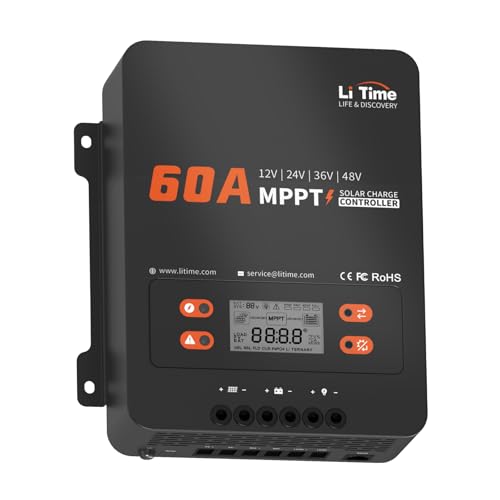
Best for: LiFePO4 or lead-acid systems needing precise MPPT tracking and broad voltage support. This model delivers 99% tracking efficiency with peak 96% conversion efficiency and supports 12V/24V/48V for LiFePO4 and up to 12V/24V/36V/48V/Auto for lead-acid batteries.
Why selected: The high-accuracy MPPT tracking helps maximize panel output, particularly in fluctuating light. The LCD display and two-button interface simplify setup and monitoring. Best for owners who value transparent status information and straightforward operation.
Caution: Requires proper parameter configuration for LiFePO4 vs. lead-acid modes; mis-setting may limit performance or affect charging.
Renogy 60A MPPT Solar Charge Controller Rover Lite

Best for: Larger DIY solar installations with higher panel counts. It features a robust 150V maximum solar input, enabling multiple panels in series and reducing wiring complexity.
Why selected: Useful for setups that demand significant array voltage headroom and reliable operation in extreme temperatures, including low-temperature protection for lithium.
Caution: BT2 Bluetooth module is sold separately; this model relies on optional accessories for wireless monitoring.
ECOBOSS 60A MPPT Solar Charge Controller
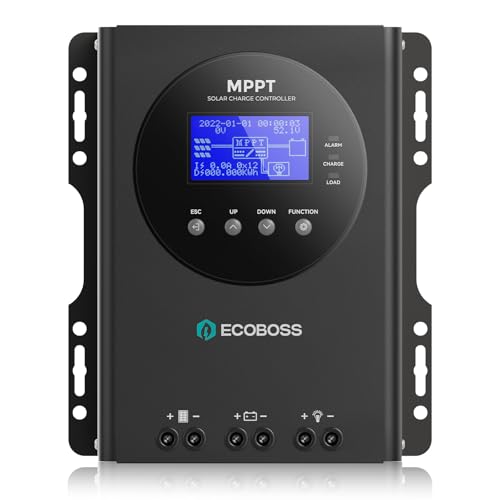
Best for: Mixed-battery systems, including LiFePO4 and various lead-acid chemistries. Its high efficiency under shading makes it suitable for partially shaded installations.
Why selected: It detects 12V/24V/36V/48V automatically and includes multi-peak MPPT with strong protection features. Good balance of performance and compatibility.
Caution: While feature-rich, check that the exact battery chemistries you use are fully supported in the parameter menu before commissioning.
Renogy Solar Charge Controller 60A Rover

Best for: RVs, off-grid cabins, and marine setups with diverse battery types. It features 60A MPPT with four-stage charging and lithium recovery tech.
Why selected: Supports full spectrum charging profiles for lead-acid and lithium, with temperature compensation and protection for storms or remote locations.
Caution: The lithium reactivation feature is a specialized function; ensure actual lithium battery readiness and proper settings to avoid unnecessary cycling.
POWLAND 60A MPPT Solar Charge Controller

Best for: General off-grid systems with auto-detection for 12V/24V/36V/48V. It emphasizes fast, safe charging via a four-stage battery charging algorithm.
Why selected: The four-stage process helps optimize charging efficiency and prolong battery life, with multiple protection features including short circuit and reverse polarity safeguards.
Caution: Data notes indicate high efficiency, but real-world results depend on panel quality and wiring; verify correct cable sizing to avoid voltage drop.
Buying Guide: Key Considerations For 60A MPPT Controllers
- Battery chemistry compatibility: Ensure the controller supports your battery type (LiFePO4, Li-NCM, gel, AGM, flooded, etc.).
- System voltage compatibility: Check whether the unit auto-detects or requires manual setting for 12V, 24V, 36V, or 48V systems.
- Maximum input voltage: The PV input rating affects how many panels you can connect in series and overall wiring complexity.
- Efficiency and tracking: Higher MPPT tracking efficiency means better conversion in partial shading or cloudy conditions.
- Protection features: Look for over-current, over-temperature, short-circuit, and reverse polarity protections for reliability in harsh environments.
- Monitoring interface: LCD displays and mobile app support are helpful for ongoing system monitoring and parameter adjustments.
- Ease of installation: Consider whether the unit requires Bluetooth modules or additional accessories for wireless monitoring.
FAQ
- What is MPPT and why choose a 60A model?
MPPT stands for Maximum Power Point Tracking and optimizes PV power conversion. A 60A rating suits mid-to-large systems with multiple panels and higher charging needs.
- Can I use these controllers with LiFePO4 batteries?
Yes, most listed models support LiFePO4, but confirm parameter settings for optimal charging profiles.
- Do these controllers support auto-detection for different voltages?
Many models do auto-detect 12V/24V/36V/48V, while some require manual configuration.
- Is Bluetooth monitoring required?
Bluetooth modules are optional on some models; wired LCD displays provide immediate on-device monitoring.
- What should I consider for installation in extreme climates?
Look for wide temperature operating ranges and robust thermal protection to maintain performance in heat or cold.