Best 600 Amp Clamp Meters for Pro and DIY Electrical Work
Answering the need for a reliable 600 A clamp meter, these devices measure high current with safety and accuracy. This guide highlights five solid options across professional-grade and DIY-friendly models. Best for electricians, facility technicians, or serious hobbyists who work with high-current circuits and need dependable TRMS readings, NCV detection, and solid jaw designs. The table below compares core strengths to help you choose quickly.
| Product | Best For |
|---|---|
| Fluke-301D/ESP | Residential/commercial maintenance with slim jaw for tight spaces |
| Klein Tools CL710 | Detailed AC/DC measurements with wide range and rugged build |
| FNIRSI DMC-100 | Multi-feature tester with real-time curve recording |
| Ideal 61-757 | Durability and safety with TightSight display |
| Klein Tools CL390 | Comprehensive clamp meter with high-visibility display |
Fluke 301D/ESP 600A Clamp Meter

Features: CAT III 300V Safety Rating; AC current measurements up to 600 A; slim 10 mm jaw for tight spaces. This meter emphasizes portability without sacrificing capability. Best for technicians who often work in confined panels or conduits where space is at a premium.
Best For: Electrical maintenance in compact enclosures and everyday residential/commercial service calls where 600 A capability is needed in a slim form factor.
Caution: The safety rating is CAT III 300V, so avoid use in higher-energy environments without a suitable rating. Ensure the conductor is centered in the jaw for accurate readings.
Klein Tools CL710 Digital Clamp Meter

Features: True RMS for AC/DC current and voltage, resistance, continuity, frequency, capacitance, NCVT; IP40 protection; 6.6-foot drop protection; Transflective display with backlight for visibility in sunlight or dim conditions.
Best For: Technicians needing accurate TRMS readings across multiple parameters in a durable meter with protective features for field use.
Caution: Higher feature set means more to learn; allow time to become proficient with menu navigation and measurement modes.
FNIRSI DMC-100 Clamp Meter

Features: 10000 counts TRMS, measures AC/DC current up to 600 A, includes curve recording, 2″ TFT color screen, live NCV detection, and data storage for real-time analysis. Supports voltage, resistance, capacitance, frequency, temperature, and more.
Best For: Professionals who need real-time data visualization and historical logging to troubleshoot intermittent faults in HVAC, automotive, or industrial settings.
Caution: The manufacturer notes the jaw measures current on a single conductor; clamping around a whole cord will yield incorrect results—center the conductor in the jaw for accurate current readings.
Ideal 61-757 600A TRMS Clamp Meter

Features: UL Certified CAT IV 600V and CAT III 1000V; measures 0-600 A and 0-1000 V; rugged over-molded design with a built-in flashlight and dual backlit displays; True RMS readings for non-linear signals.
Best For: Professionals who need robust safety features, reliable backlighting, and a design that withstands drops in demanding environments.
Caution: Larger form factor might be less ideal in extremely tight panels; verify clearance before use in cramped spaces.
Klein Tools CL390 AC/DC Clamp Meter
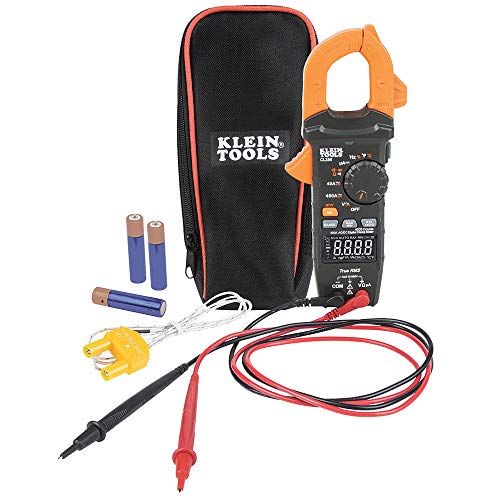
Features: Auto-Ranging, 400 A capacity, NCVT tester; Hi-Viz LCD display; TRMS; measures resistance, continuity, frequency/duty cycle, && temperature via test leads; non-contact voltage testing built into the jaw.
Best For: Field technicians who value a broad feature set, clear display, and the convenience of NCVT and non-contact testing in a single tool.
Caution: While capable, it has a lower current ceiling than some 600 A models; choose this if 400 A suffices for your typical tasks, otherwise opt for 600 A variants.
Buying Guide
What should I prioritize in a 600 A clamp meter?
Consider current range, True RMS measurement for non-linear loads, jaw size, safety ratings (CAT IV/III), and display visibility. A slim jaw helps in tight panels, while a rugged build supports field work.
Should I get an auto-ranging or manual-ranging meter?
Auto-ranging simplifies use for quick checks and multi-parameter work. Manual-ranging can be faster for experienced users with a known target range but adds an extra step if you’re unsure of the load.
Is NCVT and non-contact testing important?
NCVT helps quickly verify live circuits without direct contact. Non-contact voltage testing is convenient for preliminary safety checks, especially in unfamiliar panels.
Which safety ratings matter?
Look for CAT IV or CAT III ratings appropriate to your typical environment. Higher ratings protect against transient spikes and offer broader application, especially in commercial or industrial settings.
Display and usability considerations
A backlit or transflective display improves readability in various lighting. A dual-backlit or high-contrast screen reduces measurement errors when reading in dark or bright conditions.
How to compare five models quickly?
- Check whether the model supports the full 0-600 A range in both AC and DC where needed.
- Note jaw size and whether it can fit in your typical panel or conduit space.
- Assess whether you need data logging, curve recording, or temperature measurements.
- Evaluate durability features for field use, such as drop protection and protective casing.
Maintenance tips
- Keep leads and clamps clean; avoid excessive bending of the jaws.
- Calibrate or have the device serviced according to the manufacturer’s guidelines.
- Store in a protective case to protect the display and buttons from impact.
FAQs
Q: Can I measure 600 A with these meters in DC or AC only?
A: Each model varies; some support 600 A AC/DC, while others emphasize AC or DC depending on the design. Check the product specifications for the exact current type.
Q: Are these clamps safe for high-energy environments?
A: Most listed models come with CAT III or CAT IV safety ratings appropriate for typical residential and some commercial settings. For industrial facilities, verify the exact rating and use appropriate PPE.
Q: Do these meters log data or provide graphs?
A: Several models offer real-time curve recording or data storage, which is valuable for diagnosing intermittent faults. Confirm the model’s data-logging capability if that feature matters.
Q: Can I use a clamp meter to test voltage directly?
A: Many models measure voltage with test leads; some include NCVT for non-contact voltage testing. Do not attempt voltage measurements by clamping without a proper test setup if the device is not designed for that purpose.
Q: How do I choose between 400 A and 600 A?
A: If your work frequently involves high-current loads (e.g., large appliances, feeders, or industrial equipment), select a 600 A-capable meter. If most tasks stay below 400 A, a 400 A model may be more compact and cost-effective.