Best 60 Amp Solar Controller for Efficient Off-Grid Power
The best 60 amp solar controller choices below are suited for larger off-grid setups, RVs, and boats requiring robust MPPT performance. These controllers help you optimize battery health and maximize solar harvest across LiFePO4, lead-acid, and other common chemistries. The top picks balance high tracking efficiency, clear monitoring, and durable protection features. This guide highlights five strong options and who they’re best for, with a quick comparison table to help you decide quickly.
| Product | Battery Types | Max PV Input | Key Strength |
|---|---|---|---|
| LiTime 60A MPPT Solar Charge Controller | LiFePO4, Lead-Acid | 200VDC | Very high tracking efficiency |
| Renogy Rover Lite 60A MPPT | Lithium, AGM, Gel | 150V | Strong extreme-temp performance |
| Depvko 60A MPPT Solar Controller | 12V/24V | Unknown | User-friendly LCD and USB |
| POWLAND 60A MPPT | 12V/24V/36V/48V | 150V | Four-stage charging with safety protections |
| ECOBOSS 60A MPPT | LiFePO4, Gel, Flooded | 150V | Very high MPPT efficiency |
LiTime 60A MPPT Solar Charge Controller
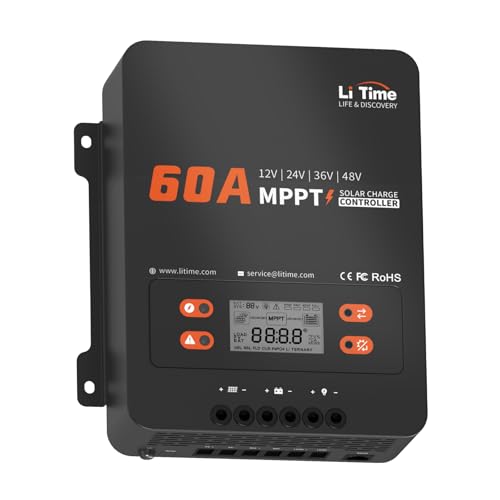
Best for high-efficiency battery charging in mixed chemistries. This controller supports LiFePO4 and lead-acid setups, delivering 12V/24V/48V for LiFePO4 and 12V/24V/36V/48V/Auto for lead-acid batteries. It features a 200VDC maximum PV input and an LCD display with simple controls. The 99% tracking efficiency and up to 96% peak conversion efficiency make it ideal for larger arrays where maximizing harvest matters. The built-in fault indicator helps diagnose issues quickly. Best for владельцы needing precise monitoring with robust multi-voltage support. Caution: Ensure correct parameter settings for each battery type to avoid misconfiguration.
Renogy Rover Lite 60A MPPT

Best for larger DIY solar setups with lithium or AGM/Gel batteries. The Rover Lite 60A supports up to 150V solar input and uses MPPT to maximize harvest, especially when panels are wired in series. It is designed for extreme temperatures and includes low-temperature protection to safeguard lithium packs. Choose this if you plan a sizable off-grid system with multiple panels and a focus on reliability in varied climates. Limitation: BT Bluetooth module is sold separately, so on-board Bluetooth may not be available out of the box.
POWLAND 60A MPPT Solar Controller

Best for versatile charging with four-stage logic. POWLAND provides 60A rated charging current and auto-detects 12V/24V/36V/48V, with several protection features including short circuit and overload protection. This model emphasizes efficient real-time power tracking and robust protection, making it a balanced choice for medium-to-large off-grid systems. Caution: As with many 60A controllers, proper heat management is important in hot environments to maintain MTBF.
ECOBOSS 60A MPPT Solar Charge Controller
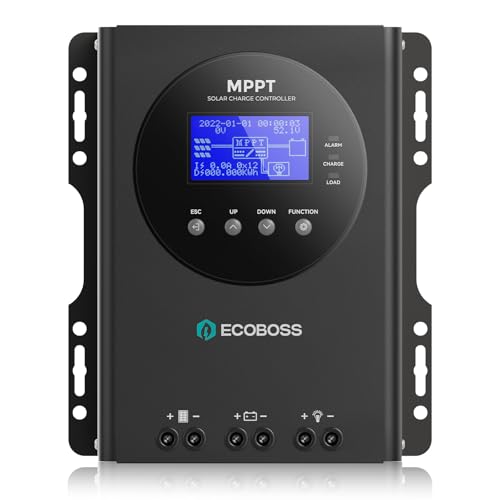
Best for multi-type battery systems with high MPPT efficiency. ECOBOSS auto-detects 12V/24V/36V/48V and supports LiFePO4, Gel, and Flooded batteries. It emphasizes high MPPT efficiency (up to 99.5%), strong shading performance, and multiple safety features, including automatic power reduction at high temperature. Choose this if you need broad battery compatibility and strong performance in less-than-ideal sunlight. Limitation: Some users report that advanced configuration may require the manual for optimal settings.
Renogy Rover 60A MPPT

Best for versatile RV and marine setups with mixed-battery compatibility. The Rover Master 60A supports 12V/24V/36V/48V and uses extensive multi-peak tracking with 99.9% efficiency. It handles gel, sealed, flooded, and lithium chemistries with analog temperature compensation for lithium lifecycles. If you need robust storm-ready protection and lithium recovery features, this is a strong option. Caution: The more advanced features may require more setup time and understanding of charging profiles.
Victron Energy SmartSolar MPPT Tr Solar Charge Controller

Best for smart, synchronized charging across multiple controllers. The Victron SmartSolar MPPT supports up to 150V and 60A per controller, with Bluetooth for monitoring. It is designed to optimize power output and battery longevity with intelligent charge algorithms and synchronization features that help panels perform as a unified system. Avoid this if you require a non-Bluetooth model or a strictly budget-focused option; the Bluetooth capability adds cost and potential compliance considerations in some installations.
Buying Guide: Key Purchase Considerations
What should you compare when selecting a 60A MPPT controller? Consider:
- Battery compatibility: Verify if the controller handles LiFePO4, lead-acid, gel, and flooded batteries, and whether it auto-detects battery type or requires manual configuration.
- Maximum PV input: Ensure the PV array voltage and current stay within the controller’s input rating to avoid overheating or derating.
- Charging algorithm: Look for four-stage charging (Bulk/Absorption/Float/Equalization) for longevity and safety across chemistries.
- Protection features: Short-circuit, reverse polarity, over-temperature, and overload protections help prevent system damage in harsh environments.
- Monitoring and control: LCD displays, LED indicators, and Bluetooth or app connectivity affect ease of use and diagnostics.
- Temperature performance: Consider models with temperature compensation for lithium and other chemistries in extreme climates.
Frequently Asked Questions
- What does a 60A MPPT controller do?
A 60A MPPT controller optimizes the conversion of solar power to battery charging, handling up to 60 amps of charge current and adjusting voltage to maximize energy harvest from the solar array.
- Can I use a 60A controller with both LiFePO4 and lead-acid batteries?
Yes, many models support multiple chemistries. Check the manufacturer’s parameter settings to ensure proper charging profiles for each battery type.
- Is Bluetooth on solar controllers essential?
Bluetooth provides convenient monitoring, but non-Bluetooth models may offer lower cost and fewer setup steps. Choose based on how you prefer to monitor the system.
- What input voltage is typical for these controllers?
Many 60A MPPT controllers support up to 150V or 200V PV input. Ensure your solar array’s open-circuit voltage stays within the controller’s limit.