Best 60 Amp Marine Battery Charger Options for 12-Volt Systems
Looking for a reliable 60-amp charger for a 12-volt marine system? This guide compares top 60A, triple-bank chargers ideal for boats, RVs, and off-grid marine use. It highlights which model suits starter batteries best, how smart multi-stage charging protects longevity, and where to avoid common drawbacks. The selections below are aimed at boat owners needing robust, sea-ready charging with multiple banks and smart features.
| Product | Bank Count | Best For | Why It Stands Out |
|---|---|---|---|
| ProMariner ProNautic 1260P | 3 | Owners needing distributed charging | Digital performance, automatic bank distribution, up to 12 charge profiles |
| Sterling ProCharge Ultra 1260 | 3 | All-around reliability | 11 pre-programmed curves, user-friendly wiring, 4-stage profile |
| Victron Energy Centaur 12-Volt 60 Amp | 3 | Global use and temperature protection | Auto-ranging input, temperature sensing, float maintenance |
| Renogy DC to DC Charger 60A | 3 | Multi-battery compatibility | Smart 3-stage charging, protects against over-voltage/over-temp |
| RENOGY REGO 60A DC-DC Charger | 1-2 (suitable for multiple setups) | Universal battery chemistries | Auto-detects battery type, fast charging, LiFePO4 activation |
ProMariner ProNautic 1260P (12V) 60-Amp 3-Bank Charger

Best for: Boat owners needing distributed charging across three banks with extensive profile control. The ProNautic 1260P uses Generation 3 digital control and software-based power conversion. It automatically senses and distributes charging capacity across one or all banks. It supports up to 12 digitally controlled four-stage profiles, including Charge, Condition, Auto-maintain, and Recondition. This makes it well-suited for complex battery banks on larger boats where precise balancing matters. A potential limitation is reliance on software profiles that may require periodic updates for optimal performance.
Sterling ProCharge Ultra 1260 – 12V, 60 Amps

Best for: Mariners who value a wide range of battery curves and simple local control. The Sterling ProCharge Ultra includes eleven pre-programmed charge curves for LiFePO4, GEL, AGM, Calcium, and Flooded Lead Acid, plus a user-programmable profile. It uses a four-step charging process to extend battery life, with a float/energy-save mode to prevent overcharging. Real-time current and voltage are displayed on two digital meters, and three isolated outputs can direct all output to a single battery if needed. A caution: some users may rely on external monitoring for complex setups, as advanced features are accessed via the charger’s own controls rather than a connected computer.
Victron Energy Centaur 12-Volt 60 Amp 3 Bank

Best for: Global sailors needing versatile input options and robust protection. The Centaur features auto-ranging input from 90-265 VAC, allowing worldwide use. It includes an internal temperature sense to reduce output under high heat, protecting components. It charges at bulk rate until about 70% capacity, then a 4-hour timer manages the transition to float. This is particularly suitable for vessels with inconsistent shore power and variable environmental conditions. Limitation: reputation is strong, but older installations may require exact wiring compatibility checks for multi-bank configurations.
Renogy DC to DC Charger 60A Lifepo4 Battery Charger
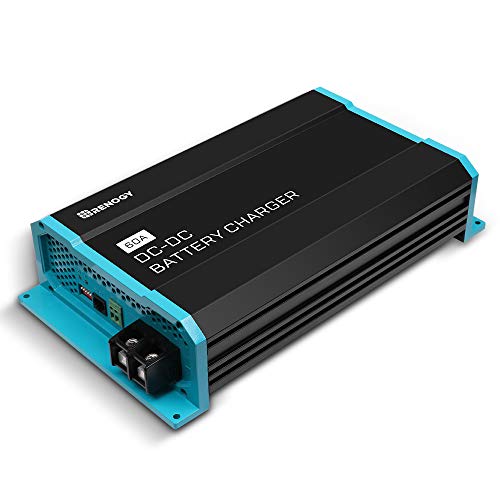
Best for: Boats and RVs needing universal battery compatibility across multiple chemistries. The Renogy 60A DC-to-DC charger handles AGM, Flooded, Gel, and Lithium batteries and uses a three-stage charging sequence (Bulk, Boost, Float) to ensure a full, safe charge. It includes protections for over-voltage, over-temperature, and reverse polarity, and isolates input/output to prevent charging interference. Choose this if you want a single charger capable of handling diverse battery types, but be aware installation may require attention to input/output isolation in tight spaces.
RENOGY REGO 12V 60A DC-DC Battery Charger

Best for: Dual-battery setups in boats where a universal charger is desired. The REGO 60A DC-DC charger auto-detects chemistry (LiFePO4, AGM, Gel, Flooded) and supports 60A turbo charging with Bulk/Boost/Float stages. It’s designed for RVs, boats, and all-weather conditions, providing quick charging and a smart engine-start protection feature for vehicles. Limitation: some users may require additional marine-grade enclosure or weatherproofing in exposed installations.
Buying Guide: Key Purchase Considerations
- Bank configuration: Choose a model with 3 banks if you have multiple battery groups; three-bank chargers support better balance on boats with separate engines, house banks, and starting batteries.
- Battery chemistry support: Ensure compatibility with LiFePO4, GEL, AGM, and flooded lead acid if you mix chemistries on board.
- Input voltage and environment: Look for auto-ranging input (90-265 VAC) for global use and protections for temperature to avoid overheating in hot engine rooms.
- Charging profiles: More profiles offer finer control. If you need simple operation, prefer presets; for complex systems, a charger with programmable profiles is beneficial.
- Protection features: Over-voltage, over-temperature, reverse polarity, and input-output isolation are important for safety and longevity.
- Install considerations: Check for space, mounting, and water exposure; some models are more enclosure-friendly for marine applications than others.
FAQ
- What is the advantage of a three-bank charger?
It can independently manage multiple battery banks, improving charge balance and extending overall battery life on boats with separate starting and house batteries. - Can I use a 60A charger for LiFePO4 batteries?
Yes, but ensure the model explicitly supports LiFePO4 chemistry or has a lithium-specific mode to avoid improper charging. - Is auto-ranging power input important for marine use?
Yes, auto-ranging input increases compatibility with shore power from different regions and reduces the need for adapters. - Should I choose a DC-DC charger for a boat?
If you need to charge house batteries from the starter battery while the engine runs, a DC-DC charger is a practical choice with proper isolation. - What maintenance is required for these chargers?
Regular inspections, secure connections, and periodic verification of charge profiles help ensure reliable performance; follow manufacturer guidelines for software updates where applicable. - Do these chargers require professional installation?
Installation complexity varies; for multi-bank systems and marine electrical standards, professional installation is often recommended.