Best 6-Gang Marine Panel for Boats and RVs: Tough, Versatile Power Control
Answering what to choose for a reliable, six-gang marine switch panel, this guide highlights proven options for boats, RVs, and off-road vehicles. These panels combine rocker switches, USB charging, voltmeters, and cigarette-lighter sockets into weatherproof enclosures. Best fits include boat owners needing reliable navigation-or lighting-control, RV enthusiasts seeking centralized power management, and off-road users requiring rugged, pre-wired installs. The following selections emphasize durability, multi-function capability, and ease of installation. The summary table helps you compare essential specs at a glance.
| Product | Key Features | Best For |
|---|---|---|
| DaierTek 6 Gang Marine Rocker Panel | Dual LED, USB charging, cigarette lighter socket, voltmeter | Dark cabin or night driving where quick switch location matters |
| Nilight 6 Gang Rocker Panel (12V, QC 3.0 USB) | Built-in voltmeter, QC3.0 USB, LED night glow, 6 switches | Vehicles needing fast USB charging and voltage monitoring |
| Nilight 6 Gang Panel with PD Type C | PD Type-C, USB, voltmeter, cigarette socket, 6 switches | Modern electronics and high-speed charging on 12/24V systems |
| RVBOATPAT 6 Gang Marine Switch Panel | Aluminum panel, LED voltmeter, USB fast charger, cigarette lighter | Durable marine-grade build with strong charging options |
| Kohree 6 Gang Marine Panel | USB-C/QC 3.0, voltmeter, USB charge, 6 rocker switches, USB power switch | Power management with battery-saving USB switch |
DaierTek 6 Gang Marine Rocker Panel

The DaierTek panel combines a six-gang rocker setup with dual LED indicators and a built-in voltmeter. It includes a cigarette lighter socket compatible with 12V–24V accessories and a USB charging arrangement (two ports). This unit is best for boaters who want straightforward, visible power control with lighted cues in low-light conditions. A potential limitation is reliance on a single, all-in-one power panel; users should ensure their loads stay within the combined switch ratings to prevent overload.
Nilight 6 Gang Rocker Panel with USB QC 3.0

This Nilight panel integrates six 12V switches with a center-position voltmeter and a QC 3.0 USB charger. The package emphasizes fast charging and voltage awareness, making it well-suited for vehicles that depend on quick device recharging while monitoring battery health. It suits boats, RVs, and trucks that require a compact, all-in-one control center. The main caveat is that the combined load on the USB ports should stay within the provided ratings to avoid heat buildup and potential tripping of circuit protection.
Nilight 6 Gang Aluminum Panel with PD Type C
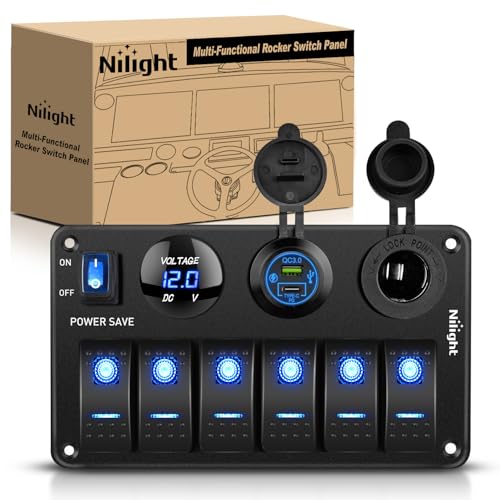
Nilight’s pre-wired, aluminum power panel features PD Type-C and USB charging alongside a voltmeter. It is designed for 12V–24V systems across cars, boats, and RVs. The panel provides circuit-control versatility with built-in safety features like resettable breakers and a compact footprint. Choose this if you need modern, high-speed charging coupled with robust protection. A potential limitation is the complexity of wiring for first-time installers; follow the included instructions closely to ensure correct polarity and fuse placement.
RVBOATPAT 6 Gang Marine Switch Panel

RVBOATPAT offers an aluminum-panel six-gang panel with an LED voltmeter, USB fast charger, and a cigarette lighter socket. It emphasizes corrosion resistance and robust construction, making it a favorable choice for saltwater environments. Best for mariners who need a sturdy, all-in-one charging and monitoring hub. A limitation is that the description highlights faster charging but does not specify exact USB output for every port; plan for typical 2A–3A per port expectations accordingly.
Kohree 6 Gang Marine Boat Panel

The Kohree panel blends a 6-gang rocker layout with USB-C/USB QC 3.0 charging, a digital voltmeter, and a cigarette-lighter outlet. It includes a USB switch to conserve battery life, appealing to users who want explicit control over USB power. This unit suits boats and RVs where devices are frequently charged during extended trips. A caution is the USB switch adds an extra step to power management; ensure you actively use or disable it to prevent unintended charging.
Buying Guide
- Power handling and voltage range: Most panels operate on 12V–24V. Confirm the maximum current per switch and total panel rating to avoid overloading circuits.
- Charging options: Look for USB QC/PD ports and the number of USB ports. Consider whether you need USB-C support for newer devices or only standard USB-A.
- Monitoring and indicators: A built-in voltmeter helps monitor battery health. LED indicators simplify nighttime operation, especially on boats.
- Durability and environment: For marine use, choose panels with aluminum or sealed housings and IP ratings (IP65/IP67) to resist water, salt, and grime.
- Installation and wiring: Pre-wired options with clear mounting hardware save time. Ensure compatibility with existing fuses, breakers, and main power feeds.
- Safety features: Look for circuit breakers or fuses, overload protection, and reverse polarity protection to protect loads.
- Size and layout: Ensure the panel fits your dash or wall space and aligns with your load distribution plan for easy access.
FAQ
- What is a 6-gang marine panel used for? It centralizes power control for multiple accessories such as lights, pumps, USB chargers, and outlets in a single, water-resistant unit.
- Do these panels require professional electrical work? Basic installation can be DIY with proper wiring diagrams, but complex setups on boats or RVs may benefit from an electrician.
- Is USB-C faster for charging on these panels? USB-C with PD often provides faster charging for compatible devices than USB-A, depending on port power and device compatibility.
- Can I mix different brands on the same vehicle? Yes, but ensure voltage compatibility, load ratings, and fuse protection align to avoid overloading any circuit.
- What maintenance is needed? Periodically inspect seals, terminals, and connectors for corrosion, and test breakers or fuses to ensure reliable protection.
- What should I consider when choosing? Prioritize load needs, environment (marine vs. land), available space, and the need for monitoring and fast charging in your setup.