Best Electric and Gas 6 Hp Boat Motor Options for Safe, Quiet Floating Adventures
Answering the buyer’s search for a 6 hp electric boat motor, this guide highlights practical options that blend efficiency, reliability, and ease of use. The featured products include true electric models and strong gas-powered alternatives when electric equivalents aren’t available. This makes the choice suitable for anglers, recreational boaters, and paddlers seeking quiet propulsion with manageable power. The list emphasizes best-fit scenarios, portability, runtime, and maintenance considerations to help you pick the right motor for saltwater or freshwater outings.
| Product | Power Type | Best For | Key Benefit |
|---|---|---|---|
| Newport NT300 Electric Outboard Motor | Electric | Saltwater/Freshwater anglers seeking quiet propulsion | Long range and digital throttle |
| Newport NK300 Electric Kayak Motor | Electric | Kayak anglers needing compact power | Lightweight and efficient |
| 55lb Thrust Trolling Motor (BODIOO) | Electric | Kayaks and small boats needing precise control | 8-speed handle and adjustable shaft |
| HANGKAI 6.5HP 4 Stroke Outboard | Gas | Small to mid-sized boats needing robust power | Water cooling and multiple gears |
| BJTDLLX 6HP Outboard Motor | Gas | Inflatable boats and dinghies requiring reliability | 360° steering rotation and corrosion protection |
Newport NT300 Electric Outboard Motor

The Newport NT300 delivers 1300 watts of power in a 36V system, achieving approximately 110 lb of thrust for quiet, emissions-free propulsion. It uses a digital throttle with an LCD display and supports a 24.6″ shaft with a 9.8″ 2-blade composite propeller. Its trim/tilt options and field-oriented control optimize responsiveness in varied water conditions. Best for anglers and small craft that prioritize silence and range on saltwater and freshwater alike. A potential limitation is lower peak thrust compared with high-displacement gas engines.
Newport NK300 Electric Kayak Motor

The NK300 provides 1300W, or a 3HP-equivalent power level, specifically tuned for kayaks. It offers top speeds around 6.5 MPH and a maximum range of up to 66 miles on a single charge with run times up to 30 hours. Its 36V direct-drive setup emphasizes efficiency and minimal weight, making it ideal for anglers who require prolonged sessions without frequent recharging. It is best for kayak anglers who value compact design and extended range while remaining easy to mount.
55lb Thrust Trolling Motor (BODIOO)

This electric trolling motor delivers about 55 pounds of thrust and features an 8-speed shift with 5 forward and 3 reverse gears, plus a 30-inch adjustable shaft. It is designed for kayaks and small boats, offering quiet operation to reduce disturbance in shallow waters. Best used for controlled, precise maneuvering rather than high-speed cruising. A limitation is that thrust is modest compared to higher-horsepower gas engines, which can affect speed in windy conditions or against currents.
HANGKAI 6.5HP 4 Stroke Outboard
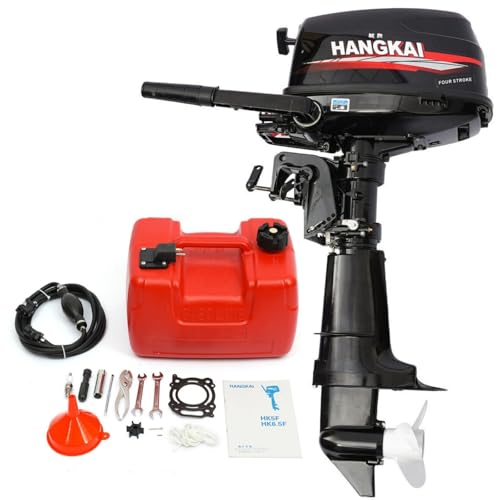
HANGKAI offers a 6.5HP four-stroke outboard with water cooling and CDI ignition, designed for inflatable boats, kayaks, and small sailboats. It includes a 3.5–4 gear range with forward, neutral, and reverse, and a 3.2-gallon external tank configuration for practical fuel management. Best for small craft needing steady power and fuel efficiency. A caveat is its gas-powered design, which requires fuel planning and maintenance typical of combustion engines.
BJTDLLX 6HP Outboard Motor

The BJTDLLX 6HP outboard provides a 2-stroke, water-cooled design with CDI ignition and a short shaft option. It features 360° steering rotation and strong corrosion protection in cast aluminum construction. This motor is suitable for inflatable boats and small dinghies requiring reliable all-around performance. Best for boaters who want flexible steering and straightforward maintenance. A limitation is the typical higher fuel consumption associated with two-stroke engines compared with modern four-stroke models.
Buying Guide
What kind of propulsion should you choose? Electric motors are best for quiet operation and emissions-free boating, ideal for lakes, gentle coastal waters, and anglers who fish near shorelines. Gas outboards deliver maximum power and faster planing for rougher seas or larger craft where weight and run time are less critical. Consider the boat size, weight, and typical water conditions when comparing 6 hp electric equivalents and traditional gas options.
Key considerations include:
- Power and thrust: Electric motors offer steady, efficient propulsion but may have lower peak thrust compared with gas engines. Gas engines provide higher power, faster acceleration, and practical range for bigger boats.
- Weight and mounting: Electric options tend to be lighter and easier to mount on small craft; gas outboards add weight and may require more robust mounting.
- Run time and fuel: Electric motors depend on battery capacity and charging availability; gas engines depend on fuel availability, tank size, and consumption.
- Maintenance and emissions: Electric motors require less maintenance and are emission-free; gas engines require regular maintenance, fuel management, and exhaust considerations.
- Environmental suitability: Saltwater use demands corrosion resistance and appropriate prop materials; freshwater setups still benefit from corrosion protection and proper flushing after use.
Frequently Asked Questions
- What is the best electric option for a small boat? Answer: For quiet operation and easy mounting on small craft, electric options like the Newport NT300 or NK300 are strong choices, especially for anglers and kayakers.
- Do electric motors have enough power for larger boats? Answer: Electric motors provide excellent efficiency and range on smaller craft, but gas engines are typically preferred for higher horsepower needs on larger boats.
- How important is motor weight when choosing a smaller boat motor? Answer: Weight affects buoyancy, mounting compatibility, and ease of handling, particularly on inflatable and kayak setups.
- Should I choose a trolling motor versus a full outboard? Answer: Trolling motors excel in precise control and reduced noise, ideal for fishing and slow cruising; full outboards offer more power for faster speeds and heavier loads.
- What maintenance should I expect with a gas outboard? Answer: Regular checks of fuel, oil, spark system, cooling system, and gear oil are essential for reliable performance and longevity.
- Is a 6.5HP engine sufficient for an inflatable boat? Answer: For small inflatables, a 6.5HP engine can provide adequate propulsion, but performance depends on weight, hull design, and water conditions.