Best 5500 Watt Portable Generator Guide for Power on the Go
Get clear, buyer-focused guidance on top 5500-watt portable generators. This guide highlights models suited for home backup, RVing, camping, and job sites, with practical pros, limits, and who each unit serves best. Use the product snapshots below to compare core capabilities at a glance.
| Product | Rated/Peak (W) | Best For | Key Benefit | Limitations |
|---|---|---|---|---|
| GENMAX GM5500iHD | 3800/5500 | Camping and RV setups needing quiet operation | Hybrid Boost with battery support for silent output | Battery adds complexity; heavier startup due to hybrid system |
| Westinghouse 6500W | 5300/6500 (gas) | Home backup with full 240V capability | Two fuel options and multiple outlets | Heavier unit, longer startup time |
| ComJoy 5500W Peak | 5500/5000 | Heavy-duty off-grid or shop use | L14-30R 120/240V output, broad USB/DC ports | Inverter stability varies by load |
| Champion 5500-Watt RV Ready | 5500/4000 | RV and outdoor adventures | CO Shield and quiet technology | Lower continuous watts than peak in some conditions |
| DuroMax XP5500EH | 5500/4500 | Dual-fuel flexibility for extended outages | Gasoline or propane two-fuel option | Propane efficiency is reduced versus gas |
GENMAX GM5500iHD 5500W Hybrid Inverter Generator

Best for users who need portable power with quiet operation and the option for battery-assisted start. The GM5500iHD combines a gas engine with a detachable battery to deliver a 5500W peak and 3800W running power. It includes a 144Wh portable power station and a 300W battery-only output for silent use during camping or office work. Use when you want immediate peak power for AC units and a compact frame with eco-mode efficiency. Limitation: battery integration adds a layer of maintenance and setup compared to traditional inverter models.
Westinghouse 6500W Dual Fuel Backup Generator
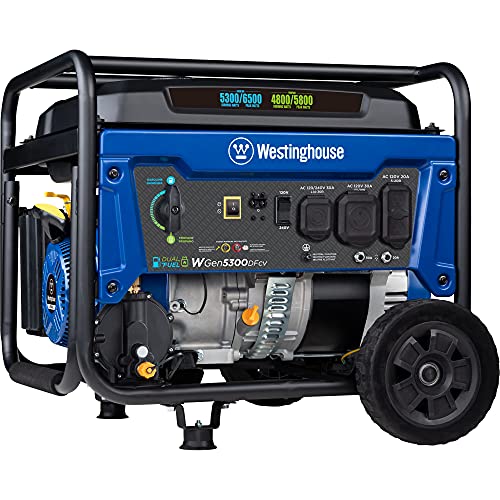
This dual-fuel unit is best for homeowners seeking robust capability and flexibility. It runs on gasoline or propane, with a 4.7-gallon tank and long runtime, plus a 120/240V selector for versatile loads. It’s suitable for budget-conscious buyers needing transfer-switch readiness and RV compatibility. Caution: heavier unit with more complex setup; not as portable as smaller models.
ComJoy 5500W Peak Portable Inverter

Best for users needing strong peak power with a broad 120V/240V capability and multiple ports. The 223cc engine delivers 5500 peak watts and 5000 running watts, with a 7-port charging hub and RV-ready L14-30R outlet. It suits job sites or home backup where high-draw devices run alongside electronics. Limitation: inverter performance under high surge can vary with load balance.
Champion Power Equipment 5500-Watt RV Ready

Best for RV enthusiasts seeking built-in safety and quiet operation. It delivers 5500 starting watts and 4000 running watts with CO Shield technology and a quieter profile. This makes it suitable for campsite power without excessive noise. A limitation to consider is its continuous wattage capacity in prolonged high-demand scenarios may be lower than peak figures.
DuroMax XP5500EH Dual Fuel Generator

Choose this if you want the flexibility of running on gasoline or propane. The XP5500EH provides 5500 starting watts and 4500 running watts, with a 224cc engine designed for demanding loads. It includes a dual-fuel option ideal for extended outages or remote work sites. Caution: propane efficiency is typically lower than gasoline, affecting runtime under fuel-limited conditions.
Buying Guide
- Power needs and outlets: Determine your essential loads and ensure the generator provides at least 20A 120V outlets plus 240V options if needed (for RVs or larger tools).
- Fuel options and runtime: Gasoline-only units are straightforward, while dual-fuel models offer extended operation using propane. Consider the expected run time at your typical load.
- Noise and portability: If you’ll use the unit at a campsite or near living spaces, prioritize models with quiet technology and lighter frames or wheels.
- Safety features: Look for CO sensors, auto-shutoff, low-oil alarms, and overload protection to reduce risk during operation.
- Startup and usability: Electric start and eco-mode can simplify operation and improve fuel efficiency, but may add maintenance considerations.
- Portability vs. power: Higher wattage often means a heavier unit. Balance your need for mobility with peak power requirements for appliances like air conditioners.
Frequently Asked Questions
- What is a good wattage range for a home backup generator? A 5500W unit typically covers essential appliances and supports short-term power needs, making it suitable for many residential backup scenarios.
- Which fuel type is best for portability? Gasoline is common and convenient, but dual-fuel models offer flexibility if you have propane available.
- What does “peak watts” mean? Peak watts indicate the maximum surge the generator can produce for brief periods, such as starting an air conditioner. Continuous running watts are lower.
- Are inverter generators quieter? Yes, inverter models generally run more quietly and provide cleaner power, which is better for sensitive electronics.
- Do I need a transfer switch? For home backup with a generator, a transfer switch simplifies safe power transfer and meets electrical code requirements.
- Can I run a 5500W generator on propane? Some models support propane, but fuel type can affect runtime and power output. Check the specific unit’s capabilities.