Best 50A Solar Charge Controller for Robust Off-Grid Power Systems
Answering the question for reliable, mid-range solar management, a 50A solar charge controller helps balance fast charging with battery longevity for off-grid setups. This guide highlights top options suited for RVs, cabins, boats, and small solar arrays. Each pick targets different priorities—from peak efficiency and app control to rugged durability. Read on to compare best-for scenarios, practical limits, and why these models stand out for 12V and 24V systems.
Summary table of selected products:
| Product | Best For | Key Benefit | Limitations |
|---|---|---|---|
| Victron Energy SmartSolar MPPT 50A | Shaded panels, synchronized systems | Best overall MPPT with Bluetooth and synchronization | Higher upfront cost |
| iSunergy MPPT 50A | LCD visibility, simple setup | Excellent efficiency with user-friendly display | Limited details on protection features |
| Bietrun 50A MPPT | Smart app users | Comprehensive app data and alerts | IP rating modest |
| Renogy 50A MPPT | Budget-friendly reliability | High efficiency and robust protection | Requires BT module for some features |
| VEVOR 50A MPPT | Bluetooth monitoring, modular use | High efficiency with Bluetooth and Modbus | Quality consistency varies |
Victron Energy SmartSolar MPPT Solar Charge Controller

Best for: Users who want top-tier MPPT performance with Bluetooth for monitoring and the ability to synchronize multiple controllers. This model offers optimized charging curves to extend battery life and maximize daily energy capture, even when panels face shading. The built-in synchronization feature is ideal for larger, modular systems where several controllers operate in concert.
Why selected: Victron’s SmartSolar line is renowned for precise MPPT tracking, fast response to changing irradiance, and scalable configurations. The Bluetooth capability supports on-site or remote adjustments, and the synchronization feature helps ensure system-wide energy optimization without manual tuning.
Important caution: The advanced features may require a learning curve for new users, and initial setup can be more complex than simpler controllers.
iSunergy MPPT Solar Charge Controller 50A
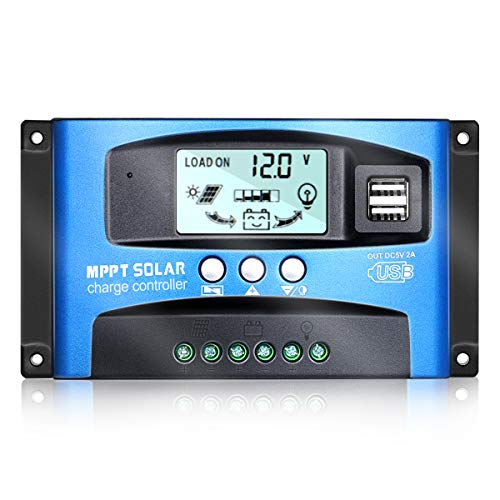
Best for: Buyers who value clear, large-screen LCD feedback and straightforward operation. This model emphasizes high conversion efficiency and a detailed display of charging parameters, making it suitable for users who want quick visibility into solar performance and battery status.
Why selected: It claims efficiency near 99.5% with rapid tracking, plus an LCD that shows charging and discharging current, cumulative power, and temperature readings. Dual USB output adds convenience for charging devices directly from the controller.
Important caution: Some users may prefer models with broader protection suites or more formal IP ratings depending on installation environment.
Bietrun 50A MPPT Solar Charge Controller
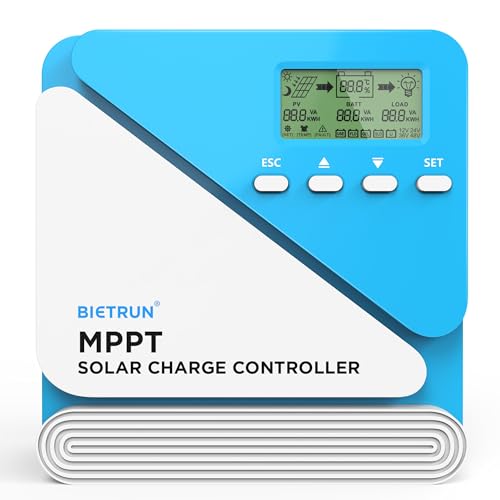
Best for: Tech-savvy buyers who want app control, real-time data, and alerts. This unit emphasizes smart app connectivity via Bluetooth or Wi-Fi, with a robust protection package and a high max input voltage, making it attractive for larger or more complex off-grid systems.
Why selected: The combination of 100V PV input, auto 12V/24V recognition, and a 50A charging current allows flexible panel configurations. The 9-layer protection system helps guard against common electrical issues, and the app provides a way to track performance over time.
Important caution: The controller’s protected features are strong, but users should ensure the chosen solar array and battery type align with the listed specifications to avoid misconfiguration.
Renogy 60A MPPT Solar Charge Controller

Best for: Larger off-grid systems needing higher input tolerance and compatibility with multiple panel configurations in series. Although rated at 60A, this model is often chosen by users who run higher-power configurations or lithium battery setups requiring robust MPPT tracking.
Why selected: It supports up to 150V solar input, enabling more panels in series and simplified wiring. The controller is designed for harsh environments with wide operating temperature ranges, and it notes future compatibility with Bluetooth modules for extended features.
Important caution: This product may require additional BT modules to unlock full feature sets, depending on the installation plan.
Renogy 50 Amp MPPT Charge Controller
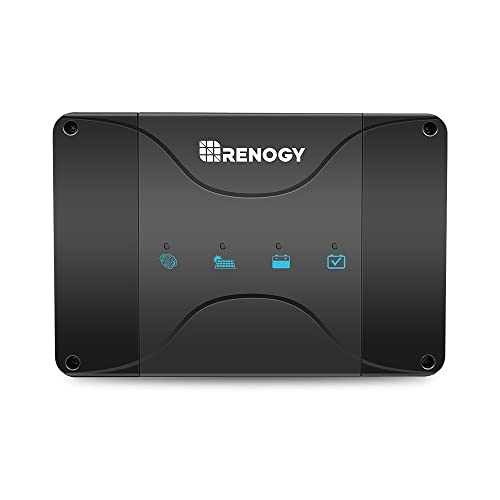
Best for: Energetic users who need a dependable DC-DC charging solution with an emphasis on protection and versatility across battery chemistries. This controller is strong in 0V battery recovery and safe charging cycles for various battery types.
Why selected: It offers a high-efficiency MPPT design (up to 99%), supports Gel, AGM, and Lithium batteries, and includes remote temperature sensing. It’s also compatible with DC-to-DC charging from alternators, which is helpful for mobile setups.
Important caution: The full feature set may rely on remote temperature sensing and compatible configurations; users should verify battery type and system wiring before use.
VEVOR 50A MPPT Solar Charge Controller

Best for: Buyers seeking a feature-rich, Bluetooth-enabled controller with flexible connections and Modbus compatibility. The device targets users who value remote monitoring and data access for ongoing system optimization.
Why selected: The model advertises up to 98% charging efficiency and a wide 12V/24V auto-detect capability, plus Bluetooth for mobile monitoring and a TTL interface for Modbus expansion. It supports a broad range of battery chemistries and high current handling for mid-sized arrays.
Important caution: Some buyers report variability in build consistency; ensure proper wiring and protection devices to maximize lifespan.
Buying Guide: How To Choose A 50A Solar Charge Controller
What to look for when shopping for a 50A MPPT controller:
- System voltage and compatibility: Confirm 12V or 24V battery banks and whether the controller auto-detects these voltages.
- Input voltage and panel compatibility: Check the maximum PV input voltage (VOC) and whether the controller handles high panel counts or higher-voltage configurations.
- MPPT tracking efficiency: Higher percentages mean faster charging and better performance on cloudy days or in shaded conditions.
- Protection features: Prioritize over-voltage, reverse polarity, overload, over-temperature, and short-circuit protections to safeguard batteries.
- Monitoring and connectivity: Bluetooth, Wi-Fi, LCD displays, and Modbus support help manage and optimize the system over time.
- Battery compatibility: Ensure compatibility with Gel, AGM, flooded, and LiFePO4 chemistries as needed for your setup.
- Physical environment: Look for IP ratings and rugged designs if the unit will be mounted outdoors or in harsh conditions.
How To Use A 50A MPPT Controller Effectively
Place the controller in a dry, well-ventilated area and keep it away from direct heat sources. Use proper fusing on the battery and PV lines as recommended by the manufacturer. When configuring, set appropriate charging voltages for your battery type to maximize longevity and performance. Regularly monitor temperature and load conditions to prevent overheating and ensure safe operation.
FAQs
- What does 50A mean for a solar charge controller? – It indicates the maximum charging current the controller can manage, suitable for medium-sized solar arrays and common 12V or 24V systems.
- Can MPPT controllers work with LiFePO4 batteries? – Yes, many MPPT controllers support LiFePO4 and other chemistries, but verify voltage presets and protection features for optimal charging.
- Is Bluetooth monitoring essential? – Not essential, but it makes real-time monitoring easier and helps with tuning and alerts, especially in remote installations.
- Do I need a separate battery management system with these controllers? – For most setups, a BMS is integrated with lithium batteries; however, some controllers provide direct LiFePO4 charging support without an external BMS.
- Can I run more panels than the controller’s rating? – Exceeding the rated input can reduce efficiency and may risk damage; design the array to stay within the controller’s PV input limit.
- What installation mistakes should be avoided? – Avoid reverse polarity connections, undersized wiring, and insufficient protective fusing. Follow manufacturer wiring diagrams closely.