Best High-Current Continuous-Duty Relays for Vehicles and Industrial Systems
Answering the common need for reliable, continuous-duty relays in high-current applications, this guide highlights five top Amazon-ready options. These relays are best for demanding automotive, marine, HVAC, and equipment setups where continuous operation and high switching capacity matter. Readers will find clear, objective reasons to choose each model and who it suits best, plus a practical buying guide to compare specs side by side.
Summary table of selected products:
| Product | Rated Current | Voltage | Best For |
|---|---|---|---|
| iRhapsody 250A, 12V | 250A | 12V DC | Heavy-duty, high-power automotive and industrial circuits |
| iRhapsody 120A, 12V | 120A | 12V DC | Split charging and high-current automotive tasks |
| Hamolar 200A, 12V | 200A | 12V DC | Universal 12V applications with high current needs |
| iRhapsody 120A, 24V | 120A | 24V DC | Higher voltage systems with robust load handling |
| Kwaich 4-Pack 50A | 50A per relay | 12V DC | Compact, multi-relay installations in OEM boxes |
iRhapsody 250A, 12V Continuous Duty SPST Relay

The 250A iRhapsody relay is designed for heavy-duty, high-current switching at 12V DC. Its coil power is 1.8W with an 80-ohm coil resistance, offering reliability improvements over higher power variants. This relay is best for buyers who need a single, robust relay for large automotive or industrial loads, and who will operate within about 85–90% of its rated capacity to preserve longevity.
Best for: high-current automotive and industrial circuits where a single, strong switch is required. Caution: avoid pushing beyond its rated current in continuous duty to prevent overheating.
iRhapsody 120A, 12V Continuous Duty SPST Relay

This 120A, 12V SPST relay uses a 1.8W coil with 80-ohm resistance, providing a balance between power consumption and switching capacity. It’s positioned as a strong choice for split charging or other high-current automotive tasks where a reliable, compact relay is preferred over larger units.
Best for: split charging setups and other mid-to-high current automotive needs. Caution: ensure the circuit current stays within 90% of rating for long-term reliability.
Hamolar 2 Pack 200A Continuous-Duty Relays

The Hamolar relays provide 200A switching capability in a 12V system, with heavy-duty construction and silver-plated internal contacts for durability in high-current environments. These are ideal for universal 12V applications, including truck, boat, and marine setups where split charging or heavy loads are involved.
Best for: large automotive and marine loads that require repeated high-current switching. Caution: verify terminal dimensions and mounting fit before installation to avoid clearance issues in tight spaces.
Kwaich 4-Pack 12V 50A Mini ISO Relays
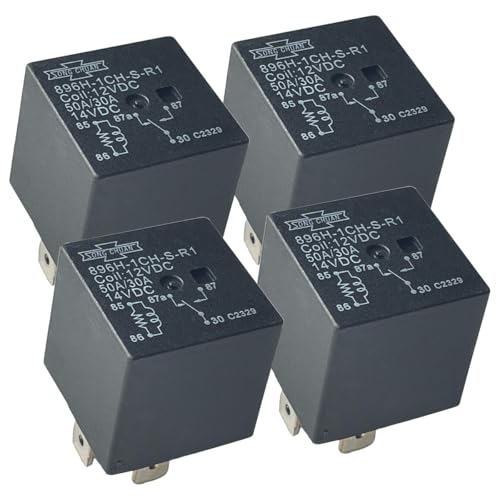
This 4-pack offers 50A SPDT relays with a mini ISO footprint, sealed housing, and silver tin-oxide contacts. Rated at 12V DC with 50A NO/30A NC at 14V, they include an integrated resistor for surge suppression. The compact form factor makes them a practical choice for compact under-hood boxes or OEM-like installations.
Best for: multi-relay automotive or small equipment boxes where space is at a premium. Limitation: the 50A rating is best for lighter heavy-duty tasks; for sustained high-current loads, stay within recommended margins.
Fastronix Waterproof Relay, 50A/30A

The Fastronix waterproof relay combines rugged durability with value, offering a 50A normally open and 30A normally closed configuration in a sealed, vibration-resistant package. It is well-suited for outdoor and vibration-prone installations where weather resistance is important.
Best for: outdoor or vibration-prone environments requiring sealed performance. Limitation: the 30A NC rating may limit some fail-safe or indicator-laden circuits compared to 50A NO configurations.
Buying Guide: Key Considerations For Choosing The Right Continuous-Duty Relay
- Current Rating And Type: Match the relay’s continuous current rating (A) to the load it will switch. SPST and SPDT types offer different control options; SPDT provides a normally open and normally closed path for more versatile switching.
- Voltage Rating: Choose relays that operate at your system voltage (12V or 24V). Higher coil resistance can reduce coil draw, but ensure the contacts handle the load you plan to switch.
- Coil Power And Resistance: Lower coil power reduces parasitic draw but may affect switching speed or throw distance. Higher coil resistance typically means less current drawn from the control circuit.
- Durability And Sealing: For outdoors or vibration-heavy environments, sealed or waterproof relays reduce corrosion and failure. Consider metal mounting tabs for stress resistance.
- Contact Material And Build: Silver-plated or tin-oxide contacts improve durability with high current and frequent switching. Verify contact ratings at your operating voltage.
- Physical Footprint: Mini ISO or compact formats save space in tight enclosures. Ensure terminal spacing and mounting compatibility with your panel box.
- Ambient And Temperature Performance: For compressors and HVAC, look for relays rated for elevated temperatures and continuous duty to prevent overheating.
How To Choose Between 12V And 24V Relays
12V relays are common in automotive work, with broad compatibility for car electrical systems. 24V relays fit trucks, commercial vehicles, or equipment with higher system voltages. If your logic or control circuit is battery-fed at 24V, a 24V relay aligns better and can reduce coil current draw, though you must confirm contact ratings at the operating voltage.
Placement And Wiring Tips
Mount relays away from heat sources and ensure there is adequate ventilation. Use proper grommets for wiring through panels and route coil wires separately from high-current circuits to minimize interference. Always follow manufacturer wiring diagrams and observe polarity when applicable.
FAQ
- What makes a continuous-duty relay different from a standard relay? Continuous-duty relays are designed to switch loads for extended periods without overheating, with higher thermal tolerance and stable contact performance compared to standard relays.
- Is a higher current rating always better? Not necessarily. Choose a rating above the maximum load but within practical limits to avoid overheating and to maintain reliability over time.
- Can I mix 12V and 24V relays in the same system? Yes, as long as each relay’s coil voltage matches its control circuit and the contact ratings cover the load, but avoid driving a 24V coil from a 12V control signal.
- Are sealed relays weatherproof? Sealed or waterproof relays provide better protection in outdoor or humid environments, reducing corrosion and contamination risk.
- What is SPST vs SPDT? SPST is a single-pole single-throw relay with one on/off path. SPDT provides a normally open and normally closed path, enabling more flexible circuit designs.
- How do I know if a relay is suitable for a compressor or HVAC system? Look for a high continuous-current rating, temperature tolerance to elevated levels, and a design optimized for high inrush currents typical of compressors.