Best 48V Solar Power System for Home Backup and Off-Grid
This guide helps buyers compare 48V solar power systems designed for home backup and off-grid use. It highlights five ECO-WORTHY kits that fit a range of needs—from whole-house back-up to portable off-grid setups. The best option depends on storage needs, daily energy use, and whether you want hybrid or battery-backed power. Each section notes who should consider the product and why it’s selected, plus a practical caveat when applicable.
Summary table of selected products:
| Product | System Type | Storage Capacity | Output | |
|---|---|---|---|---|
| ECO-WORTHY 10000W Off-Grid Kit | Complete home-ready system | 16.1 kWh | Up to 10 kW continuous | Large homes, high power needs |
| ECO-WORTHY 10KW Off-Grid Kit | High-output with 9.36 kWh daily | 9.36 kWh/day | Up to 10 kW | Power-intensive cabins, sheds, barns |
| ECO-WORTHY 9.36KWH 2340W Kit | Compact off-grid with 12×195W panels | 9.36 kWh/day | ~2340 W PV input | Smaller homes, apartments, backups |
| ECO-WORTHY 4.68KWH Kit | Low-to-moderate energy kit | ~4.68 kWh/day | ~1200 W inverter | Mobility-friendly or limited space |
| ECO-WORTHY 48V Off-Grid System 1600W | 1200/1600 W nominal inverter | ~6.24 kWh/day | ~1600 W output | Flexible, small home setups |
ECO-WORTHY 10000W Output Off-Grid Kit

Best for large homes needing reliable, high-continuous power. This all-in-one kit includes a 10 kW inverter and 5 × 590W solar panels (total PV 2,950W) with 16.1 kWh of LiFePO4 storage in a 48V pack. Battery management features and WiFi/PC connectivity enable real-time monitoring. Suitable for 120V/240V split-phase loads and can run common appliances smoothly.
Best choice for: households with substantial daytime load or frequent outages. The integrated design reduces setup complexity and improves scalability with parallel operation up to six units. A potential limitation is its size and weight, which may require a dedicated installation space and some planning for battery mobility.
ECO-WORTHY 10KW Complete Off-Grid Kit

Best for energy-heavy setups that still want single-unit simplicity. The kit features 12 × 195W panels (~2,340W PV) and a 10 kW inverter with 120V/240V split-phase. It supports parallel operation for expanded capacity and includes a 48V battery-ready design for future storage expansion. Real-time battery monitoring via CAN/RS485 adds control for advanced users.
Best for: homeowners planning future storage expansion or who need strong AC support for multiple appliances. Limitations include a higher energy footprint and the need for adequate space and a robust mounting area.
ECO-WORTHY 9.36KWH 2340W Kit
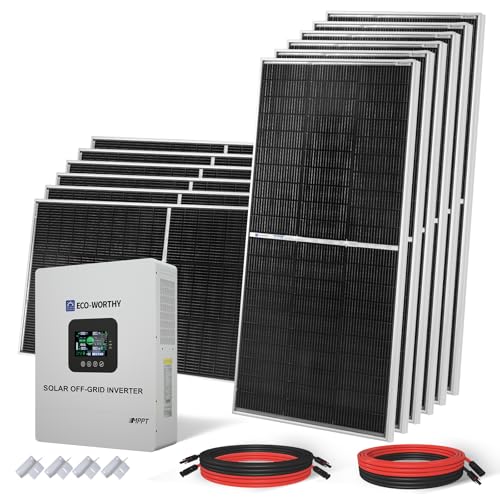
Best for compact off-grid needs with robust panel input. The package combines 12×195W panels (N-Type, high-efficiency cells) with a 5000W inverter and a 48V battery system. It supports parallel expansion and real-time battery monitoring through a dedicated app. Gas or appliance profiles can be matched with the inverter’s switch modes.
Caution: While compact, this kit may require careful planning for solar charging in shaded or low-sun conditions to maximize daily kWh production.
ECO-WORTHY 4.68KWH Kit

Best for space-constrained homes or renters needing a scalable solution. This kit provides about 4.68 kWh per day with 6×195W panels and a 3500W inverter, plus 80A MPPT and WiFi monitoring. It supports parallel connections up to six units, enabling moderate growth as energy needs rise.
Choose this if you want a smaller footprint or a modular path to larger systems. A limitation is that total daily output may be lower in cloudy conditions or during winter months.
ECO-WORTHY 48V Off Grid System 1600W

Best for flexible, smaller off-grid deployments. The kit uses 8×195W bifacial panels and a 1600W inverter. It delivers about 6.24 kWh per day and supports expansion up to 15 units in parallel, suitable for home backup, small cabins, or RV setups. Real-time monitoring via remote connectivity options is included.
Choose this for a budget-conscious entry into 48V systems with room to grow. Limitation: daily kWh may be limited for larger households with high heat or big appliances.
Buying Guide
What determines the best 48V solar power system for you?
- Daily energy consumption: Calculate your typical kWh per day and match it to system output and storage.
- Storage needs: Do you want energy storage for outages, or is a battery-free setup acceptable?
- Space and installation: Ensure roof area, mounting, and indoor space for batteries and inverters are adequate.
- Hybrid versus battery-backed: Decide between grid-tied, hybrid, or off-grid configurations based on utility rules and backup needs.
- Expandability: If you plan to grow, choose systems that offer parallel expansion without complex rewiring.
- Monitoring features: Look for real-time monitoring, app access, and remote control for easier management.
Practical considerations
- Inverter compatibility: Ensure the inverter supports your desired loads and voltage (120V/240V split-phase).
- Battery chemistry: LiFePO4 is common for 48V systems, offering safety and long cycle life; verify BMS protection and cooling provisions.
- Certifications and safety: Look for UL certifications and compliance with local electrical codes.
- Maintenance and mobility: Some batteries are built with wheels and handles for easy relocation; plan for service access.
FAQ
- What is a 48V solar power system best used for?
They are well-suited for home backup, off-grid living, and small to mid-size properties requiring reliable DC-to-AC conversion with efficient battery management.
- Can I expand a 48V system later?
Yes. Several kits support parallel expansion to increase storage or output, but verify compatibility with existing modules and BMS.
- Is LiFePO4 the only option for storage?
LiFePO4 is common due to safety and lifespan, but some kits also support lead-acid or other chemistries; check warranty and monitoring features.
- Do I need a professional for installation?
For most home installations, especially with 120V/240V split-phase, professional electrical work is recommended to meet code and safety standards.
- What should I check before buying a kit?
Check inverter rating, battery capacity, expansion options, monitoring features, and whether the kit fits your roof space and climate.