Best 48V MPPT Solar Charge Controller for Reliable Off-Grid Power
When building a 48V solar system, selecting the right MPPT charge controller is essential for maximizing efficiency and extending battery life. The models below cover a range of inputs, protections, and monitoring features. This guide compares five top options that support 48V systems, including auto-detection, high input voltages, and Bluetooth or LCD displays for real-time data. Use the buying guide at the end to fine-tune your choice to your setup.
Summary Table
- Ampinvt 80A MPPT Solar Charge Controller (48V auto-detect, up to 150V input)
- Victron Energy SmartSolar MPPT Charge Controller (150V, 35A, Bluetooth)
- Renogy Rover Lite 60A MPPT Controller (150V input, 12-48V battery range)
- POWLAND 120A MPPT Controller (auto-sensing 12-96V, up to 230V input)
- POWLAND 100A MPPT Controller (12-48V, up to 150V input)
Ampinvt 80A MPPT Solar Charge Controller (48V Auto Detect)
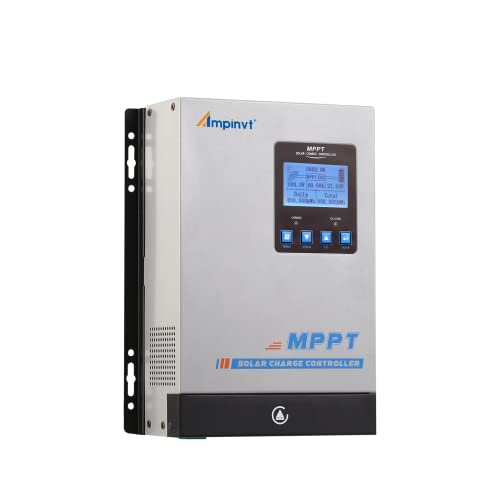
The Ampinvt MPPT controller supports 12V, 24V, and 48V auto-identification with a robust 80A charging capacity. It accepts a wide PV input up to 150V and lists several max input ranges by system voltage (18–80V for 12V, 30–100V for 24V, 65–150V for 48V). It includes an LCD display for real-time data, and it limits charging power and current to stay within rated values. This model targets multi-voltage setups, including lead-acid and lithium chemistries, with a focus on practical daily monitoring. It may suit larger off-grid arrays where space and installation simplicity matter.
Key features include:
- Auto-identification for 12V/24V/48V systems
- Wide MPPT input voltage ranges per voltage class
- Real-time energy statistics and a clear LCD readout
- Protection against overcharging by controlling power and current
Victron Energy SmartSolar MPPT (Bluetooth) 150V 35A

The Victron SmartSolar MPPT controller emphasizes intelligent charging with Bluetooth connectivity for real-time monitoring and configuration. It is designed to maximize power output through fast, optimized MPPT tracking and advanced charging algorithms. The device supports a 150V input and is suited for 12/24/36/48V battery systems. A notable feature is synchronization capability, letting multiple Victron SmartSolar units coordinate to manage complex systems while promoting battery longevity and broader energy optimization across the installation.
Highlights include:
- Bluetooth-enabled monitoring and configuration
- Fast MPPT tracking for maximum energy harvest
- Support for 12–48V battery systems and high input voltage (up to 150V)
Renogy Rover Lite 60A MPPT Controller

Renogy Rover Lite 60A MPPT is built for versatile solar systems with a 150V maximum solar input and support across 12V–48V battery configurations. It emphasizes reliability in challenging environments with full-load operation in a wide temperature range and low-temperature protection for lithium batteries. Self-cooling helps maintain performance in hot conditions. The controller’s versatility shows in its compatibility with a variety of battery chemistries and its suitability for homes, RVs, and marine applications alike.
Key attributes:
- 150V maximum solar input for flexible array sizing
- Wide voltage compatibility (12V–48V)
- Low-temperature protection and self-cooling design
POWLAND 120A MPPT Controller (12V–96V Auto)

This high-capacity POWLAND model auto-senses a wide range of system voltages from 12V up to 96V with a substantial 120A charging current. It emphasizes high efficiency (up to 98%+) and MPPT optimization, promising energy gains in RVs, off-grid homes, or mobile power stations. The unit provides robust protection against common fault conditions and supports multiple battery chemistries, including LiFePO4, AGM, GEL, and flooded lead-acid. It targets users needing strong performance across varied solar arrays and battery stacks.
Notable points:
- Auto-sensing for 12V–96V systems
- Up to 120A with high MPPT efficiency
- Comprehensive protection and multi-chemistry support
POWLAND 100A MPPT Controller (12V–48V)

The POWLAND 100A model provides a strong 100A charging capability with auto-sensing across 12V/24V/36V/48V. It highlights an efficient MPPT algorithm to track maximum power points quickly and features three-stage charging to optimize efficiency and battery life. It is compatible with multiple battery types and includes safety protections to guard against short circuits, reverse polarity, and overload. This unit is suitable for mid-sized solar setups in RVs, cabins, and off-grid builds where reliable performance is essential.
Important considerations:
- 100A charging current for sizable arrays
- Auto-detects 12–48V battery systems
- Three-stage charging and multi-protection features
Buying Guide
- Voltage and battery compatibility: Ensure the controller supports your battery voltage (12V, 24V, 36V, or 48V) and chemistry (lead-acid, AGM, Gel, LiFePO4, or lithium). Some models offer auto-sensing across multiple voltages, which simplifies installations with mixed setups.
- Maximum solar input and voltage range: Consider the PV array size and open-circuit voltage. Controllers with higher maximum input voltage (e.g., 150V or more) enable larger strings or higher series connections, reducing wiring complexity.
- MPPT efficiency and tracking: A higher MPPT efficiency (often 98% or above) yields more usable energy, especially in partial shading. Look for fast MPPT tracking to maintain performance during changing conditions.
- Display and monitoring: LCD displays provide local data, while Bluetooth or app-based monitoring offers remote insights. Decide whether real-time monitoring, historical trends, or remote control matters for your project.
- Protections and safety: Check for protections against reverse polarity, overcharge, short circuits, over-temperature, and overload. Multi-stage charging (bulk/absorption/float) helps extend battery life in diverse climates.
- System expandability and integration: If you plan future upgrades or synchronization across multiple controllers, consider models with synchronization features and modular design that accommodate additional panels or batteries.
- Weight, size, and installation: Larger controllers may require secure mounting and adequate ventilation. For RVs or boats, lightweight, compact designs help with mobility and space constraints.
- Warranty and support: A strong manufacturer warranty and accessible customer support can reduce total cost of ownership in the long run.