Best 48V LiFePO4 Battery Charger Options for 2026
Choosing a reliable 48V LiFePO4 charger is essential for safe, efficient charging and long battery life. This guide highlights five top chargers that fit a range of LiFePO4 systems—from home off-grid setups to golf carts and small industrial applications. Each product is selected for compatibility, protection features, and ease of use. Compare specs, mounting options, and protection functions to determine which charger best matches your 48V LiFePO4 battery configuration.
| Brand | Model / Description | Voltage / Current | Key Feature |
|---|---|---|---|
| ECO-WORTHY | Upgraded (Version 2) 48V Charger with CAN BMS | 32–64V, up to 60A | CAN BMS communication for safety and lifespan |
| EPOWREY | 18A Lithium Golf Cart Charger | 58.4V, 18A | Onboard mounting, protection suite |
| DUDHOIK | 48V/58.4V 10A Lifepo4 Charger | 110–120V input, 58.4V output | Dedicated LiFePO4 optimization, multiple protections |
| KAISAL | 48V 18A LiFePO4 Battery Charger | 58.4V, 18A | IP67 waterproof option for marine/off-grid |
| Guanlan | 58.4V 18A 48V LiFePO4 Charger | 58.4V, 18A | 0V wake-up mode, multiple protections |
ECO-WORTHY Upgraded 48V Charger With CAN BMS
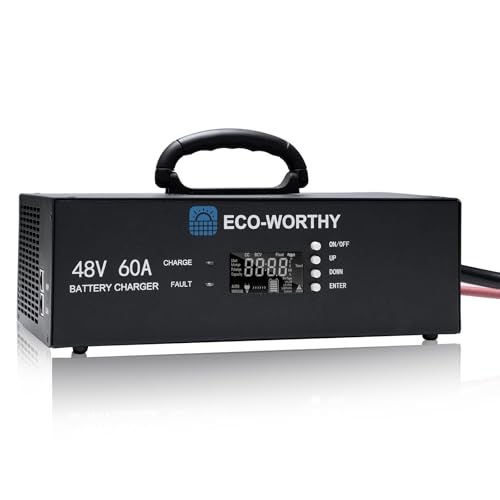
The ECO-WORTHY charger provides versatile LiFePO4 charging with adjustable voltage from 32 to 64V and current up to 60A at 240V. It’s designed for compatibility with various LiFePO4 battery systems and supports direct CAN BMS communication, enabling automatic optimization for safety and longer battery life. A detachable generator plug adds flexibility for off-grid use, and an integrated DC side fuse enhances protection during long-term operation.
EPOWREY 18A Golf Cart LiFePO4 Charger

The EPOWREY charger is tailored for 48V golf carts and similar 58.4V LiFePO4 packs, featuring ring terminals for straightforward onboard mounting. It emphasizes high efficiency and stable charging across multiple battery strings, with over-voltage, over-current, overheating, short-circuit, and reverse polarity protections. A pre-charge function extends battery life, and automatic shut-off ensures safe termination when fully charged. The unit is designed for wall mounting or easy portability.
DUDHOIK 48V/58.4V 10A LiFePO4 Charger

DUDHOIK offers a 10A LiFePO4 charger designed to activate and support BMS performance for 48V cells. It emphasizes protections against over-current, over-voltage, short circuits, and reverse polarity, aiming to maximize Lifepo4 battery life. The charger is suitable for residential off-grid setups or mobile applications where moderate charging speed is acceptable. It is marketed as compatible with multiple 48V LiFePO4 configurations while prioritizing battery longevity.
KAISAL 18A 48V LiFePO4 Battery Charger

The KAISAL charger is designed for 48V LiFePO4 systems and handles 58.4V at 18A, making it suitable for golf carts, forklifts, and off-grid setups. It supports wide compatibility with 48V LiFePO4 batteries and features a fast charging profile. Its on-board charging method aims to efficiently replenish battery packs while including protections to guard against abnormal conditions and ensure battery health over time. The unit is designed for wall mounting or mobile use in various environments.
Guanlan 58.4V 18A LiFePO4 Charger

The Guanlan charger operates at 58.4V with 18A and includes a 0V wake-up mode to reactivate batteries after BMS cut-off. It provides multiple protection features (low-voltage, over-voltage, over-current, over-temperature, short circuit, and reverse polarity) to safeguard LiFePO4 packs. Its waterproof rating and robust construction make it suitable for outdoor and marine applications, as well as off-grid or RV setups, while maintaining battery health through smart management.
Buying Guide: Key Considerations for 48V LiFePO4 Chargers
When selecting a charger for 48V LiFePO4 batteries, consider the following:
- Battery chemistry and voltage range: Ensure the charger supports LiFePO4 chemistry and operates within your battery’s voltage window (typically around 51.2V to 58.4V for 48V systems).
- Charge current and speed: Higher amperage charges faster but may require larger wiring, cooling, and compatible BMS support. Match charger current to battery capacity and daily usage needs.
- BMS communication: Chargers with CAN or other data interfaces can optimize charging and protect cells by coordinating with the battery management system.
- Protection features: Look for over-voltage, over-current, short-circuit, reverse polarity, overheating, and a pre-charge function to extend battery life.
- Mounting and form factor: Wall-mount, portable, or onboard options influence installation flexibility in vehicles, cabins, or sheds.
- Environmental robustness: IP ratings and cooling are important for outdoor or marine use.
- Future compatibility: If you plan battery upgrades, choose chargers with adjustable voltage ranges or wide compatibility to avoid replacements.
- Regulatory compliance: CE or equivalent certifications can indicate adherence to safety standards.
In practice, the best choice depends on your application: high-speed charging for frequent use may lean toward ECO-WORTHY’s CAN-enabled model; golf-cart or marine use may benefit from the Guanlan or KAISAL units with waterproof ratings; off-grid enthusiasts might prefer a rugged, wall-mounted design like DUDHOIK or HEXWATT with clear monitoring displays.