Best 48V PoE Injectors for Network Devices and Remote Installations
Looking for a reliable 48-volt PoE injector to power cameras, access points, or other network devices without replacing your switch? This guide presents five top options, explains who each is best for, and highlights practical considerations. Each product supports 48V passive PoE or PoE/PoE+ standards, with ranges up to 100 meters. The buyers most likely to benefit are small to medium setups needing easy, wall-mounted, plug-and-play power over Ethernet solutions.
Summary table of chosen products:
- Product: TP-Link PoE Extender / Adapter (TL-PoE4824G) | Type: Passive PoE | Best for: Small offices needing wall-mountable, simple power over Ethernet
- Product: iCreatin Gigabit PoE Injector | Type: 48V, 802.3af | Best for: Upgrading existing non-PoE gigabit links to power PoE devices
- Product: ThePoEstore Gigabit PoE+ Injector | Type: 48V/PoE+ | Best for: Networks needing up to 30W on PoE+ or compatibility with 802.3af devices
- Product: UltraPoE Ultrahigh-Power Injector | Type: 30W PoE/PoE+ | Best for: Higher-power devices over longer runs (up to 100 m)
- Product: TP-Link TL-PoE4818G 48V/18W | Type: Passive PoE | Best for: Budget-friendly PoE needs with reliable wall-mount option
TP-Link PoE Injector 48V Passive 24-Watt, Wall Mount

Best for: Small offices or homes upgrading to PoE without changing existing switches. This model uses 48V passive PoE and can auto-determine the device’s power needs, so it is suitable for simple, low-profile deployments. The wall-mount design helps keep equipment storage tidy and reduces cabling clutter. A potential limitation is that passive PoE does not negotiate power levels with devices, so compatibility is best when the device is designed to accept 48V passive input.
iCreatin Gigabit PoE Injector, 48V 15.4W
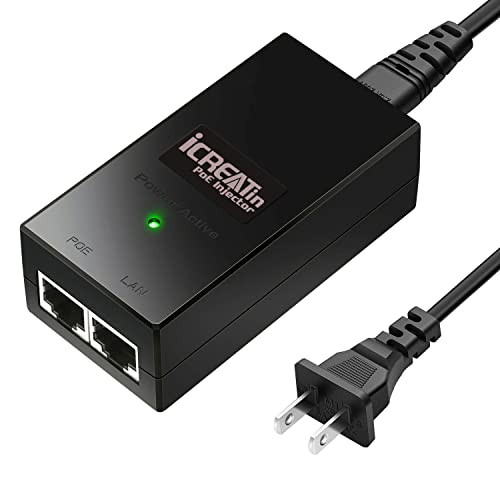
Best for: Upgrading a non-PoE Gigabit port to support PoE devices up to 100 meters away. It features a Gigabit input and a PoE Gigabit output, enabling full 1 Gbps data alongside PoE power. It’s suitable for IP cameras or access points where 802.3af compatibility is essential and budget is a concern. Caution: Power delivery and device compatibility depend on the PoE device’s power expectations; ensure your device accepts 48V or 802.3af compatibility accordingly.
ThePoEstore Gigabit PoE+ Injector 30W/15.4W

Best for: Networks needing PoE capability with up to 30W on PoE+ devices and compatibility with 802.3af devices. The injector has a 1 Gbps input and 1 Gbps PoE output, suitable for cameras and wireless access points. A noted limitation is that power output is optimized for PoE+ devices; devices requiring higher power may need a different model or multiple injectors in series.
ULTRAPOE 30W Gigabit PoE Injector

Best for: High-power PoE devices over longer runs. This injector delivers up to 30W with auto-detect technology and maintains 1 Gbps data through a single Ethernet cable. It’s backward compatible with 802.3af devices and supports long-distance transmission up to 100 meters. Caution: The 30W budget means it may not be suitable for devices requiring more than 30W per port.
TP-Link TL-PoE4818G 48V/18W Passive PoE Injector

Best for: Budget-conscious setups needing a reliable wall-mountable PoE injector with 18W output. It converts non-PoE to PoE with a 48V passive output and supports a Gigabit input/output for fast wired connections. The main limitation is power: 18W may be insufficient for higher-power PoE devices like some PTZ cameras or video access points.
Buying Guide: Key Considerations for 48V PoE Injectors
- Power budget: Choose a device that matches the PoE device’s power needs. 15.4W, 18W, 30W, and 48V passive options each serve different device classes.
- PoE standard compatibility: 802.3af (PoE) vs 802.3at (PoE+) vs 48V passive. Ensure the injector matches the device’s input requirements.
- Data speed: All models listed provide at least Gigabit Ethernet performance on both input and output where specified. Confirm device requirements for throughput.
- Distance: Most injectors support up to 100 meters. Plan cable runs accordingly and account for potential power drop at longer distances.
- Installation: Wall-mountable designs help with space management. Check available mounting hardware and enclosure fit for your environment.
- Safety and protection: Look for over-voltage, over-current, and short-circuit protections. These features reduce risk in mixed installations.
- Future-proofing: If planning for higher-power devices later, consider PoE+ capable injectors or models with higher wattage budgets.
Frequently Asked Questions
- What is a 48V PoE injector used for? It powers PoE-enabled devices like cameras and access points over Ethernet without needing a separate power cable.
- Do passive 48V injectors require device negotiation? No. Passive injectors deliver fixed voltage and power; ensure device compatibility is designed for 48V input.
- Can I mix PoE standards in one network? Yes, but verify each device’s acceptance of PoE, PoE+/802.3af, or non-PoE devices to avoid power or data issues.
- Is a higher wattage injector always better? Not necessarily. Match wattage to the device’s power needs; excess power does not improve performance if the device cannot use it.
- Will longer cables reduce PoE power? Yes. Power loss increases with distance; plan runs within recommended 100-meter ranges and consider higher-wattage injectors for longer spans.
- Do these injectors require configuration? Most are plug-and-play; no further setup is required unless your network has specialized requirements.