Best 48 Volt Charge Controller Options for Efficient Solar Power
Choosing a reliable 48V solar charge controller is essential for maximizing battery life and optimizing energy harvest in off-grid, RV, or home solar systems. The following selections focus on 48V support, MPPT technology, safety protections, and user-friendly features. Each option below is well-suited to a 48V system and offers a balance of performance and value for American setups.
| Product | Max Input (V) | Rated Current | Key Benefit | Link |
|---|---|---|---|---|
| Ampinvt 80A MPPT | 150 | 80A | Clear LCD, auto voltage sensing (12/24/48V) | View |
| Victron Energy SmartSolar MPPT 20A | 100 | 20A | Bluetooth monitoring, synchronized charging | View |
| Renogy Rover Lite 60A | 150 | 60A | Solid thermal range, broad battery compatibility | View |
| POWLAND 120A MPPT | 96 | 120A | Auto-sensing, high charging capacity | View |
| Temank 140A MPPT | 500 | 140A | High PV input, extensive LCD monitoring | View |
Note: All products listed are MPPT controllers designed for 48V battery systems, offering protections such as over-voltage, reverse polarity, and temperature safeguards. The table highlights essential specs and advantages to help compare options quickly before diving into each product’s details.
style=”margin-top: 40px;”>Ampinvt 80A MPPT Solar Charge Controller
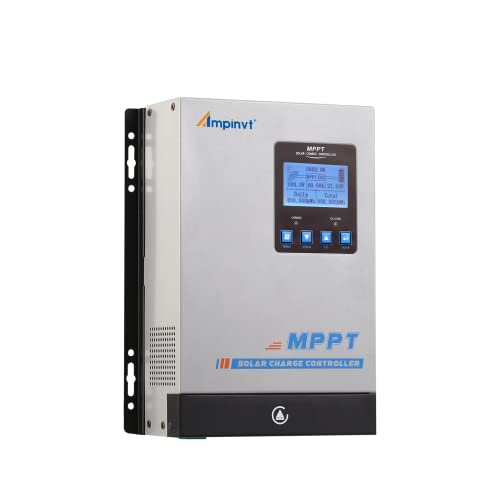
The Ampinvt controller supports multiple system voltages, auto-identifying 12V, 24V, and 48V configurations. It handles up to 80A of charging current and a maximum PV input around 150V, making it suitable for mid- to large-capacity solar arrays. The unit includes an LCD display to present real-time operating data, instantaneous energy statistics, and a daily power generation curve. It also features an automatic control system to prevent charging power or current from exceeding rated values, improving system safety and longevity.
Key features include: MPPT optimization within the DC18V-DC80V (for 12V) and DC65V-DC150V (for 48V) ranges, real-time energy tracking, and multiple load control modes. This model is appropriate for users who want a straightforward, all-in-one MPPT solution for their 48V storage while keeping an eye on ongoing performance via the LCD readout.
style=”margin-top: 40px;”>Victron Energy SmartSolar MPPT 20A (Bluetooth)

Victron’s SmartSolar MPPT controller emphasizes intelligent charging and networked control. The 20A model is compact yet powerful for 48V systems, and Bluetooth connectivity enables easy monitoring through a mobile device. The controller’s rapid MPPT tracking helps extract maximum energy, even when panels experience partial shading. The ability to synchronize multiple Victron SmartSolar units can align charging stages across an entire system, contributing to battery longevity and overall energy efficiency.
Typically chosen for its reliable performance and ecosystem compatibility, this controller is ideal for users who value remote monitoring, scalable configurations, and integration with Victron components for a broader solar solution.
style=”margin-top: 40px;”>Renogy Rover Lite 60A MPPT

The Renogy Rover Lite 60A MPPT controller is designed for flexible 12V–48V systems with a robust 150V maximum solar input. It is engineered to perform across a wide temperature range to support harsh environments. The controller supports lithium, AGM, and gel batteries, making it versatile for RVs, homes, and remote installations. Its protection features help prevent damage from short circuits, reverse polarity, and overcurrent events, while maintaining stable charging profiles for battery longevity.
Installation is straightforward for larger setups that use multiple panels in series, reducing wiring complexity and offering reliable performance for off-grid projects requiring durable, high-capacity MPPT control.
style=”margin-top: 40px;”>POWLAND 120A MPPT Solar Charge Controller

The POWLAND 120A MPPT controller offers extreme current capacity and broad voltage compatibility, auto-sensing 12V–96V systems. With a quoted efficiency up to 98% and MPPT tracking, it’s well-suited for larger off-grid installations or mobile setups where maximizing each watt matters. The unit emphasizes comprehensive protection against short circuits, overcurrent, reverse polarity, and overload, alongside a three-stage charging profile for diverse battery chemistries including LiFePO4, AGM, and flooded lead-acid.
Its 120A rating makes it an attractive choice for higher-output solar arrays, providing reliable performance while simplifying system integration in DIY or professional projects.
style=”margin-top: 40px;”>Temank 140A MPPT Solar Charge Controller

The Temank 140A MPPT controller stands out with a high 500V maximum PV input and a wide MPPT voltage range. This makes it suitable for large, high-voltage solar arrays and longer-distance battery connections where efficiency matters. The unit supports multiple battery chemistries, including lead-acid and lithium, and offers an extensive LCD to monitor PV voltage, PV current, PV power, battery voltage, current, and error codes. A notable benefit is the ability to customize charging current up to 140A, enabling flexible design for large energy storage projects.
For users deploying expansive solar systems or seeking a future-proof option that accommodates growth, Temank provides a capable, high-current MPPT solution with comprehensive monitoring features.
style=”margin-top: 40px;”>Buying Guide: Key Considerations For 48V MPPT Controllers
- System voltage and battery chemistry: Ensure the controller auto-detects 12V/24V/36V/48V and is compatible with LiFePO4, AGM, GEL, and flooded batteries. This compatibility influences charging profiles and battery longevity.
- Maximum PV input and charging current: A higher MPPT input voltage and charging current enable larger or more panels to be used in a single controller. Match the controller’s specs with your panel array and intended load.
- MPPT efficiency and tracking: Look for high tracking efficiency (often 98% or higher) and fast MPPT algorithms. This directly affects energy harvest, especially in marginal sun conditions.
- Protection features: Key protections include reverse polarity, short circuit, overcurrent, over-voltage, and thermal safeguards. These reduce risk of damage in harsh environments.
- Monitoring and connectivity: LCD displays are valuable for onsite data, while Bluetooth or remote monitoring helps optimize performance over time. Consider whether you want cloud or local monitoring, and how you’ll read data.
- Installation and wiring: Check for recommended wire gauges, DC input/output terminals, and whether the controller supports series panel configurations. High-voltage PV inputs require careful wiring practices.
- Expansion and synchronization: Some brands offer multi-unit synchronization to balance charging across several controllers. If you plan a scalable system, this may be a critical feature.
- Physical durability and temperature range: For outdoor or RV use, ensure the unit withstands operating temperatures and environmental conditions typical to your location.