Best 460V to 120V Transformers: Top 5 Industrial Models
Answering the needs of facility managers, HVAC technicians, and control panel designers: these 460V to 120V transformers convert high-voltage inputs into stable 120V outputs for control devices, relays, thermostats, and other low-voltage equipment. The top picks below balance reliability, compatibility, and ease of installation. Each entry highlights who benefits most and a key caveat to consider before purchase.
| Product | Output Voltage / VA | Best For |
|---|---|---|
| Functional Devices TR50VA008 | 120 VAC, 50 VA | Industrial controls in HVAC and automation panels |
| GUSUUI TR50VA008 | 120 VAC, 50 VA | Replacement in four-voltage industrial setups |
| Siemens KT8100 | 120 VAC, up to 100 VA | General purpose control panels and HVAC systems |
| ABB 9T58K2810 | 120/240 VAC secondary, 0.5 kVA | Light industrial and control applications needing isolation |
| ABB 9T58K0044 | 120 VAC, 100 VA | Machine tool, control panels, and signal circuits |
Functional Devices TR50VA008 Transformer

The TR50VA008 is a 50 VA, 480/277/240/208 V to 120 V transformer with a circuit breaker-ready design and Mounting options. Best for industrial control circuits where a compact, proven 120 V supply is needed for thermostats, relays, and timers. It features a primary thermal-magnetic circuit breaker for overload protection and isolation between input and output. Suitable for HVAC controls in commercial environments.
Best for: facilities needing a robust, field-serviceable control transformer with integrated protection. Choose this if you require an easily mounted unit with reliable isolation and a built-in breaker.
Caution: Verify mounting compatibility and ensure the 120 V load stays within 50 VA to prevent overheating.
GUSUUI TR50VA008 Transformer

This TR50VA008 variant offers the same 480/277/240/208 V to 120 V output with a 50 VA rating and integrated circuit breaker design. It emphasizes precise power control for applications like HVAC thermostats, relays, and timers in industrial settings. The four-input voltages provide flexibility in mixed-utility environments.
Best for: replacement in multi-voltage systems where a compact, 50 VA transformer is required for 120 V control circuits. It’s a solid pick when you value integrated protection and simple mounting.
Caution: As with the other 50 VA units, ensure the connected load does not exceed 50 VA to avoid tripping or overheating.
Siemens KT8100 Industrial Transformer Kit

The KT8100 kit reduces primary voltages in industrial contexts from up to 460/480 V down to 120 V for control devices. Rated up to 1000 VA input efficiency with a silicon steel-laminated core and copper magnet wire, it aims for high efficiency in demanding HVAC and control panel environments.
Best for: projects needing robust efficiency and a larger secondary capacity for multiple 120 V devices. Better for higher-load control panels where space permits a larger transformer footprint.
Caution: Higher VA means a larger, heavier unit; verify mounting space and physical dimensions before installation.
ABB 9T58K2810 Isolation Transformer

The ABB 9T58K2810 offers a 0.5 kVA rating with 240×480 V primary and 120/240 V secondary, designed for isolation in light-industrial uses. Its moisture-resistant encapsulated core and seismic qualification support reliable performance in diverse environments.
Best for: light-industrial control panels and HVAC setups needing isolation to reduce noise and interference. Choose this if you require a rugged, moisture-resistant design.
Caution: It’s not the smallest option; ensure the footprint fits in cramped control cabinets.
ABB 9T58K0044 Low Voltage Transformer
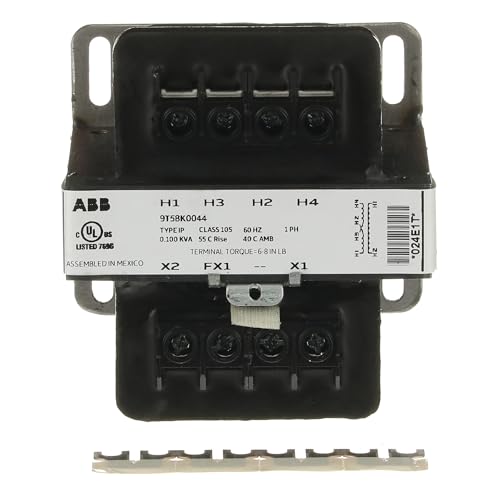
The 9T58K0044 is a compact 100 VA, 240×480 to 120 V isolation transformer designed for machine tools and control panels. It emphasizes moisture resistance, a welded core for quiet operation, and optional fuse clips for flexible wiring options in space-constrained installations.
Best for: small to mid-size control panels and machine tool setups where stable 120 V output is required without a large footprint. Avoid this if you need higher VA ratings or dual secondary outputs.
Caution: Ensure fuse wiring aligns with protection requirements in your panel to maintain safety margins.
Buying Guide: 460V To 120V Transformer Considerations
- Load and VA rating: Match the transformer’s VA rating to the total 120 V load to avoid heat and efficiency loss.
- Primary voltages supported: Confirm the unit accepts your specific high-voltage input (e.g., 460 V, 480 V, 277 V).
- Isolation and safety features: Look for units with isolation between input/output, and integrated circuit breakers or fuses where needed.
- Mounting and footprint: Check mounting options (foot, hub, or panel) to fit the control cabinet layout.
- Durability in environment: Consider moisture resistance, seismic qualification, and enclosure ratings if used in harsh areas.
- Thermal performance: Ensure adequate ventilation or heat sinking for higher loads or continuous duty.
Frequently Asked Questions
- What is the primary purpose of a 460V to 120V transformer?
– To supply low-voltage 120 V power to control devices from a higher-voltage industrial supply, while providing isolation and protection. - How do I determine the right VA rating?
– Add up the current draw of all 120 V devices in the circuit; choose a transformer with at least that sum plus a safety margin. - Is isolation transformer necessary for control panels?
– Isolation reduces electrical noise and potential ground loops, improving device reliability. - What should I consider for mounting in a cramped cabinet?
– Opt for compact units with smaller footprint and confirm clearance around connectors and terminals. - Can I use a higher VA transformer for the same 120 V load?
– Yes, but it will be larger and may generate more heat; ensure cabinet cooling is adequate. - Do these transformers require external fusing?
– Some include internal circuit breakers; others rely on external fusing per system design. Always follow local electrical codes.