Best 4000 Watt Dual Fuel Generators for Home and RV Backup Power
Choosing a reliable 4000-watt dual fuel generator ensures you have portable power when gasoline isn’t available or you want to run propane. This guide highlights five top options, comparing power output, fuel flexibility, noise levels, and essential safety features like CO sensors. Each model supports RV use, emergency backup, and outdoor activities, with different running times and parallel capabilities for extended power. Use the buying guide at the end to help decide which best fits your energy needs and environment.
| Product | Brand | Fuel Type | Key Feature | Approx Watt Range |
|---|---|---|---|---|
| Champion Power Equipment 4000-Watt Dual Fuel Inverter | Champion | Gas / Propane | CO Shield, Quiet Operation | Starting 4000W / Running 3000W on gas |
| Westinghouse 4000 Peak Watt Dual Fuel | Westinghouse | Gas / Propane | Remote Start, CO Sensor | Peak 4000W / Run 3300W |
| WEN 5,600-Watt Dual Fuel (DF5600X) | WEN | Gas / Propane | CO Shutdown Sensor | Gas: 5600 surge / 4500 run; Propane: 5000 surge / 4050 run |
| Pulsar GD400BN | Pulsar | Gas / Propane | Parallel Capability | Gas 4000 peak / 3200 run |
| PowerSmart 3800-Watt Inverter | PowerSmart | Gas / Propane | RV Ready 30A, Quiet | Gas 3800 starting / 3300 running |
Champion Power 4000-Watt Dual Fuel Inverter Generator

Champion’s 4000-watt dual fuel inverter delivers flexible power for RVs and emergency backup. It runs on gasoline or propane and includes CO Shield to automatically shut off if CO levels become unsafe. The unit operates quietly at about 64 dBA from 23 feet, suitable for neighborhood use and campsites. On gasoline, expect up to 10 hours of runtime, while propane can extend run time up to 25 hours with lower continuous wattage. A parallel kit (sold separately) allows connecting with another Champion inverter or power station for extra power and longer operation.
Key considerations
Pros: Dual fuel flexibility, quiet operation, CO monitoring, and RV-ready features with potential for more runtime when paired with a second unit. Cons: Higher initial cost and potential fuel availability concerns in propane-heavy locations.
Westinghouse 4000 Peak Watt Dual Fuel Inverter

Westinghouse offers a dual fuel inverter designed for RVs and home use, with 4000 peak watts and 3300 running watts at less than 3% THD, ideal for sensitive electronics. It features a remote start (key fob) along with electric and recoil options, and multiple outlets including a 120V duplex and a TT-30R RV outlet. It also includes automatic low oil and CO shutdown protection. The digital display provides fuel level, power output, remaining runtime, voltage, and lifetime hours for easy monitoring.
Key considerations
Pros: Remote start, RV-ready outlets, and built-in CO safety. Cons: Runtime may vary with load, and propane performance may differ from gasoline in certain climates.
WEN 5,600-Watt Dual Fuel Portable Generator (DF5600X)

The WEN DF5600X provides higher-than-typical wattage with dual-fuel flexibility. Gas mode delivers a 5600 surge and 4500 rated watts, while propane provides 5000 surge and 4050 rated watts. Electric start makes ignition quick, and the unit incorporates a CO Shutdown Sensor to safeguard against dangerous gas levels. Its larger output suits more demanding loads, including home backup or job-site needs, with a focus on maintaining clean power for electronics.
Key considerations
Pros: Strong power output, electric start, and CO safety. Cons: Heavier unit, higher noise profile at full load, and essential to maintain fuel supply.
Pulsar GD400BN 4000W Dual Fuel Generator

Pulsar GD400BN is a portable generator with 4000 peak watts and 3200 running watts on gasoline, and 3600 peak / 2800 running watts on propane. It supports continuous operation for up to 4.5 hours at half-load with a 1.1-gallon fuel tank. The unit is designed for RVs and home use with convenient parallel capability to extend power when needed. It’s CARB compliant, which broadens its availability across various states.
Key considerations
Pros: Compact, parallel-ready, and CARB compliant. Cons: Shorter runtime between refuels; higher load can increase fuel consumption.
WEN Quiet DF480iX 4800-Watt Dual Fuel Inverter

The WEN DF480iX offers a robust 4800 surge watts and 4000 rated watts on gasoline, with propane performance of 4320 surge and 4000 rated watts. It emphasizes extremely quiet operation suitable for conversations and sensitive electronics, earning high marks for clean power output. Features include CO watchdog to automatically shut down if CO levels rise, making it a reliable choice for indoor-outdoor use and digital devices.
Key considerations
Pros: Very quiet, strong clean power, and CO safety. Cons: Heavier and may require longer runtimes for extended outages depending on fuel type and load.
PowerSmart 3800-Watt Dual Fuel Inverter
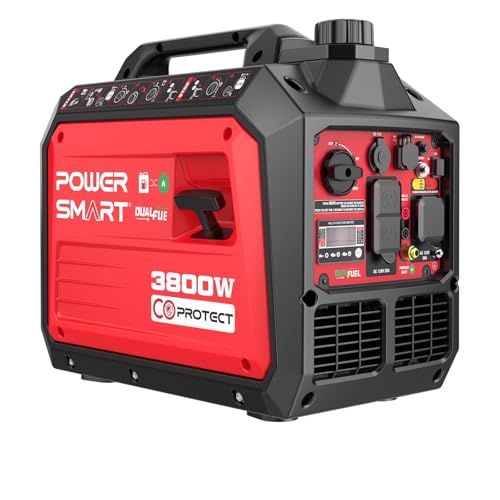
PowerSmart’s 3800-watt inverter balances power with portability, offering dual-fuel operation and RV-ready features via a 30A outlet. It’s designed for home use and emergency backup, with quiet operation—reported around 59 dBA at partial load and 70 dBA at full load. It’s a practical option for those who need a compact unit that still delivers solid power for essential appliances and devices during outages or trips.
Key considerations
Pros: RV compatibility and quiet operation;Cons: Lower peak wattage compared to some rivals, and propane efficiency may vary by environment.
Buying Guide: Key Purchase Considerations
- Power needs and runtime: Estimate your essential loads (refrigerator, lighting, HVAC, electronics) and choose a model with a suitable surge wattage and anticipated run times on both gasoline and propane.
- Fuel flexibility: Dual-fuel capability can provide flexibility in fuel availability and storage, but performance may differ between fuels. Consider local fuel access and climate.
- Safety features: Look for CO sensors or CO shutoff, automatic low-oil shutdown, and reputable certifications to protect users in enclosed spaces or during long outages.
- Noise and portability: Inverter generators tend to run quieter, which is beneficial for campgrounds and neighborhoods. Consider weight, wheel kits, and handle design for easy transport.
- Outlets and RV readiness: Check the availability of RV-ready outlets (TT-30R) and standard 120V outlets. A dedicated 30A outlet is important for RV use.
- Parallel operation: If you anticipate higher power needs, consider models that support parallel kits to connect with another inverter or power station for extended runtime.
- Maintenance and warranty: Review service networks, ease of service, and warranty terms to minimize downtime during extended use.
These options provide a range of wattage, fuel flexibility, and portability to fit RV living, home backup, or outdoor activities. Always follow local guidelines for safe operation, especially in enclosed spaces or near sleeping areas. This guide helps compare the major features and provides a framework to decide which generator best matches your power profile.