Best 400 Amp Distribution Block Solutions for Marine, RV, and Auto Wiring
When choosing a 400A distribution block, the key is a sturdy copper bus bar, ample stud count, and reliable insulation for harsh environments. The best options below are designed for high-current 12V to 48V systems, such as boats, cars, RVs, and solar setups. They suit buyers who need durable, high-capacity power distribution with clear positive/negative separation and easy wiring access.
This quick-reference table highlights five top picks and why they’re suitable for different needs. Use it to compare layout, stud size, and installation style at a glance.
| Product | Best For | Key Feature |
|---|---|---|
| Joinfworld 400A Bus Bar (4 x 3/8″ Studs) | Vehicles and boats needing larger wires | 8mm thick copper bar, dual polarity |
| Joinfworld 400A 4 x 5/16″ Studs (2 in 1) | Compact, space-saving dual bus setup | Negative/Positive in one unit, sturdy nylon base |
| RVMARINEPAT 400A 6 x 5/16″ Studs | Marines and heavy solar arrays | Nickel-plated copper, robust mounting base |
| RVBOATPAT 400A (4 x 3/8″ Studs) | Boat electrical systems with large wires | Tinned copper, corrosion resistance |
| Seamaka 400A Bus Bar (4 x 3/8″ Studs) | Military-grade durability for automotive projects | Brass bottom, 304 stainless terminals |
Joinfworld 400A Bus Bar With 4 x 3/8″ Studs
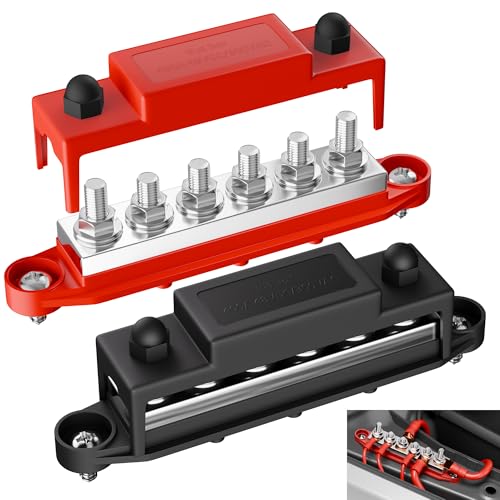
The 400A unit uses an 8mm thick copper bus bar with stainless steel studs and nuts, supporting high-current connections. It includes a red/black pair for positive and negative distribution. Best for boat or car setups needing larger connectors and solid mounting. Limitations include the need for compatible wiring and hardware to maximize the 3/8″ studs’ capacity.
RVBOATPAT 400A Bus Bar With 6 x 5/16″ Studs

This heavy-duty 400A block uses a tinned copper plate for high conductivity and corrosion resistance, suitable for marine and solar systems. It is designed to resist torque, with a design that keeps the copper bar and base securely connected. Best for long-term reliability in wet or humid environments. A caution: ensure the base installation is rigid to prevent loosening over time.
Seamaka 400A 12V Bus Bar With Cover

Seamaka’s unit features a brass bottom plate and 304 stainless steel screws, plus a nylon protective sleeve and base for flame retardance. It supports up to 400A, with a 8mm copper bus bar and 3/8″ studs. Best for users who prioritize robust materials and safer insulation. Limitation: heavier assembly may require more mounting support.
Joinfworld 400A Dual Bus Bar (4 x 5/16″ Studs)

This dual-bus design provides separated positive and negative rails in one compact unit. The 6 x 5/16″ studs support larger connectors, making it suitable for space-conscious installations like small RVs or compact boats. Best for improved wiring organization. Caution: verify polarity labeling is clear to prevent miswiring.
Joinfworld 400A 12V With 3 x 3/8″ Studs

This unit uses three 3/8″ studs and eight #10 screw terminals, with a 8mm copper bus bar. It is well-suited for larger automotive or marine wiring that needs higher current support. Best for users who require multiple large connections in a compact footprint. Limitation: fewer lugs than some larger modules, so plan wire routing accordingly.
Joinfworld 400A Dual 5/16″ Studs

This 4 x 5/16″ stud unit spaces a dual-bus layout with positive/negative separation, designed for tidy installations in automotive or marine projects. Best for users needing reliable high-current distribution with clear polarity. Caution: ensure the screws and nuts remain torqued to avoid stud loosening over time.
Buying Guide: How To Choose A 400A Distribution Block
- Current and voltage range: Look for components rated for 12V-48V DC and up to 300V AC if needed. Choose blocks rated at or above your system’s peak current (often 400A for high-demand setups).
- Bus bar thickness and material: Thicker copper bars (6–8 mm) provide better conductivity and lower voltage drop. Stainless studs and nickel plating enhance corrosion resistance in marine environments.
- Stud count and size: Ensure the block has enough large studs (3/8″ or 5/16″) to accommodate your wires and lugs. Confirm compatibility with your terminal connectors.
- Polarity separation: A dual-bus design with clearly labeled positive and negative rails reduces miswiring. Some units include a built-in cover for safety.
- Insulation and mounting: Nylon bases and protective sleeves improve safety and flame resistance. Check for secure mounting features to prevent loosening under vibration.
- Installation scope: For boats and RVs, consider waterproofing and corrosion resilience. For cars, compact size with neat wiring is often more important.
- Maintenance and accessibility: Favor blocks with easy access to lugs and screws for future wiring changes or repairs.
Frequently Asked Questions
- What is a 400A distribution block best used for?
It serves as a centralized hub for high-current DC systems (12V-48V) and can distribute power to inverters, solar panels, and various appliances in boats, RVs, and vehicles. - Why choose a copper bus bar over other metals?
Copper provides superior conductivity, lower resistance, and better longevity in high-current applications, especially in harsh environments. - How many lugs should I expect on a 400A block?
It varies; look for at least 4–6 large studs plus multiple screw terminals to accommodate typical wiring needs. Plan future additions. - Is dual polarity important?
Yes, a dual-positive/negative design helps reduce wiring clutter and lowers short-circuit risk by clearly separating rails. - What installation challenges should I anticipate?
Vibration, corrosion, and space constraints. Ensure proper mounting, sealants, and accessible wiring paths to minimize maintenance. - Can I mix brands on the same system?
It’s generally fine to mix brands if current ratings and terminal sizes match. Always ensure safe and organized wiring.