Best 400 Amp 3-Phase Meter Socket With Main Breaker Options for Modern Installations
Choosing the right 400 amp 3-phase meter socket with a main breaker ensures reliable power distribution for commercial and industrial settings. This guide compares top-rated options from trusted brands, focusing on outdoor suitability, compatibility, and ease of wiring. While some choices cover lower amperages, they illustrate common configurations, expansion potential, and installation versatility for 3-phase systems.
Below is a concise summary of the selected products to help you compare at a glance. The table highlights amperage, enclosure type, main features, and brand for quick reference as you read the detailed sections.
| Product | Brand | Amperage | Enclosure | Key Feature |
|---|---|---|---|---|
| Eaton HP4040SHPVCSR | Eaton | 400 A | Outdoor rated | Solar ready and utility-grade main |
| ABB TSM420CSCUP | ABB | 200 A | Outdoor rated 4-space | Meter Load Center with main breaker |
| Siemens S4242B3225 | Siemens | 225 A | Indoor/Outdoor capable | 3-phase, plug-in breaker compatible |
| Milbank U9701-XL-QG-BLG-AEPU | Milbank | 200 A | Meter socket | Bypass option |
| Square D SC816F200P | Schneider Electric | 200 A | Outdoor surface mount | Solar-ready with neutral distribution |
Eaton 400 Amp Solar Ready Meter Main

The Eaton HP4040SHPVCSR represents a robust 400-amp outdoor meter main solution designed for solar-rated readiness. It integrates a main breaker with space for sufficient distribution, supporting high-demand commercial or industrial installations. The solar-ready designation indicates future-proofing for PV connections, enabling quick field integration of solar components without major rewiring. The design emphasizes weather resistance and ease of service, making it suitable for outdoor installations where reliability and accessibility are critical.
Key features include a high-capacity main breaker suitable for demanding load profiles, compatibility with typical 400-amp service feeders, and a configuration that supports straightforward wiring of line and neutral conductors. The enclosure is built to withstand outdoor conditions, and the unit’s layout simplifies inspection and monthly testing routines. Wiring access points and knockouts are arranged to accommodate diverse feed arrangements, aiding rapid installation and maintenance.
ABB TSM420CSCUP 200A Meter Load Center

The ABB TSM420CSCUP is a 200-amp outdoor meter load center with a combination main breaker, four spaces, and eight circuit positions. It is designed for flexible meter socket integration and supports both overhead and underground applications. The unit accepts 1-inch THQL and 1/2-inch THQP branch breakers, enabling broad compatibility with existing electrical panels. Its weather-resistant NEMA 3R enclosure provides reliable performance in outdoor environments, while a one-piece copper bus adds durability and corrosion resistance. This makes it suitable for quick service upgrades or retrofits in outdoor environments.
With a focus on versatility, the ABB load center supports ring-type meter sockets and can be paired with various feed-through or sub-feed configurations. The modular design improves serviceability, allowing technicians to replace or upgrade components without replacing the entire unit. The combination main breaker reduces the number of panels required on-site, which can simplify installation logistics and reduce material costs for projects at scale.
Siemens S4242B3225 225-Amp 42-Space Load Center

The Siemens S4242B3225 is a 225-amp indoor/outdoor capable main breaker load center with 42 spaces and 42 circuits. It is UL listed for 3-phase systems and accepts approved plug-in style Siemens or Murray breakers, offering a familiar and flexible wiring environment for technicians. The 4-wire, 120/240 or 120/208-volt configuration supports common commercial and light-industrial applications. The large circuit count supports complex electrical layouts, including dedicated lighting, control circuits, and motor loads, all within a single enclosure.
Key advantages include a scalable design for growing electrical needs, strong compatibility with Siemens’ breaker families, and a robust enclosure suitable for harsh environments. The unit’s modular nature helps with phased installations and ongoing upgrades, reducing downtime during panel expansions. While maintenance can require careful labeling and documentation, the panel’s clear space allocation supports efficient field work.
Milbank 320 Amp 3-Phase Meter Socket
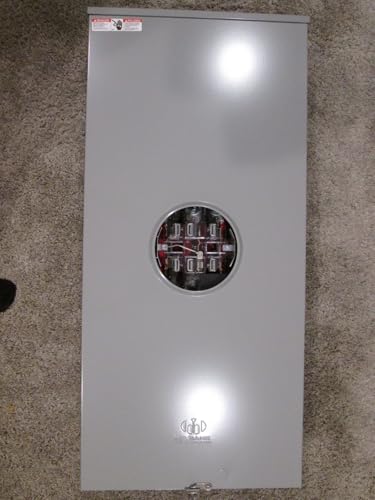
The Milbank 320-amp 3-phase meter socket offers strong outdoor performance with a straightforward configuration designed for robust service entrances. While not a 400-amp unit, its three-phase capability and compact form factor make it a practical choice for mid-range service requirements and upgrades. It supports standard meter socket configurations and is well-suited for facilities seeking reliable metering with a clean, single-point installation. The by-pass option can be beneficial for testing or temporary isolation during maintenance work, depending on local electrical codes and field needs.
Durability, ease of wiring, and compatibility with common distribution equipment are among this unit’s strengths. The enclosure typically features weather resistance and sturdy construction, contributing to lower long-term maintenance and improved reliability for outdoor installations where exposure to the elements is a factor.
Schneider Electric SC816F200PS Homeline Outdoor Meter Socket

The Schneider Electric SC816F200PS Homeline outdoor meter socket and main breaker load center offers eight spaces and 16 circuits in a solar-ready design. It features a fully distributed neutral bar that supports Homeline plug-on neutral breakers, allowing for flexible circuit distribution. The unit is designed for solar-ready installations with provisions for field-installed CTs on the line bus and an optional SR69064A solar sub-feed lug kit for solar connections ahead of the main breaker. This configuration helps accommodate future energy efficiency and renewable energy projects while maintaining a compact footprint.
Outdoors or indoors, this panel emphasizes ease of wiring, intuitive labeling, and a robust protective enclosure. Solar-readiness is a central theme, enabling users to plan for on-site generation with minimal disruption to current electrical infrastructure. The Homeline system’s compatibility with a broad range of breakers supports long-term adaptability as loads evolve.
Buying Guide: Key Considerations For 3-Phase Meter Sockets With Main Breakers
- Amperage rating and future growth: Select a unit that matches the service size (preferably 400 A for heavy use) and consider transformers, feeders, and potential expansion to prevent costly upgrades.
- Outdoor versus indoor suitability: Outdoor installations require NEMA or equivalent weather resistance, corrosion protection, and rainproof or weatherproof enclosures. Indoor units may prioritize compactness and ease of access.
- Meter socket integration: Ensure compatibility with the local utility meter configuration (ring-type, socket size, and exit orientations) and whether bypass options are needed for maintenance.
- Main breaker capabilities: Confirm that the main breaker size and trip characteristics align with the service disconnect requirements and applicable electrical codes. Look for solar-ready or PV-ready features if solar installations are planned.
- Breaker compatibility and expansion: Check if the panel accepts standard plug-in breakers from the same brand or compatible third-party breakers. Assess space for future expansion (spaces vs. circuits).
- Installation and maintenance: Consider access for wiring, labeling, and testing. A modular design can simplify service, while a heavier enclosure may require professional installation.
- Environmental and code compliance: Confirm NEMA rating, UL listings, and local code requirements, especially in outdoor, wet, or corrosive environments.
- Renewables readiness: For solar-ready models, review available sub-feed lug kits and CT configurations to plan for integration with PV systems.
- Cost of ownership: While 400 A units may have higher upfront costs, savings can come from reduced future upgrades, easier maintenance, and improved reliability.