Best 40 Volt Power Supply Guide: Top 5 40V DC Converters
Answering the common buyer need for a reliable 40–48V DC power source, this guide highlights five strong options. These power supplies suit electronics hobbyists, 3D printer builders, LED installers, CCTV setups, and small lab projects. Each entry explains who benefits most, why it was chosen, and a simple caution. Use these details to compare outputs, safety features, and ease of use across similar models.
Summary Table
| Product | Output Voltage / Current | Best For | Notable Note |
|---|---|---|---|
| BOSYTRO 48V Adjustable DC Power Supply | 0–48V, up to 12.5A, 600W | 3D printers, LED arrays, lab benches | LED display; cooling fan |
| DROK 48V Power Supply | 0–48V, up to 10A | LEDs, CCTV, small labs | Fixed current (not adjustable) |
| Jesverty SPS-6005 | 0–60V, 0–5A | Bench testing, variable loads | 4-digit display; auto CV/CC |
| VAYALT 48V 25A 1200W | 48V ±10%, up to 25A | Industrial setups, CCTV, multi-device loads | Peak power up to 1200W |
| ALITOVE 36V Power Supply 4A | 36V, up to 4A | 36V devices, LEDs | Not 40V, but common 36V rail compatibility |
BOSYTRO 48V Adjustable DC Power Supply 600W

Best for: Dimmable LEDs, 3D printers, and computer labs needing stable up to 48V power with high current headroom. Why chosen: This unit provides a wide 0–48V output with adjustable current up to 12.5A and a robust 600W maximum output. An LED digital display and built-in cooling improve visibility and reliability during long runs. Safety testing and RoHS compliance add practical peace of mind.
Limitations: Peak load can differ from maximum load; ensure connected devices stay under 12.5A for safe operation.
DROK 48V Power Supply 480W

Best for: LED lighting setups, CCTV projects, and small labs needing a straightforward 0–48V supply. Why chosen: It offers a broad voltage range with a precise 0.1V adjustment and a fixed current limit of 10A, paired with an LED readout and active cooling. This combination supports stable performance with reasonable heat management.
Limitations: The current does not adjust with voltage; plan around a maximum of 10A regardless of voltage setting.
Jesverty DC Power Supply SPS-6005
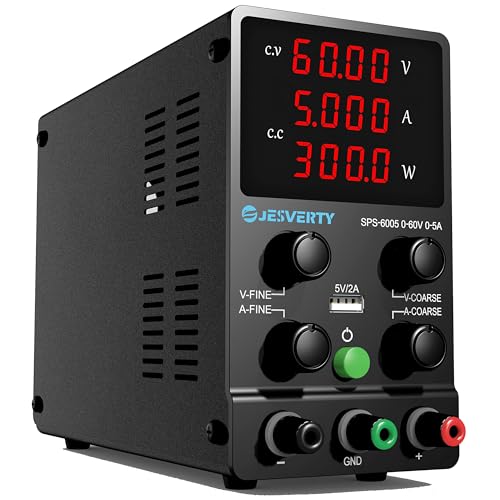
Best for: Bench tasks that require precise voltage and current management with clear real-time readouts. Why chosen: It features a high-precision 4-digit display and automatic CV/CC mode switching, helping users manage changing loads without constant reconfiguration. The unit supports up to 60V and 5A, suitable for a range of test rigs.
Limitations: Some users may need higher current than 5A for power-intensive devices; plan accordingly.
VAYALT 48V 25A 1200W DC Power Supply

Best for: Industrial installations and multi-device setups requiring a high wattage 48V supply with strong cooling. Why chosen: The model delivers up to 1200W with 25A at 48V, featuring an intelligent cooling system, sturdy aluminum housing, and multiple load connections. Its design supports simultaneous connections while maintaining efficiency.
Limitations: Peak power handling is device-dependent; ensure loads do not exceed safe operating limits per channel.
ALITOVE 36V Power Supply 4A

Best for: 36V electronics projects or LED lighting setups that don’t require a 40V output. Why chosen: This unit provides a reliable 36V at up to 4A with common 5.5×2.5mm jacks. It’s a practical option when 36V devices are the target and 40V is not strictly required.
Limitations: It does not reach 40V, so select this only if your device expects 36V or compatible rails.
Buying Guide
What to consider when choosing a 40V (or near-40V) power supply
- Voltage range and accuracy: Look for models with a clear 0–48V or 0–60V range and precise voltage adjustments (±0.1V or better).
- Current capacity: Match the supply to the maximum current your devices need. Overprovisioning helps handle startup surges but watch heat and efficiency.
- Power rating and cooling: Higher wattage units often include cooling fans and aluminum casings. Adequate ventilation prevents thermal throttling or failure.
- Display and usability: A readable LED or digital display simplifies monitoring, especially in lab or bench environments.
- Safety features: Overcurrent, short-circuit, and thermal protections minimize risk in busy setups.
- Multichannel capability: If powering multiple devices, consider supplies with multiple outputs or solid load distribution.
- Plug and cord compatibility: Check input voltage compatibility (110/120V or 220–240V) and connector types for output.
FAQ
- Do these supplies handle both CV and CC modes?
– Some models auto-switch between constant voltage and constant current based on load, while others fix current at a maximum value. - Can I use a 40V supply for 36V devices?
– Yes, many 40–48V models can output 36V but confirm device tolerance and step-down requirements. - Is a higher wattage always better?
– Not always. Choose power that matches your load; excess wattage doesn’t guarantee efficiency for lighter loads. - Are these safe for LED strips and CCTV equipment?
– Most models include protection features; ensure correct voltage, current limits, and heat management for LEDs and cameras. - What should I consider for multiple devices?
– Look for a supply with multiple outputs or the ability to safely split a high-current rail without overheating. - Do these require assembly or programming?
– Most are plug-and-play; some models include a knob for voltage adjustment and an LED display for monitoring.