Best 40 Amp Timer Switches for Reliable Power Scheduling
If you need a dependable 40 amp timer switch to automate pumps, lights, or HVAC components, these models offer robust mechanical or digital control designed for high-current loads. This guide highlights five top options, who they’re best for, and practical buying considerations to help you pick the right switch for 208–277 VAC or 120 VAC systems.
Summary of top picks:
| Product | Voltage / Load | Best For | |
|---|---|---|---|
| Intermatic T104 | 208–277 VAC, DPST, 40A | Industrial-style high-demand circuits | Heavy-duty, manual override |
| Intermatic T101 | 120 VAC, SPST, 40A | Residential lights and pumps | Flexible daily programming |
| DEWENWILS 24-Hour 208–277 VAC | 208–277 VAC, DPST, 40A | Outdoor/heavy-duty pools and heaters | Weatherproof metal enclosure |
| DEWENWILS 24-Hour 120 VAC | 120 VAC, SPST, 40A | Indoor/outdoor heavy-duty devices | Weatherproof and ETL listed |
| SURAIELEC Pool Timer | 120/240/277 VAC, 40A | Pool equipment with 3HP load | Digital with multiple programs |
Intermatic T104 24-Hour DPST Mechanical Timer
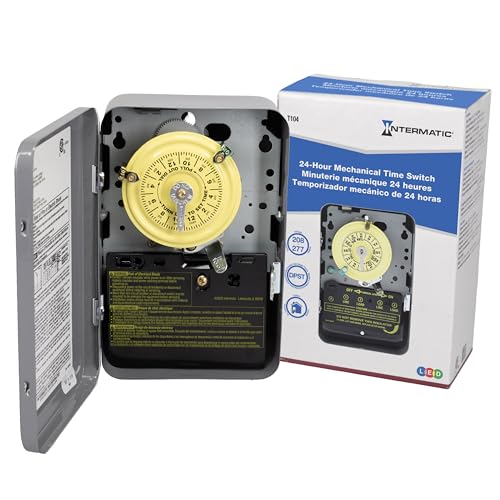
The Intermatic T104 provides double-pole, single-throw control for 208–277 V circuits with up to 40 amps. This makes it suitable for high-demand loads like motors, HVAC components, and continuous-duty lighting in commercial or large residential setups. The metal enclosure enhances durability, and a manual override offers immediate control when needed. Best for: high-current, hard-wired installations where both legs of the circuit require switching. Limitation: some users may prefer a digital timer for fine-grained 15-minute scheduling, which this model does not offer.
Intermatic T101 24-Hour Mechanical Timer

The T101 is a 120 V mechanical timer with SPST contacts and 40 amp capacity. It offers a full 24-hour control cycle with up to 12 on/off operations per day and a minimum 1-hour interval, providing precise daily scheduling for lights, pumps, fans, or HVAC components. A manual override adds on-demand control. Best for: residential or small commercial settings needing reliable, hourly scheduling without digital programming. Caution: limited to 120 V operation; not suitable for 208–277 V systems.
DEWENWILS 24-Hour Mechanical Timer 208–277 VAC

This 208–277 VAC, 40A DPST model is designed for heavier indoor or outdoor environments, including pool pumps, water heaters, and landscape lighting. It features two on/off programs in a 24-hour cycle with a durable metal enclosure and manual override. Best for: outdoor or wet-location applications needing reliable high-voltage control. Limitation: installation guidance emphasizes avoiding jumper wires, which may differ from older timer setups.
DEWENWILS 24-Hour Mechanical Timer 120 VAC

This model operates at 120 VAC with SPST contacts and 40A capacity, supporting two programs per day and a weatherproof metal enclosure. It is suited for indoor or outdoor use with heavy-duty loads like pool equipment and water heaters. Best for: users needing a robust, weatherproof timer for 1–2 devices at 120 V. Limitation: fewer programming options than digital timers or 24/7 smart controllers.
SURAIELEC 7-Day Digital Pool Timer

The SURAIELEC digital timer controls up to 40A on 120/240/277 VAC and supports a 7-day programming cycle with DST adjustments and a random function. It uses a built-in battery to retain time and settings through outages. Best for: pool pumps and hot water heaters requiring flexible daily or weekly schedules. Caution: digital modules may require more setup than simple mechanical timers.
DEWENWILS 24-Hour Mechanical Timer 120 VAC Outdoor

This 120 VAC SPST mechanical timer is designed for outdoor duty with a rugged enclosure and two on/off programs per day. It suits pool pumps, water heaters, lights, and fans in damp environments and provides straightforward wiring. Best for: outdoor installations where a simple, weatherproof timer is needed. Limitation: no digital memory or advanced scheduling beyond two daily programs.
SURAIELEC Mechanical Pool Timer, 40A 240V

Upgraded with an AC contactor concept, this 240V timer supports up to 3HP pool equipment for stable operation in start-stop cycles. It uses a 24-hour mechanical setting with a 12-hour dial showing 96 pins for 15-minute increments. Best for: pools or spa setups needing higher current capacity and durable operation. Caution: more complex to install for beginners due to higher current handling.
Buying Guide
What should you look for when choosing a 40 amp timer switch?
- Voltage compatibility: Ensure the timer supports your system’s voltage (120 V, 208–277 V, or 240 V). Choose a model that matches your circuit and load type.
- Contact configuration: DPST vs SPST affects whether both legs or a single leg are switched. For high-power motors, DPST is typically preferable.
- Indoor vs outdoor: Outdoor installations require weatherproof enclosures and ETL/UL listings. Verify enclosure rating for damp or wet locations.
- Programming style: Mechanical timers offer simple on/off cycles; digital timers provide 7-day or programmable schedules and memory through outages. Pick based on scheduling needs and complexity tolerance.
- Number of programs: If you need more than two on/off periods per day, digital or multi-program mechanical timers are better suited.
- Manual override: This feature provides quick control during maintenance or testing without altering programmed schedules.
- Load rating and compatibility: Confirm motor or pump compatibility (HP rating) at your system voltage to avoid overloads.
FAQ
- Q: Do these timers require a neutral wire?
- A: Most mechanical timers do not require a neutral; digital timers may depend on model. Always follow the wiring diagram in the installation guide.
- Q: Can I use a 40A timer for a smaller load?
- A: Yes, but ensure the timer’s contact rating and enclosure suit your circuit. Oversizing typically does not harm the timer, but wiring and enclosure must fit the installation.
- Q: Are outdoor timers weatherproof?
- A: Many models feature weatherproof metal enclosures and ETL listings. Verify outdoor suitability before exposure to the elements.
- Q: What is the difference between mechanical and digital timers?
- A: Mechanical timers provide simple, reliable cycles with fewer settings; digital timers offer multi-day programming, memory, and adjustable DST features for complex schedules.
- Q: How do I choose between 120 V and 277 V models?
- A: Match the timer to your circuit’s voltage and the device’s current draw. Higher voltage timers are used for large HVAC, pool pumps, or commercial loads.