Best 40 Amp MPPT Charge Controllers for Solar Power Systems
Finding the right 40 amp MPPT charge controller helps maximize solar harvest, protect battery banks, and simplify off-grid or RV solar setups. This guide reviews five top-rated options, highlighting efficiency, battery compatibility, cost of ownership, and features that matter for Gel, Flooded, Sealed, AGM, and LiFePO4 batteries. Each product section provides key specs and practical considerations to aid a straightforward choice for American readers.
Summary of chosen products
| Product | Brand | Battery Types | Key Feature |
|---|---|---|---|
| Rover 40A MPPT | Renogy | Gel, Sealed, Flooded, Lithium | Dual-Peak Tracking, 99.9% efficiency |
| Rover 40A Bluetooth MPPT | Renogy | Gel, Sealed, Flooded, Lithium | Bluetooth connectivity, user parameter customization |
| Tracer4210AN-G3 | EPEVER | Gel, Flooded, Sealed, LiFePO4, Lithium | RS485, wide battery support, advanced protections |
| BougeRV Sunflow 40A | BougeRV | LiFePO4, SLD, Gel, FLD, AGM | Low-temp cut-off, app control |
| Vansdon 40A MPPT | Vansdon | Lithium, AGM, Gel, FLD | High efficiency, 0V lithium activation |
Renogy Rover 40A MPPT Charge Controller

Renogy’s Rover 40A MPPT controller combines reliable performance with broad battery compatibility. It manages 12V and 24V systems, supporting gel, sealed, flooded, and lithium batteries. Its dual-peak tracking helps maintain efficient charging under partial shading or cloudy conditions, maximizing energy harvest for RVs, off-grid cabins, and marine applications. The 4-stage charging profile supports lead-acid batteries and includes a lithium reactivation feature for recovering deeply discharged packs. This model emphasizes storm-ready protections and auto-detection for system voltage, making it a solid baseline choice for diverse solar setups.
Renogy Rover 40A MPPT With Bluetooth

This Bluetooth-enabled Renogy Rover 40A model adds remote configurability and monitoring. It maintains high MPPT efficiency (up to around 99%) and supports auto-detection of 12V/24V systems. The controller is designed to accommodate sealed lead-acid, GEL, flooded, and lithium batteries, with a user mode allowing manual lithium parameter adjustments to address voltage matching issues. The charging strategy includes 4 stages for lead-acid and an optimized approach for lithium chemistry, aiming to extend battery life and ensure stable performance in varying sunlight conditions.
EPEVER Tracer4210AN-G3 40A MPPT
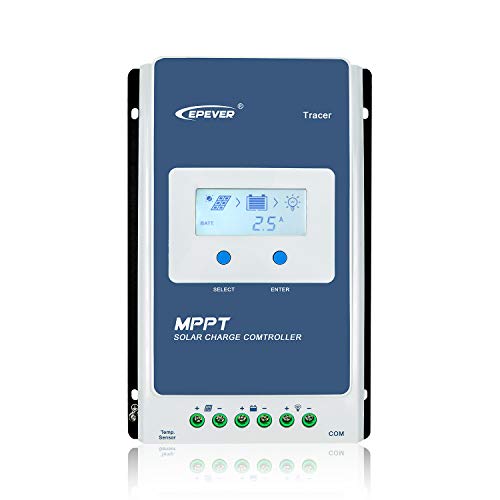
EPEVER’s Tracer4210AN-G3 supports 12V/24V auto system recognition with a broad input range up to 100V and a high PV input capacity. It offers common negative grounding and supports multiple battery types, including LiFePO4, sealed, gel, flooded, and even some lithium chemistries. Notable features include a real-time energy statistics function, battery temperature compensation, overheat protection, and RS485 communication for Modbus integration. It also supports optional accessories like MT50/MT52 and WiFi/BLE adapters for mobile monitoring and parameter tuning.
BougeRV Sunflow 40A MPPT

BougeRV’s Sunflow 40A MPPT controller emphasizes LiFePO4 compatibility with a low-temperature cut-off below 32°F. It offers app control via BougeRV’s app (Bluetooth range up to ~32 feet) and provides multiple display modes, including a full-featured mode for parameter adjustment. The device claims high efficiency, aided by a robust heat sink to minimize losses under full load. This option suits users prioritizing remote monitoring and LiFePO4 safety features in cold environments.
Vansdon 40A MPPT Charge Controller
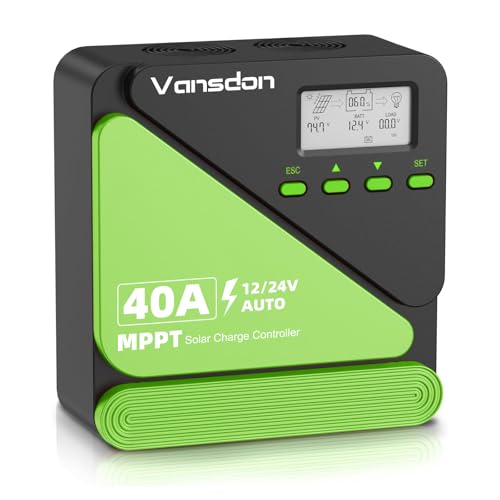
Vansdon’s 40A MPPT controller targets flexible battery compatibility and practical protection features. It identifies 12V and 24V systems, tracks with high efficiency up to approximately 99%, and features a 0V lithium activation function to recover deeply discharged batteries. The product is designed for RVs, boats, cabins, and off-grid systems, supporting LiFePO4, AGM, Gel, and Flooded chemistries. The inclusion of comprehensive protections helps prevent common solar charging mishaps in variable conditions.
Buying Guide: key purchase considerations
- Battery chemistry compatibility: Ensure the controller supports your battery types (Gel, AGM, Flooded, LiFePO4, Lithium). Some models tailor features for LiFePO4 and lithium reactivation, while others are more general.
- Voltage detection and system voltage: Look for auto-detect between 12V and 24V systems. Verify compatibility with your array’s voltage range (PV input limits vary by model).
- MPPT efficiency and tracking: A higher tracking efficiency (around 99%) improves harvest, especially under shading or cloud cover. Consider models with dual-peak or multi-peak tracking for partial shading.
- Protection features: Key protections include reverse polarity, overcharge/discharge, short circuit, lightning surge, and overheating. Some units also offer TVS protection and load control.
- Temperature compensation: Temperature compensation helps optimize charging in varying ambient conditions, protecting battery longevity in cold or hot environments.
- Monitoring and connectivity: Bluetooth, RS485, or WiFi options enable remote monitoring and adjustment. Mobile apps can simplify parameter tuning and data logging.
- Display and user interface: A clear LCD or display panel helps with real-time status, current charging values, and battery health indicators on-site.
- Installation environment: Consider the controller’s enclosure rating, heat sinking, and how it handles high ambient temperatures or storm-prone locations.
- Ease of integration: If you use a specific solar kit or brand ecosystem, compatibility with that ecosystem (Modbus, MT50/MT52 adapters) can simplify setup and future expansion.
The options above cater to a range of needs—from off-grid RV setups to home solar installations—while emphasizing efficiency, battery protection, and ease of use. When evaluating, map your system’s voltage, battery chemistry, climate, and monitoring preferences to the features that matter most, ensuring a balanced choice between upfront cost and long-term reliability.