Best 4 Inch Knockout Punch: Top 5 Hydraulic Kits for DIY and Pro Projects
Answering the search intent for a reliable 4 inch knockout punch, the following five kits are among the most capable options for every-day electrical work or metalworking projects. These selections are best for professional-installers needing consistent hole sizes in conduit and metal sheets, as well as DIY enthusiasts tackling home projects. Each product is evaluated for punching capacity, range of conduit sizes, tool durability, and practicality in tight spaces. The list includes 4″ punch sets that cover 1/2″ to 4″ conduit holes, with strong hydraulic action and robust dies for clean holes.
| Product | Conduit Range | Punching Power | Best For | |
|---|---|---|---|---|
| AMZCNC 4″ Conduit Punch | 4″ to 4.54″ hole (actual) | 12 Tons | Compact projects; draw stud 3/4″-16UN | Conduit fitting 4″ |
| TEMCo TH0037 4″ KO Kit | ½” to 4″ | 13 US tons | Precision and alignment | Laser marks; rugged case |
| VEVOR 15 Ton KO Kit | ½” to 4″ | 15 Tons | Heavy-duty and versatile | Wide kit includes case and dies |
| AMZCNC 15 Ton KO Driver Kit | ½” to 4″ | 15 Tons | General purpose 15T kit | 10 dies; compatible tooling |
| AMZCNC 12 Ton KO Hole Punch Kit | ½” to 4″ | 12 Tons | Budget-conscious 12T option | Deep draw dies; 360° head |
AMZCNC 4″ Conduit Punch and Die

Powerful 12-ton hydraulic action drives a 4″ conduit hole with an actual 4.54″ hole size, making it suitable for thicker materials and larger conduit fittings. The kit uses 3/4″-16UN draw studs and is designed for a smaller footprint, ideal for tight workspaces. Best for electricians and metalworkers who encounter larger conduit openings but need a compact tool for frequent site use. A potential limitation is the slightly larger actual hole than nominal 4″, which should be accounted for in project planning.
VEVOR 15 Ton Hydraulic Knockout Kit
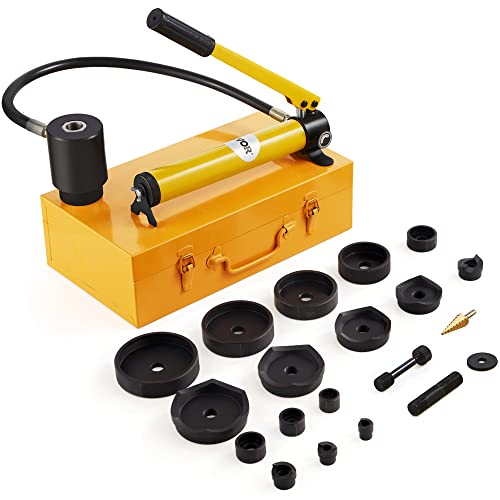
This complete punch tool set offers a 15-ton hydraulic punch with 1/2″ to 4″ dies, a sturdy carrying case, two draw studs, and a piston shaft. It emphasizes efficiency and accuracy with laser-engraved alignment marks for quick positioning. Best for frequent heavy-duty punching on metal electrical panels or control cabinets. Limitation: maximum punching thickness varies by material (0.1″ for soft carbon steel, 0.08″ for stainless), so very thick sheets may require multiple passes or a thicker-dedicated punch.
TEMCo TH0037 4″ Hydraulic KO Kit

True 13-ton hydraulic knockout with ten dies covers sizes from ½” to 4″. Laser-engraved alignment marks help with precise placement, and the rugged storage case keeps parts organized. Best for professionals who need a reliable high-torque punch with clear sizing indicators. A potential limitation is heavier weight and larger profile, which may reduce portability in tight job sites.
AMZCNC Hydraulic KO Tool Kit 1/2 to 4″ (15T)

This 15-ton kit includes 10 dies for sizes from ½” to 4″, plus compatible head tooling for GREENLEE and domestic punch systems. It is designed for efficient, consistent holes in steel and stainless materials, with solid punching capacity. Best for shop and job-site use where a versatile 15T option is needed. Limitation: as with most 15-ton sets, the weight and bulk may hinder operation in very narrow spaces.
AMZCNC 15 Ton 1/2 to 4 Inch KO Kit

Offers the 15-ton capacity with a 360° head for better reach in awkward angles. Includes ten dies covering ½” to 4″ conduits and displacement in 1/8″ steel and 1/16″ stainless, enabling broad material compatibility. Best for users who need a flexible, well-built hydraulic KO tool with easy die alignment. Consider the 360° head as a benefit for awkward installations; the only caveat is the routine maintenance to keep the hydraulic system responsive.
Buying Guide: 4 Inch Knockout Punch Considerations
What operating environment will you face? For portable field work, a compact 12- to 15-ton kit with a carrying case helps. For shop setups, a heavier 15-ton system with multiple dies reduces tool switching. Consider the material you punch—soft carbon steel vs. stainless steel—and thickness, as this affects maximum punching thickness and die wear.
Key questions to guide your purchase
- What conduit sizes do I most often punch? If ½” to 4″ covers your needs, a 10-die set is beneficial.
- Do I need alignment marks? Laser or etched marks speed setup and improve accuracy.
- Is portability important? A compact model with a sturdy carrying case helps on job sites.
- Will I punch thick or hard materials regularly? A higher-ton kit (13–15T) provides more force but adds weight.
- Compatibility with other tooling? Look for models that are compatible with GREENLEE and common domestic punch tooling.
Practical comparison at a glance
- Best for compact spaces: AMZCNC 4″ Conduit Punch and Die.
- Best for all-around performance: TEMCo TH0037 4″ KO Kit.
- Better for heavy-duty, frequent use: VEVOR 15 Ton KO Kit.
- Choose this if you need a full 15T kit with versatile dies: AMZCNC 15 Ton KO Driver Kit.
- Good budget-friendly 15T option: AMZCNC 12 Ton KO Hole Punch Kit.
Frequently Asked Questions
- What does “15 ton” mean in knockout kits? It refers to the hydraulic force the tool can apply, affecting ability to punch through thicker materials.
- Are these tools compatible with other brands? Many kits claim compatibility with GREENLEE or other domestic tooling; check thread size 3/4″-16UN for draw studs to ensure fit.
- Can I punch stainless steel with these kits? Yes, but punching thickness is limited (often around 0.08″ for stainless depending on model).
- Do all kits include dies for 4″ conduits? Most ½” to 4″ kits include a full range of dies; verify the included dies in the product description.
- Is a carrying case important? For frequent field use, a case helps keep dies, rods, and the hydraulic unit organized and portable.
- What is the difference between 4″ and actual hole sizes? Some models specify an actual hole slightly larger than 4″ due to die geometry; plan hole sizes accordingly.