Best 4-Gas Monitor for Safety: Top Multi-Gas Detectors
The best 4-gas monitor picks are compact, durable, and capable of rapid, accurate sensing of H2S, CO, O2, and LEL. This guide highlights top options for industrial workers, first responders, DIY enthusiasts, and home safety. Each product section explains who it’s best for, why it was selected, and any important limitations to consider. A quick summary table follows to help you compare at a glance.
| Product | Best For | |
|---|---|---|
| TopTes Guard-101 | Long-duration monitoring on the job site | Triple alarm; 14h battery; rugged ABS housing |
| BW Technologies MCXL-XWHM-Y-NA | Lightweight wearable protection | One-button operation; easy ambient monitoring |
| Forensics USA NIST Calibrated | Calibration-focused accuracy | USA NIST traceable calibration; precise alarms |
| Forsensal Gas Detector With Pump | Pumping detection in difficult-to-ventilate spaces | Integrated pump; long standby; calibration kit |
| TopTes Guard-863Pro | Professional-grade reliability | TFT color display; 5-year O2 sensor life; USB export |
TopTes Guard-101 Gas Detector
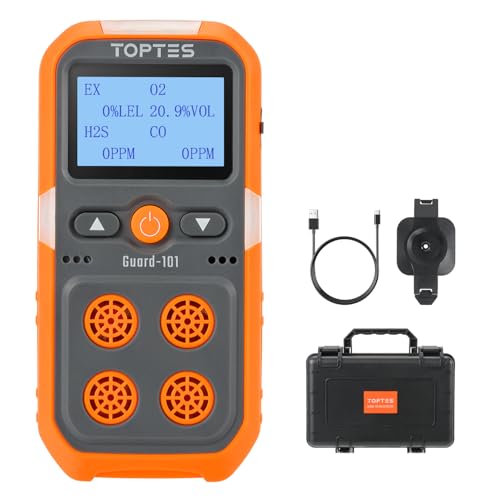
Best for: workers needing durable, 4-gas protection with long battery life. This model detects H2S, CO, LEL, and O2 quickly with a 0.5-second response, and lasts up to 14 hours per charge. It features waterproof, dustproof, and explosion-proof construction plus a back clip for portable use. An initial password (69) helps prevent accidental operation. Caution: initial password security should be documented in your facility policy to avoid lockouts during emergencies.
BW Technologies MCXL-XWHM-Y-NA GasAlertMicroClip XL 4 Gas Detector

Best for: users who value ultra-light wearability and simple operation. This four-gas monitor covers H2S, O2, CO, and LEL with a lightweight form factor and straightforward one-button use. Limitation: fewer advanced data features compared with higher-end units.
USA NIST Calibrated 4 Gas Monitor

Best for: seekers of calibration-grade accuracy. This device uses high-quality electrochemical sensors with USA NIST traceable calibration, measuring O2, CO, H2S, and LEL. It offers adjustable alarms and timestamps for events. Caution: reliance on calibration status is essential for accuracy over time; confirm calibration intervals in your program.
Forensics 4 Gas Monitor with NIST Calibration

Best for: environments requiring visible data displays and logging. It includes a color display for gas concentration visualization and USA NIST calibration, covering O2, CO, H2S, and LEL. Limitation: calibration maintenance is important to preserve data accuracy over time.
Gas Detector With Pump (Forsensal)

Best for: use in confined or hard-to-ventilate spaces where air flow is limited. This 4-gas monitor includes a built-in pump to actively draw air samples, and a long-lasting 3000mAh battery with a Calibration Kit. Caution: the pump increases size and may affect battery life in extended field use.
TopTes Guard-863Pro 4 Gas Monitor

Best for: professional-grade reliability and data management. Guard-863Pro offers a TFT color display, an upgraded O2 sensor with up to 5-year life, USB data export, and fast 0.5-second responses. Limitation: higher feature set may come with a higher purchase price and a learning curve for advanced data handling.
Buying Guide: How To Choose The Right 4-Gas Monitor
- What gases do you need to detect? Ensure the model covers O2, CO, H2S, and LEL for your environment.
- Battery life and power source: look for longer runtime if you work long shifts or in remote areas.
- Durability: check if the unit is waterproof, dustproof, and explosion-proof for harsh environments.
- Alarms and data features: consider triple alarms (sound, light, vibration) and whether you need data logging or USB export.
- Calibration requirements: decide between factory-calibrated units and those with NIST traceable calibration for precise measurement.
- Ease of use: evaluate the ease of operation, especially in noisy or dim conditions where alarms and indicators matter.
- Portability vs. pump: determine if you need a pumped model for stagnant air or a diffusion-only detector for general use.
- Cost of ownership: consider maintenance, calibration intervals, and potential replacement sensors.
Frequently Asked Questions
- What is a 4-gas monitor used for? It detects four gases (typically O2, CO, H2S, and LEL) to assess ambient air safety in workplaces or home environments.
- Do all 4-gas monitors require calibration? Some come factory-calibrated; others offer NIST traceable calibration options and require periodic recalibration for accuracy.
- What is a pumped gas detector? A pumped detector uses an internal pump to draw air into the sensor, useful for hard-to-ventilate areas.
- What is the difference between diffusion and pumped detectors? Diffusion monitors sample air passively, while pumped units actively pull air for faster sample delivery in low-flow environments.
- Can I rely on alarms alone for safety? Alarms are critical, but you should also rely on sensor data, proper training, and regular maintenance to ensure accuracy and timely response.
- Are NIST-calibrated devices more accurate? NIST calibration provides traceable measurement standards, which can improve confidence in readings for safety-critical applications.