Best 4-20 mA Splitter Solutions for Industrial Signals in 2026
The best 4-20 mA splitter guides help engineers and technicians choose reliable isolators and splitters to preserve signal integrity in harsh environments. This article targets buyers seeking DIN rail mounted splitters or isolators for process control, automation, or instrumentation. It highlights five solid options and explains who each is best for, plus practical pros and limits. Ideal buyers include plant engineers, maintenance technicians, and system integrators aiming to minimize interference while expanding current or voltage outputs.
| Product | Input | Outputs | Best For |
|---|---|---|---|
| Lelukee Signal Isolator Transmitter (4-20mA 2 In 4 Out) | 4-20mA | 2 In / 4 Out | Multiple sensors sharing a single loop |
| ASI ASI451145 4-20mA Spliter (3-Way Isolation) | 4-20mA | Dual Output | Interference-prone environments |
| Lelukee Analog Isolator (2 In / 2 Out, 4-20mA) | 4-20mA | 2 In / 2 Out | Compact DIN rail layouts |
| ANGGREK 4-20mA Splitter (One In, Two Out) | 4-20mA | 2 Out | Simple, affordable isolation |
| Automation Systems Interconnect 4-20mA Splitter (1 In / 2 Isolated Out) | 4-20mA | 2 Isolated Out | Reliable dual-output isolation |
Lelukee Signal Isolator Transmitter 4-20mA (2 In 4 Out)

Designed for industrial signal isolation with DIN rail mounting, this model supports dual input channels and four isolated outputs. It is commonly used to distribute a single sensor signal to multiple controllers or PLCs while protecting each device from cross-talk. Its isolation helps reduce ground loops and interference from powerful motors or grid equipment. Best for systems needing multiple, independent outputs from a single 4-20 mA input.
Who it’s best for
Maintenance technicians and control engineers managing several dashboards or I/O points from one sensor network. The broader output capability makes it a strong fit where data must be duplicated to multiple devices without compromising signal integrity.
Why chosen
Its 2-in / 4-out configuration supports expanding a sensor’s reach without adding new sensors. The DIN rail design eases installation in control cabinets and the signal isolation helps prevent interference from high-power equipment.
Limitations to note
Data on exact calibration controls is limited; users should verify zero/span adjustability per their process calibration needs.
ASI451145 4-20mA Splitter with 3-Way Isolation

This device features 3-way isolation and dual output to protect downstream equipment from transients and interference. It accepts a 4-20 mA input and provides two independent outputs, helping to route the same measurement to multiple controllers without common-mode noise. It’s well-suited for noisy industrial environments where signal fidelity is critical.
Who it’s best for
Plant engineers dealing with multiple PLCs or SCADA points that each require a clean 4-20 mA signal from a single source and where isolation is a priority.
Why chosen
The 3-way isolation reduces the risk of cross-coupled faults and improves reliability in systems with long cable runs or nearby high-current loads.
Limitations to note
Modest component-level adjustments may be needed for precise calibration; verify compatibility with existing input ranges.
Lelukee Analog Isolator Transmitter (2 In / 2 Out)
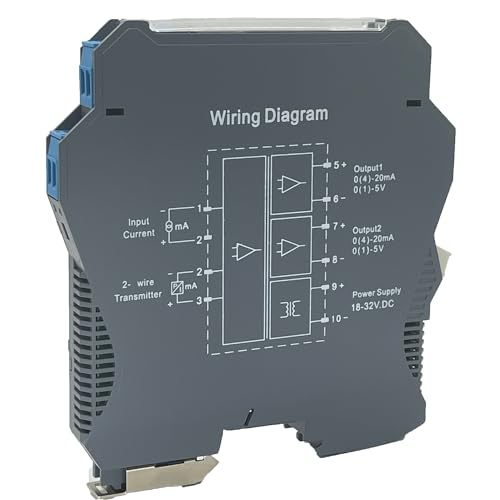
This single-channel, dual-output isolator offers integrated signal isolation and can function as a temperature transmitter or as a distributor for 4-20 mA signals. It runs on DC24V with a defined input/output configuration and a compact footprint suitable for tight DIN rail spaces. It is a practical choice when two independent outputs are required from a single input.
Who it’s best for
Facilities with limited panel space that still need two isolated outputs for separate controllers or data loggers.
Why chosen
Its 3-in-1 design (isolator, distributor, and possible temperature transmitter) provides flexibility while maintaining isolation and simplicity in installation.
Limitations to note
One-in, two-out is common; ensure the load resistance and supply compatibility match the application’s current loop requirements.
ANGGREK 4-20mA Splitter (One In, Two Out)

The Anggrek unit provides a simple, compact solution for splitting one 4-20 mA signal into two isolated outputs. It emphasizes high-quality components and multi-channel potential, making it suitable for installations needing incremental expansion without overcomplicating the signal path. It is a practical option for basic two-output needs with good reliability.
Who it’s best for
System integrators seeking an economical, reliable 4-20 mA split to two destinations without extensive configuration.
Why chosen
The device emphasizes precision and isolation, helping to prevent interference in sensitive measurement circuits.
Limitations to note
It is described as one-in, one-out in some listings; confirm the exact output count before purchasing for a given panel layout.
Automation Systems Interconnect 4-20mA Splitter (1 In / 2 Isolated Out)
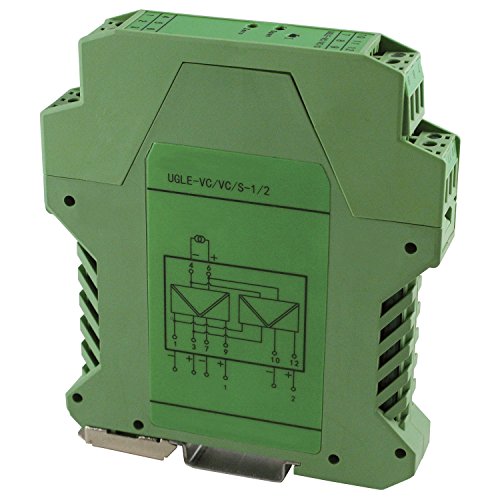
This splitter provides one input and two isolated outputs with features like zero and span adjustment for calibration and three-way isolation to reduce interference. It is well-suited for users who require precise external calibration and greenfield control panel expansion without sacrificing signal integrity.
Who it’s best for
Engineers needing adjustable calibration and a straightforward two-output isolation path for robust process monitoring.
Why chosen
Zero/span adjustments enable better alignment to process sensors, improving measurement accuracy across controllers.
Limitations to note
Calibration controls require careful handling; misadjustment can affect loop accuracy if not properly set.
Buying Guide: Key Considerations For 4-20 mA Splitters
- Isolation level: How many ways does the device isolate input from outputs? Higher isolation protects against ground loops and noise in demanding environments.
- Output configuration: Do you need one-in/multiple-out, multiple-in/multi-out, or dual isolated outputs? Match to your I/O scheme.
- Calibration options: Can you adjust zero and span to fine-tune signal accuracy for your sensors?
- Power supply requirements: Most units run on DC 24V; confirm voltage tolerance and current draw for your cabinet power budget.
- DIN rail compatibility: Ensure the physical form factor fits your control cabinet and mounting space.
- Environmental suitability: Look for devices designed to resist vibration, dust, and EMI in industrial settings.
- Cost vs. benefit: Balance the cost of isolation, output count, and calibration features against system reliability needs.
- Ease of integration: Prefer models with straightforward wiring and clear documentation to speed installation.
Quick comparison snapshot
- Best for multiple outputs from a single input: Lelukee 4-20mA 2 In / 4 Out.
- Best for strong isolation in noisy plants: ASI451145 3-Way Isolation.
- Best for compact DIN rail layouts: Lelukee 2 In / 2 Out.
- Best budget-friendly two-out option: ANGGREK 4-20mA Splitter (One In, Two Out).
- Best with calibration focus: Automation Systems Interconnect 1 In / 2 Isolated Out.
FAQ
- What is a 4-20 mA splitter used for?
It distributes a single current loop signal to multiple devices while preserving signal integrity and isolation. - Do these devices require special calibration?
Some offer zero/span adjustments; others rely on fixed calibration. Check the model’s documentation for setup steps. - Can I use any 4-20 mA splitter with any sensor?
Most are compatible with standard 4-20 mA loops, but confirm input/output ranges, load resistance, and supply voltage. - Is isolation always necessary?
Isolation protects controllers and power systems from interference and ground loops in noisy environments. - What mounting options exist?
DIN rail mounting is common for industrial cabinets; ensure the chosen device fits your panel space. - Are there safety considerations?
Ensure devices meet plant safety standards and are installed by qualified personnel to avoid electrical hazards.