Best 320 W Solar Panels for Homes and RVs: Top 5 Picks
Finding the right 320 W solar panel set for your home, RV, or boat means balancing efficiency, durability, and space. This guide highlights five top 320 W options from Renogy, chosen for high efficiency, reliable build quality, and strong performance in challenging environments. Ideal buyers include homeowners expanding grid-tie or off-grid systems, RV enthusiasts seeking dependable power, and small- to medium-scale installers aiming for scalable, high-output arrays.
Overview of selected products:
| Product | Best For | Why It Stands Out |
|---|---|---|
| Renogy Solar Panels 640 Watts 18BB N-Type (2x320W) | Rooftop installs and RVs needing reliable 640W pair | Dual 320W with 25% efficiency, robust 18BB N-Type design |
| Renogy 320W Solar Panels 4PCS (Total 1280W) | Larger off-grid systems, roof or ground mounts | Multiple panels, high efficiency, EL certified |
| Renogy Solar Panels 2PCS 320W (640W) | Small to mid-size off-grid or backup systems | Two-panel kit, strong 25% cell efficiency |
| Renogy Solar Panels 1280W (4PCS 320W) | Expanded installations for homes or farms | Higher total wattage with IP68 weatherproofing |
| Renogy Solar Panels 640 Watts 12V/24V (2x320W) | Versatile 12V/24V systems for homes or RVs | Bifacial option with up to 30% higher yield |
Renogy 640 Watts 18BB N-Type Panel Pair

This set uses an N-Type design with 18 busbars to minimize hot spots and improve performance under extreme conditions. With up to 25% cell efficiency and enhanced heat resistance, it delivers strong long-term output for homes, RVs, or boats. Best for buyers needing a compact, high-output dual-panel arrangement that fits standard mounting rails and provides reliable energy generation.
Who it’s best for: homeowners installing a rooftop array and RVers who want a robust, weatherproof solution. Why selected: the dual 320W arrangement offers expandable capacity without complex wiring. Caution: ensure your mounting hardware supports a 640W load and proper shading avoidance.
Renogy 320W Solar Panels 4PCS (Total 1280W)

This multiple-panel kit features 18BB N-Type cells and up to 25% efficiency per panel, delivering high daily output suitable for larger off-grid roofs or ground-mounted systems. Its EL certification signals safety in manufacturing and operation, with IP68-rated protection for harsh environments.
Best for: bulk installations where space allows several panels. Better for: installers seeking scalable capacity without replacing existing inverters. Choose this if you need a strong base for a higher-wattage system. Limitation: more space required and more wiring to manage than a single-pair setup.
Renogy 2PCS 320W Panels (640W)

Two 320W panels provide a compact, upgrade-friendly option for mid-sized off-grid or backup power systems. With 25% cell efficiency, better temperature tolerance, and IP68 rating, this setup supports steady energy production in varied weather. EL certification adds confidence in durability.
Best for: small cabins, RVs, or mid-scale roof installations. Better for: users who want to pair a modest system with a reliable, long-lasting solution. Caution: two-panel kits may require reconfiguring charge controllers for higher wattage, depending on system voltage.
Renogy 1280W 4PCS 320W Panels
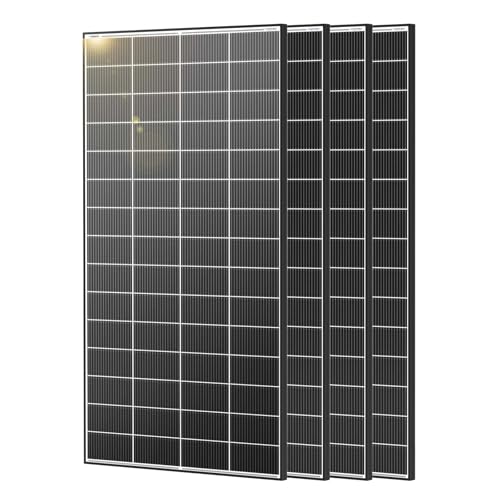
This 4-panel set totals 1280W, designed for larger 12/24V PV systems on homes or farms. It combines 18BB cells with IP68 weatherproofing and high efficiency to deliver consistent output across a sizable installation. Best for: expanding an existing system to meet higher energy demands. Better for: users prioritizing durability in exposed outdoor conditions. Caution: higher upfront wiring complexity and mounting requirements compared to smaller kits.
Renogy 640W Bifacial 2x320W Panels

This pair features a bifacial design that can capture sunlight from both sides, offering up to 30% higher energy yield under optimal conditions. It uses IP68-rated construction and a high-efficiency 18BB layout. Best for: systems with reflective surfaces or partial shading where extra yield matters. Better for: users needing space-efficient, high-output panels. Limitation: bifacial gains depend on installation height, tilt, and reflective surface presence.
Renogy 1920 Watt, 6PCS 320W Panels

This 6-panel configuration increases total system wattage to 1920W, ideal for larger off-grid installations or homes requiring substantial daytime energy. It combines 25% cell efficiency with IP68 protection and 18 busbars to reduce hot spots. Best for: expansive installs where space is available. Choose this if you need a ready-to-scale solution. Caution: larger arrays require more complex wiring and larger inverters/charge controllers.
Buying Guide: Key Considerations
- System voltage and configuration: Confirm whether your setup runs on 12V/24V or higher and ensure the panels match your inverter/charger setup.
- Efficiency and temperature tolerance: Look for 25% cell efficiency and robust temperature tolerance for reliable output in heat or cold.
- Busbar design: 18BB designs reduce hot spots and improve performance in harsh weather; this is common in Renogy 320W panels.
- Durability and weatherproofing: IP68 ratings and anti-corrosion coatings extend life in exposed environments.
- Installation footprint: Bifacial designs save space but require reflective surroundings; consider shading, tilt, and mounting clearance.
- Scalability: If planning future expansion, choose kits that align with a common mounting pattern and wiring approach.
- Safety certifications: EL certification and robust encapsulation help ensure long-term reliability.
Frequently Asked Questions
- What makes a 320W solar panel suitable for RVs? – High output in a compact footprint, with durable framing and good weather resistance for mobile use.
- Is bifacial technology worth it for a home installation? – It can increase yield if the installation has ample reflective surfaces and proper height, but gains depend on conditions.
- Do these panels require special inverters? – Not necessarily; verify your system voltage and ensure your inverter/charge controller supports the total wattage.
- What maintenance is needed for 320W panels? – Routine cleaning, inspection of seals and wiring, and monitoring output for changes that indicate edge or enclosure issues.
- Can I mix different 320W panels in one system? – It’s possible if wiring and voltage ratings are compatible; matching models helps ensure uniform performance.
- Are EL-certified panels safer? – EL certification indicates stringent safety testing in manufacturing and handling, which can reduce risk over time.