Best 30V 10A DC Power Supplies for Lab and DIY Projects
Need a reliable 30V, 10A DC bench power supply for electronics testing, repair work, or battery charging? This guide highlights five top options that balance precision, safety, and usability. Each unit is suitable for different user types—from students and hobbyists to technicians and professionals—so you can choose the best fit for your workflow. Below is a quick buyer’s table, followed by in-depth product profiles.
| Product | Best For | Why It Stands Out |
|---|---|---|
| Jesverty SPS-3010 | Hobbyists and students | 4-digit CV/CC display, precise auto CV/CC switching |
| NICE-POWER 30V 10A | Probing and lab work | High-resolution readouts, secure output with memory-safe features |
| NANKADF 30V 10A (Encoder) | Precision tuning | Encoder knob for digit-by-digit control, output enable/disable |
| Kungber 30V 10A | Safe charging and data/USB tasks | Intelligent charging mode, 18W USB, OCP alarm |
| WANPTEK TPS-C3010 | Repair technicians and labs | Memory presets, encoder control, OCP protection |
Jesverty DC Power Supply Variable, 0-30V 0-10A

The Jesverty SPS-3010 offers a 0–30 V, 0–10 A adjustable output with a 4-digit LED display showing voltage, current, and power in real time. It switches automatically between constant-voltage (CV) and constant-current (CC) modes as the load changes, making it a solid pick for bench work that involves varying loads. Best for students and hobbyists who value clear readouts and straightforward CV/CC operation. A potential limitation is that the switching threshold is fixed by the preset volt-amp crossover, which users should account for during sensitive experiments.
NICE-POWER DC Power Supply Variable 30V 10A

The NICE-POWER model delivers precise control with a 0.01 V / 0.001 A display and real-time readouts of voltage, current, and power. It includes an OUTPUT switch to quickly enable/disable power without removing the load and features robust safety protections. This unit is well-suited for professional labs where quick isolation of the output is important to protect circuits during testing. One caveat is that it is designed primarily for 110 V input, so you should ensure the input supply is compatible in your environment.
NANKADF DC Power Supply Variable 30V 10A (Encoder)

The NANKADF unit emphasizes precision with a high-accuracy encoder knob for digit-by-digit voltage/current tuning and an Output Enable/Disable button to prevent accidental load damage. It also offers overcurrent protection with audible beeps to alert users. Choose this if you require tight control for sensitive electronics tests, but be aware that the encoder-centric interface may require a moment to familiarize yourself with the button placements and beep feedback.
NANKADF 30V 10A With Encoder and USB Quick-Charge
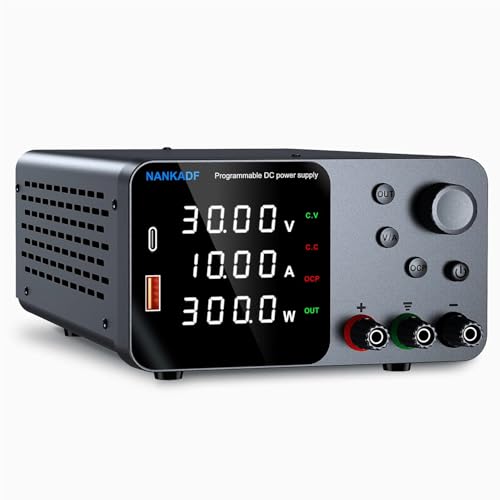
This model combines a precise encoder with a USB Type-C fast-charging port, making it convenient for charging devices while you test circuits. It provides an Output Enable/Disable button and overcurrent protection to safeguard both the power supply and attached equipment. It is well-suited for repair work where you need power for test equipment and charging devices in one compact package. A limitation to consider is that some users may find the encoder knob a bit stiff initially, requiring a brief acclimation period.
WANPTEK DC Bench Power Supply 30V 10A

WANPTEK TPS-C3010 provides 0–30 V and 0–10 A with memory presets, encoder control, OCP protection, and a four-digit LED readout. It’s designed for technicians and engineers who need repeatable setups across multiple tests, plus quick recall of common configurations via M1/M2/M3 presets. A potential drawback is beeping feedback during adjustments, which users can mute by long-pressing the encoder knob if desired.
WANPTEK DC Power Supply Variable 0-30V 0-10A

This WANPTEK model features coarse and fine encoder knobs for precise voltage and current control, plus a USB Type-C fast-charge port for auxiliary device charging. It includes an Output Enable/Disable button and OCP protection to prevent damage during testing. Choose this if you want high-resolution control combined with charging capabilities in a compact chassis. A note: the unit emphasizes encoder-based input, which may require a short adjustment period for new users.
Buying Guide: How To Pick The Right 30V 10A DC Power Supply
- Output range and resolution: Look for a unit that provides full 0–30 V and 0–10 A with a high-resolution display (0.01 V / 0.001 A or better) for precise tuning.
- Display and readouts: Four-digit LED displays are common and offer real-time V, I, and P readings. Backlit displays help in dim environments.
- Protection features: Prioritize OCP (over-current protection), OVP (over-voltage protection), OTP (over-temperature protection), and short-circuit alarms to protect both the supply and connected devices.
- CV/CC auto-switching: If you work with varying loads, an automatic CV/CC transition reduces risk of overcurrent or overvoltage during tests.
- Usability: Encoder knobs for precise digits, output on/off quick controls, and memory presets for common configurations save time during repairs or experiments.
- USB/Type-C charging: USB fast-charge ports are helpful when you need to power test devices or charge components during bench work.
- Safety and compatibility: Ensure the unit’s input voltage aligns with your region (110 V in the US is common) and that the enclosure and cooling are adequate for your usage.
- Physical footprint: If space is limited, compare dimensions and weight; some units balance compact design with full capability.
Frequently Asked Questions
- What is the typical use for a 30V 10A bench power supply?
– They provide adjustable voltage and current for electronics testing, circuit debugging, and battery charging in labs, repair shops, and DIY projects. - Do all 30V 10A supplies include CV/CC modes?
– Most do, with automatic switching based on load current. This helps maintain safe operation as you test different components. - Is a USB-C port essential on a bench power supply?
– Not essential, but convenient for charging devices or powering auxiliary test gear without using another wall outlet. - What protection features should I prioritize?
– Over-current protection (OCP) and over-voltage protection (OVP) are important, along with short-circuit detection and over-temperature protection for reliability. - Can I use these supplies for charging batteries?
– Some models include intelligent charging modes and Ah/Ah-in charging displays, which can help monitor battery status but always follow manufacturer guidelines for safe charging. - How important are memory presets?
– Presets are helpful for quickly restoring common test configurations, improving workflow efficiency in labs and repair shops.