Best 3000 Watt Propane Generators for Home Backup and RVs
Answer: If you need a propane-compatible generator around the 3000–3600 watt range, these models offer dual-fuel flexibility, quiet operation, and clean power suitable for sensitive electronics. They are best for small home backup, RV camping, and emergency power in neighborhoods where noise matters. The top picks below balance portability, runtime, and inverter efficiency for safe electronics charging.
| Product | Fuel Type | Best For | Why It Stands Out |
|---|---|---|---|
| WEN DF360iX | Gas/Propane | Home backup, RV owners needing quiet power | Dual-fuel, 3600 surge watts, CO watchdog, clean power for sensitive devices |
| PowerSmart 3800W | Gas/Propane | Quiet camping and long outages | High starting watts, long propane runtime, advanced inverter with clean power |
| Westinghouse iGen2800DFc | Gas/Propane | Portable use in parks and cabins | Lightweight, Eco Mode for fuel savings, multiple outlets |
| LIFAN 3500W | Gas/Propane | RV trips and small offices on the road | Low noise, compact, good for sensitive electronics |
| Champion 4000W Dual Fuel | Gas/Propane | Backup power with room to grow | Quiet technology, warranty, parallel-ready |
Note: Each option provides inverter-style clean power with low total harmonic distortion to protect electronics. Consider runtime on your chosen fuel, noise level at your typical location, and whether you’ll ever need to parallel multiple units for extra power.
WEN DF360iX Dual-Fuel Inverter (3600 Surge / 2900 Running)

The WEN DF360iX offers dual-fuel versatility with gas and propane. It provides 3600 surge watts and 2900 running watts on gas, and 3500 surge watts and 2600 running watts on propane. Its inverter design delivers clean power, suitable for charging smartphones, laptops, and tablets. This model is best for campers who want quiet operation and reliable backup power for essential electronics. Caution: Economy-fueled runtime can vary with load and fuel quality. Consider adding a propane bottle scale for precise fueling needs.
PowerSmart 3800W Dual Fuel Inverter
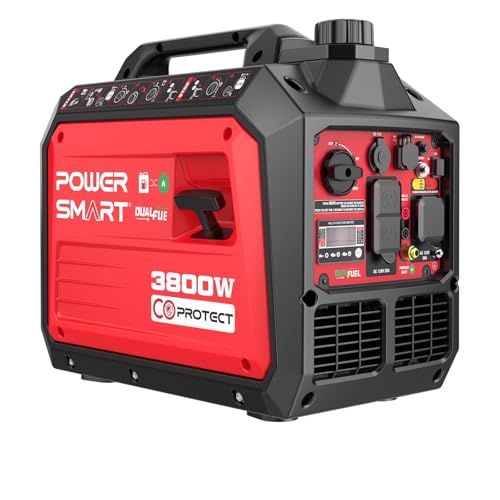
The PowerSmart unit provides 3800 starting watts and 3300 running watts on gasoline, with propane at 3500 starting and 3100 running watts. It runs up to 10 hours on gasoline and up to 25 hours on propane. Its inverter system ensures pure sine wave output with less than 3% THD, protecting sensitive devices. It’s ideal for quiet residential use and camping where long runtimes are needed. Choose this if you prioritize prolonged propane operation and minimal noise, but note that peak power varies with fuel selection.
Westinghouse iGen2800DFc Dual Fuel

The Westinghouse iGen2800DFc delivers 2,800 watts peak and 2,200 watts running on gasoline, with 2,520 watts peak and 1,980 watts running on propane. It runs up to 12 hours at 25% load and weighs about 45–50 pounds, making it portable for camping or small-home backup. Its Eco Mode trims fuel use and noise, which helps in neighborhoods or RV parks. Best for those who want light weight and straightforward operation, but it may be limited for higher-power needs without a second unit.
WEN DF480iX Dual-Fuel Inverter (4800 Surge / 4000 Running)

The WEN DF480iX expands to 4800 surge watts and 4000 running watts on gasoline, with propane capability at similar levels. It is among the quieter options, designed for families needing more power while maintaining low noise. This model suits larger RV setups or home backup needs where extra headroom is beneficial. Limitation: higher power comes with bigger footprint and weight, reducing portability compared to smaller models.
Champion 4000W Dual Fuel RV Ready

The Champion 4000-Watt Dual Fuel unit offers 4000 starting watts and 3000 running watts on gasoline, with 2700 running watts on propane, plus a CO Shield shutdown. It’s light for its class and supports parallel operation with other Champion units. Best for users who want reliable power with a manageable footprint and the option to double output with a parallel kit. Limitation: propane performance may be lower under heavy load compared to gasoline, so plan fuel sources accordingly.
Buying Guide
What to consider when choosing a 3000–3600 watt propane generator
- Fuel flexibility: Dual-fuel models allow propane and gasoline, aiding fuel availability during outages.
- Power needs: Match starting and running watts to essential devices plus potential expansion through parallel kits.
- Inverter quality: Look for Pure Sine Wave output with low THD to protect electronics.
- Noise level: Quiet operation is important for camping, neighborhoods, and RV parks.
- Run time: Propane tends to offer longer runtimes; assess fuel storage and consumption for your use case.
- Portability: Weight and handle design affect how easily you move the unit around a yard or campground.
- Outlets and safety: Check outlets, CO detectors, and automatic shutoff features for safety.
Practical questions buyers often ask
- Can a 3000–3600 watt generator power a whole-home backup? Typically sufficient for essential circuits and appliances, not a full home unless you add more units or use a transfer switch with careful load management.
- Is propane a reliable fuel for generators? Propane stores cleanly, has long shelf life, and is readily available in many regions, but energy density is lower than gasoline, affecting runtime under heavy load.
- Should I choose a dual-fuel or single-fuel generator? Dual-fuel provides flexibility during fuel shortages; single-fuel models can be simpler and lighter.
- What does THD mean for a generator? Total Harmonic Distortion indicates power quality; lower THD (typically under 5%) is safer for electronics.
- Is parallel capability important? If you anticipate needing more power, a parallel-ready model allows pairing with another unit.
- Do inverters produce the same power as traditional generators? Inverters provide cleaner power with better efficiency, ideal for sensitive electronics, though some models have lower peak outputs.
Quick references for shoppers
- Best for ultra-quiet operation and sensitive electronics: WEN DF360iX, PowerSmart 3800W, Westinghouse iGen2800DFc.
- Best for longer propane runtimes: PowerSmart 3800W and Champion 4000W depending on load.
- Best for expandability: Champion 4000W with a parallel kit option.
Frequently asked questions
- What is the typical noise level of these generators? Most models target around 52–64 dBA at a moderate distance, depending on load and model.
- What outlets should I expect? Common outlets include 120V household outlets, RV outlets, and USB ports on some models.
- Are these generators safe for laptops and phones? Yes, inverter generators with clean power and low THD protect sensitive electronics when used properly.
- Can I run a refrigerator or CPAP on propane? Yes, if the unit’s running watts meet or exceed the appliance’s startup watts and running watts.
- Do these units include automatic CO shutdown? Some models offer CO sensors with auto shutoff; verify features per model.