Best 30 Watt Solar Attic Fans for Smart, Sun-Powered Cooling
Find the right 30 watt solar attic fan to reduce attic heat, lower cooling costs, and support HVAC performance. This guide highlights five top options and clarifies who each is best for. Most are ideal for homeowners seeking off-grid cooling, with variations for night operation, humid climates, and large attics.
The following table summarizes the featured products, focusing on best-use cases and notable strengths to help you compare quickly.
| Product | Best For | Key Benefit |
|---|---|---|
| Remington Solar 30 Watt Roof Mount Solar Attic Fan | General homes with sunny roofs | Built-in humidistat/thermostat; hybrid adapter for night operation |
| Remington Solar “Builder Series” 30 Watt Solar Attic Fan | Attics needing 24/7 cooling | Includes 110V adapter for automatic night operation; built-in humidistat/thermostat |
| PATIOASIS Solar Attic Fan 30W | Large areas up to 2,800 sq ft | Self-activating sunrise to sunset; 2000 CFM; no remote required |
| PEAKROCK 30W Solar Attic Vent Fan | High airflow in big spaces | 2000 CFM; dual-axis mounting; robust durability |
| DC HOUSE 32 Watt Solar Attic Fan | Weather-prone locations; up to 3,000 sq ft | Durable shell; 2400–3000 CFM range; reliable in hail/wind |
Remington Solar 30 Watt Roof Mount Attic Fan

The Remington Solar Roof Mount Attic Fan is powered entirely by solar energy and designed to reduce attic heat while supporting HVAC efficiency. Best for homeowners with direct sun exposure who want automatic humidity and temperature-responsive airflow. The included humidistat and thermostat help optimize attic conditions. A hybrid adapter (sold separately) enables night operation, which is useful in hot climates. Caution: ensure your roof area has adequate sun exposure for maximum performance.
Remington Solar “Builder Series” 30 Watt Solar Attic Fan

The Builder Series model targets steady, automated cooling with a built-in humidistat and thermostat and includes a 110V adapter for night-time auto-run. It is best for homes where daytime solar power is abundant but there’s a desire for continuous attic airflow around the clock. The setup helps reduce moisture-related risks and HVAC load. Limitation: the adapter for night running may require surge protection to maintain warranty adherence.
PATIOASIS Solar Attic Fan 30W

Designed for large spaces, the Patioasis model delivers up to 2000 CFM from a 30W panel, covering up to 2,800 sq ft. It’s self-activating at sunrise and deactivating at dusk, making it a strong choice for energy-conscious homeowners who need significant air exchange without wiring complexity. Best for: big attics or workshops where daytime cooling is the priority. Limitation: turbulence may be noticeable at the edges due to high-speed rotation; verify airflow direction during installation.
PEAKROCK 30W Solar Attic Vent Fan

PeakRock offers a 30W solar attic fan with high airflow of 2000 CFM and a durable 12-inch alloy blade design. It is best for large, sunlit spaces requiring robust air exchange. The unit features a weatherproof, brushless DC motor and a 60,000-hour lifespan claim. A potential caution is that continuous performance can depend on direct sun; consider mounting for optimal sun exposure and note the lack of a remote control in this model.
DC HOUSE 32 Watt Solar Attic Fan
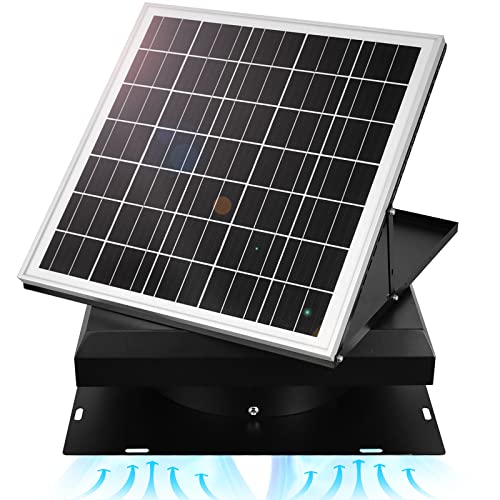
The DC House 32W model is designed for up to 3,000 sq ft spaces with 2400–3000 CFM. Its fully copper brushless motor and IP68 waterproof rating enhance durability in harsh weather. Best for homes in hail-prone or wet environments where robust weather resistance matters. Caution: performance can vary in heavy overcast days; while solar is primary, some users pair with backup ventilation in extreme climates.
iLiving Hybrid Ready 14″ Smart Solar Roof Attic Fan

The iLiving model adds a smart thermostat control with programmable temperature range and a 40W, 1150 CFM design. It supports a diversified setup with adjustable solar panel angles and a notable 15-year warranty claim in its data. It is best for buyers seeking a quick-to-install, app-free control option with added thermostat features. Limitation: not every installation requires or supports a full smart control system; evaluate your preferred control style.
Buying Guide: Key Purchase Considerations
- Attic size and airflow needs: Match CFM to square footage; larger spaces demand higher CFM and sometimes multiple fans.
- Sun exposure and roof type: Solar performance depends on direct sun; asphalt shingles vs metal roofs can influence mounting angles and efficiency.
- Control features: Humidistat, thermostat, and night operation adapters affect how proactively the fan manages moisture and temperature.
- Weather durability: Look for weatherproof motors and housings, especially in hail-prone or high-wind regions.
- Power versatility: Some models include 110V adapters for auto-run at night; consider whether you want off-grid operation only or dual power sources.
- Installation considerations: Dual-axis mounting improves solar capture; ensure compatibility with your roof structure and wiring plan.
- Noise and vibration: Brushless DC motors tend to run more quietly; check blade design and housing for reduced noise.
Frequently Asked Questions
- Do these fans require grid electricity? Most are solar-powered but some offer a night-time 110V adapter option.
- What size attic can a 30W fan cool effectively? It varies; up to about 2,800–3,000 sq ft in ideal sun conditions, depending on model and installation.
- Will a solar attic fan cool my entire house? It primarily reduces attic heat and supports HVAC efficiency; it’s most effective in reducing attic temperatures rather than cooling rooms directly.
- Is a humidistat important for attic fans? Yes, it helps regulate airflow based on moisture, reducing risk of moisture damage and mold in attic spaces.
- Can I install these on metal roofs? Yes, most models support various roof types, but mounting angles and hardware should be suitable for metal or other surfaces.
- Do solar attic fans work on cloudy days? Some models maintain airflow on low-light days, but performance drops without direct sun.