Best 3 Phase Voltage Protection Options for Industrial Systems
Find dependable 3-phase voltage protection tailored to your equipment and power system. This guide highlights five reliable options, describing who they’re best for and why each stands out. It covers universal voltage ranges, fast response, self-resetting features, and DIN-rail installation for easy integration into control panels. Suitable buyers include plant operators, electrical installers, and maintenance engineers seeking reliable protection for motors, pumps, and equipment across 176V to 552V or 208-480V systems.
| Product | Best For | Key Benefit | Limitations |
|---|---|---|---|
| Hyuduo 3 Phase Voltage Protection Relay | Industrial motors and pumps | Wide input range and clear LED status | Adjustments required for optimal thresholds |
| Hilitand 3 Phase Self Resetting Protector | Quick-response panels | DIN rail mounting, automatic reset | Basic indicators, no advanced diagnostics |
| ViaGasaFamido 3 Phase Voltage Protector | Compact control panels | Self resetting and DIN rail friendly | Standard protections may require tuning |
| Walfront STVP-935A 3 Phase Protector | Machine tool panels | Automatic reset, configurable thresholds | Manual/auto reset options may vary by model |
| SINOTIMER 3-Phase Adjustable Protector | Whole-house or subpanel protection | 6-in-1 LED display, automatic recovery | 80A rating may limit high-load systems |
Hyuduo 3 Phase Voltage Protection Relay
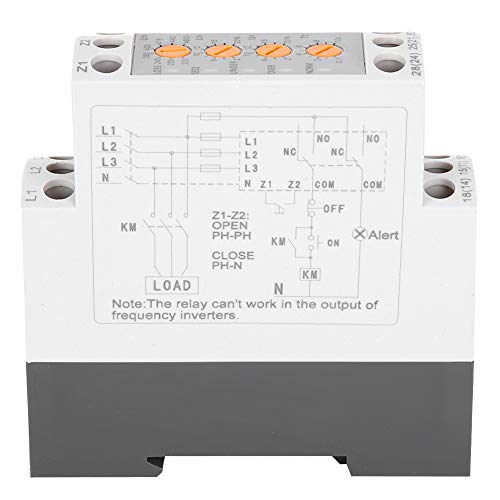
This unit supports a wide input range of 176V to 552V, enabling compatibility with diverse power systems. It provides protection against overvoltage, undervoltage, and voltage unbalance with adjustable thresholds (2-20%) and action delays (0.1–10s). Five LED indicators give quick status visibility. Best for: plants needing broad compatibility and clear fault status in motor or pump circuits. Caution: tuning thresholds is essential to avoid nuisance trips in fluctuating mains.
Hilitand 3 Phase Self Resetting Voltage Current Protector

Designed for DIN rail installation, this protector offers automatic reset and rapid response with real-time voltage and current display. It auto-cuts power during overload to protect equipment and restores normal operation when within range. Best for: panel builders seeking fast recovery and straightforward installation. Caution: automatic reset may re-energize a fault condition if the issue persists; verify wiring and thresholds after events.
ViaGasaFamido 3 Phase Voltage Protector

This 3-phase protector emphasizes DIN-rail mounting for stability and ease of use. It provides automatic self-resetting operation to prevent prolonged outages and displays real-time voltages and currents. Best for: technicians needing a compact, quick-install protector with automatic recovery. Caution: check compatibility with your panel’s DIN rail standards and confirm operation range for your load.
Walfront Voltage Phase Sequence Protector

This monitor offers 208–480V universal operation with six protections: overvoltage, undervoltage, phase failure, phase error, and voltage imbalance. It uses an LCD for easy fault interpretation and adjustable limits. Best for: control panels requiring clear voltage data and multi-function protection. Limitation: more complex parameter setup may require time during initial commissioning.
Buying Guide
What to consider when choosing a 3-phase voltage protection device:
- Voltage range: Ensure the unit supports your system voltage (e.g., 176–552V, 208–480V). Wider ranges handle more applications but may need tuning.
- Protection types: Look for overvoltage, undervoltage, and unbalance protections. Some models add phase failure, phase sequence, and imbalance monitoring.
- Response and reset: Self-resetting protectors minimize downtime; confirm whether automatic reset fits your operational requirements and safety standards.
- Installation method: DIN-rail mounting simplifies panel upgrades. Verify rail width and clearance in your control panel.
- Indication and diagnostics: LED indicators or LCD displays help operators quickly identify faults or abnormal conditions.
- Adjustment flexibility: Threshold and time-delay adjustability prevents nuisance trips and accommodates varying loads.
- Current rating: Ensure amperage ratings match or exceed the load, especially for motor starts or pumps with high inrush.
Frequently Asked Questions
- What is the main purpose of a 3-phase voltage protector? — It guards electrical equipment against voltage anomalies across all three phases, reducing the risk of damage.
- Do these devices require external power? — Most units operate off the measured voltage and do not need separate auxiliary power, though some have LCDs or displays powered from the circuit.
- Can I install these in consumer-grade panels? — Yes, many are designed for DIN-rail mounting in industrial control panels; ensure panel space and rail compatibility.
- What is the advantage of a self-resetting protector? — It quickly restores power after voltage normalizes, minimizing downtime, but verify that the fault has cleared to avoid repeating outages.
- How should I set protection thresholds? — Start with manufacturer-recommended defaults, then adjust gradually to balance protection with false-tripping risk in your environment.
- Is a higher current rating always better? — Not always; choose a rating that matches the protected load’s continuous current plus any inrush, to avoid nuisance trips or under-protection.