Best 3 Phase Socket Tester Options for Quick Phase Checks and Safe Wiring
Choosing the right 3 phase socket tester helps electricians and DIY enthusiasts verify phase sequence and motor rotation quickly and safely. This guide compares top models from reputable brands, highlighting voltage range, usability, and accuracy. Whether you need a compact tester for service calls or a robust tool for industrial panels, these picks cover a spectrum of needs.
| Product | Key Feature | Voltage Range | Notes |
|---|---|---|---|
| ATOPLEE 3 Phase Sequence Presence Rotation Tester | LED/Buzzer indicators | 60V–600V | Compact and portable |
| SM852B 3 Phase Sequence Rotation Tester | LED + Buzzer | 60V–600V | Simple, efficient |
| IDEAL Electrical 61-521 3-Phase Tester | Carrying case + leads | Up to 600V | Durable and complete kit |
| UNI-T UT261A 3-Phase Rotation Meter | Multi-function auto range | 40V–690V | Compact with backlight |
| Amprobe PRM-6 Phase Sequence Tester | Non-contact, wireless rotation | Up to 700V | High-visibility indicators |
The following sections review five standout models. Each section presents a concise overview, notable features, and practical use cases to help you decide which tester fits your needs and working environment.
ATOPLEE 3 Phase Sequence Presence Tester
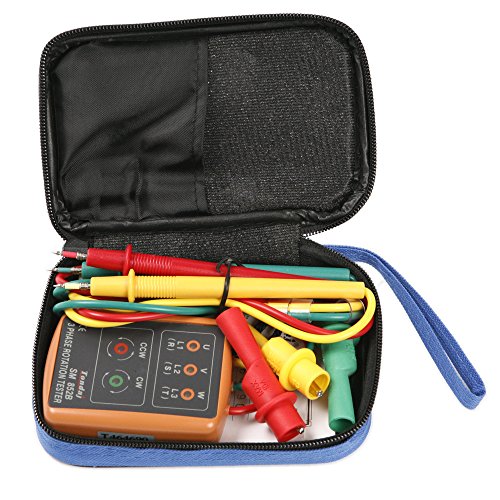
The ATOPLEE tester displays phase sequence presence and rotation with LED indicators and an audible buzzer, enabling quick diagnostics on 3-phase systems. It operates over a voltage range suitable for many field tasks and includes test leads up to about one meter long. The device is designed for 2000 V/min and supports a frequency range from 20 Hz to 400 Hz, making it versatile for various AC networks. This model emphasizes portability and ease of use in tight spaces or service calls.
SM852B 3 Phase Sequence Rotation Tester
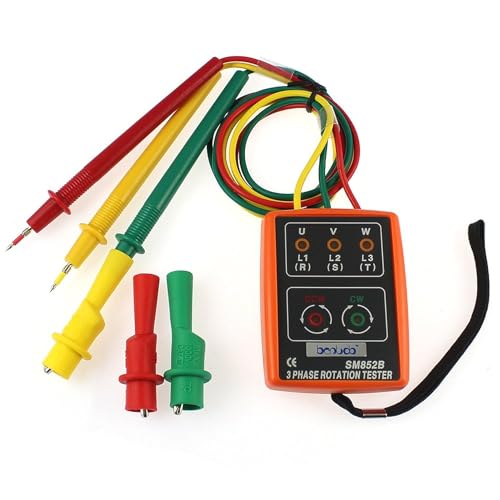
The SM852B from BESTDO provides sequence and rotation detection with LED and buzzer alerts, within a 60V–600V window and a 20 Hz to 400 Hz frequency range. It is specifically positioned as a compact, efficient tool for identifying opening phases and sequence without complex setup. This tester suits technicians needing a straightforward device that quickly confirms correct phase order in 3-phase systems.
IDEAL Electrical 61-521 3-Phase Rotation Tester

The IDEAL 61-521 tester is built for professional use, handling up to 600V and identifying three-phase sequence while also indicating when a motor is de-energized. It includes color-coded alligator clip leads and comes with a carrying case for transport. This model focuses on durability and convenience for field service tasks and job sites where organization matters as much as accuracy.
UNI-T UT261A 3-Phase Rotation Meter

The UNI-T UT261A combines phase sequence testing with general measurement capabilities, including resistance, capacitance, and frequency checks. It supports an AC voltage range up to 690V, with a 45 mm jaw opening for easy access to wiring. The unit is compact and designed for portability, making it suitable for both on-site and workshop tasks where quick verification is needed.
Amprobe PRM-6 Phase Sequence Tester

The Amprobe PRM-6 focuses on phase sequence and motor rotation detection for systems up to 700 V. It offers non-contact, wireless rotation detection on running motors and clear indicators for quick interpretation. This tester is well-suited for professionals who need to verify phase order safely on energized equipment and in higher voltage environments.
Buying Guide
Key considerations help tailor your choice to the work you do most often:
- Voltage range and phase coverage: Ensure the tester handles the maximum voltage in your typical installations. If you encounter up to 690–700 V, select a model with a higher limit.
- Indication method: LED indicators, buzzer alarms, or LCD displays affect readability in bright or tight spaces. LCD displays are helpful in noisy environments where hearing is difficult.
- Ports and leads: Look for testers that include durable test leads or alligator clips and a protective carrying case for field use.
- Multi-function capability: Some models offer additional measurements (resistance, frequency, etc.). Consider whether you need broader diagnostic features beyond phase rotation.
- Portability vs. robustness: Compact units are easy to carry between sites, while rugged builds suit heavy-duty environments and frequent drops.
- Safety and certification: Check CAT ratings and safety approvals to ensure compatibility with your regional electrical codes and standards.
- Ease of use: A straightforward interface with quick-reference indicators reduces setup time and operator error on job sites.
In practice, your choice balances voltage range, ease of use, and the kind of environments you work in. For quick on-site checks with basic phase sequencing, a compact LED/buzzer model often suffices. For higher-voltage tasks or environments with frequent motor testing, a more feature-rich tester with carrying case and robust leads provides long-term value.