Best 3 Phase Relay Switches for Industrial Control and Motor Loads
Ready to optimize three-phase control with reliable solid-state or monitoring relays? This guide highlights five solid options suited for industrial automation, CNC machines, HVAC systems, and heavy-duty motors. Best for budget-conscious projects, best for high-current loads, best for compact spaces, and best for precise monitoring—these picks cover common use cases and explain why each stands out.
Key product snapshot:
| Product | Type | Best For | Top Benefit |
|---|---|---|---|
| LCLCTC SSR-40AA | Solid State Relay | Heavy loads, high current | Broad AC input/output range |
| Baomain JGX-3340A | 3-Phase SSR | Industrial CNC and heaters | Pre-attached heat sink |
| LCLCTC SSR-25AA | Solid State Relay | Compact projects | 3-phase control with 25A |
| DPA51CM44 Walfront | 3-Phase Monitoring Relay | Motor protection & phase issues | Phase sequence and protection |
| Acogedor 3-Phase Sequence Relay | Monitoring Relay | Phase loss/sequence alerts | Compact monitoring option |
LCLCTC 3 Phase Solid State Relay SSR-40AA

- Features: AC to AC, with non-sparking, high switching speed, anti-corrosion, moisture-proof, anti-vibration, long life; electromagnetic compatibility.
Best for: Industrial loads requiring robust AC-to-AC switching with a 40A capacity. This unit is suited to motors and three-phase appliances where fast, quiet switching is essential. Caution: Ensure proper heat management and use a radiator if current approaches the upper limit.
BAOMAIN 3 Phase Solid State Relay 40A JGX-3340A

- Features: 3-phase control for heavy automation, universal 4-32VDC control, output 24-480VAC, pre-attached high-efficiency heat sink for thermal management.
Best for: CNC machines and industrial heaters needing reliable 3-phase switching with an integrated heat sink. Choose this if you want a ready-to-attach cooling solution. Caution: Verify control voltage compatibility with your controller (DC 4-32V).
LCLCTC 3 Phase Solid State Relay SSR-25AA
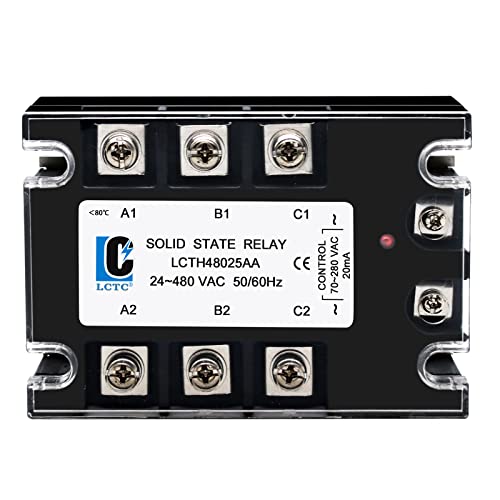
- Features: Three-phase relay, input 70-280VAC; output 24-480VAC; radiator recommended for higher currents.
Best for: Smaller three-phase control tasks where a compact 25A SSR fits the load profile. Consider this as a space-saving option compared to higher-current models. Caution: Heats up under heavier loads; plan cooling accordingly.
BAOMAIN JGX-3340A DC to AC 40A SSR

- Features: 3-phase control, DC control signal, 24-480VAC output, compatible with various industrial voltages; insulated copper base supports heat dissipation.
Best for: Projects needing DC control to switch 3-phase AC loads up to 40A. Choose this when your control logic provides a DC signal and you require reliable, fast switching. Caution: Not a voltage regulator; do not use to regulate supply voltage.
DPA51CM44 Walfront 3 Phase Monitoring Relay

- Features: Small size for easy installation, multi-functional with wide use in motors, elevators, HVAC, power systems; strong anti-interference performance.
Best for: Protection and monitoring of three-phase motors where phase sequence integrity is critical. Choose this when you need reliable detection of phase loss or sequence issues to prevent motor damage. Caution: This is a monitoring relay, not an SSR switch.
Acogedor 3-Phase Sequence Relay

- Features: Phase sequence and phase loss monitoring; compact IP20 rated housing; intended for motor and power system protection.
Best for: Environments where simple phase sequence monitoring is required to guard motor operations. Choose this if you need a compact, dedicated monitoring relay to alert on incorrect phasing. Caution: Verify electrical clearance and compatibility with your control system.
Buying Guide: Key Considerations for 3-Phase Relays
- Current rating vs. load: Match SSR or relay current rating to the actual motor or load current. Oversizing may improve longevity; undersizing risks overheating or tripping.
- Control voltage compatibility: Ensure the DC or AC control input matches your controller output. Some models offer wide input ranges (e.g., 4-32V DC).
- Thermal management: High-current SSRs often need heat sinks or radiators. Consider forced cooling for continuous operation.
- Switching speed and noise: SSRs provide fast, quiet switching without sparking, beneficial for DC or high-frequency switching needs.
- Monitoring vs. switching: Use monitoring relays to detect phase loss or sequence issues; use SSRs to actively switch loads.
- Physical footprint: If space is limited, prefer compact SSRs with integrated cooling or smaller DIN-rail friendly designs.
- Electrical protection: Look for units with anti-interference and EMC considerations, especially in industrial environments.
- Warranty and support: For critical industrial applications, consider suppliers with clear documentation and post-purchase support.
FAQ
- What is a 3-phase SSR used for?
– It switches three-phase AC loads with high speed and low noise, suitable for motors and heavy machinery. - Do I need a heat sink for a 40A SSR?
– Yes, high-current operations often require an attached or external heatsink to maintain safe temperatures. - What’s the difference between a monitoring relay and a solid-state relay?
– A monitoring relay detects faults like phase loss or sequence issues; an SSR actually switches power to the load. - Can DC control signals drive a 3-phase SSR?
– Many 3-phase SSRs support a DC control input within a specified voltage range (e.g., 4-32V). Check the product specs. - Is phase sequence protection necessary for motors?
– For some motors, yes; incorrect phasing can cause damage or inefficiency, so a monitoring relay can prevent issues. - When should I avoid using an SSR?
– If a simple on/off mechanical switch suffices, or if the application requires precise analog control of voltage or current, an SSR may not be appropriate.