Best 3 Gallon Vacuum Chambers for Resin, Wood Stabilization, and Degassing
Answering buyers who want a compact, reliable 3 gallon vacuum chamber for resin casting, silicone work, or wood stabilization: these five models stand out for durability, airtight seals, and practical features that aid precision and consistency. This guide helps you choose by outlining who each product is best for, why it was selected, and any notable limitations to watch for.
Summary of chosen products
| Product | Best For | Key Advantage |
|---|---|---|
| VIVOHOME 3 Gallon Vacuum Chamber | Detailed resin casting and degassing | Solid pump with multiple adapters for flexibility |
| VEVOR 3 Gallon Vacuum Chamber | General degassing, silicone and resin work | Reliable pump with cooling for long tasks |
| VEVOR 3 Gallon Upgraded Lid | High-use projects requiring visibility | Tempered glass lid and robust chamber |
| BACOENG 3 Gallon Tempered Glass Lid | Resin and epoxy defoaming | Acrylic crystal lid with strong airflow |
| BACOENG 3 Gallon Kit | Precision resin degassing | Complete kit with well-sealed design |
VIVOHOME 3 Gallon Vacuum Chamber With Pump

The VIVOHOME model uses a 3.5 CFM single-stage vacuum pump, powered by a 1/4 HP copper motor. It can reach down to 5 Pa and includes multiple inlet adapters for versatility: 1/4″ SAE and 1/2″ ACME, plus additional adapters for various hose configurations. The chamber is 1 mm thick 304 stainless steel with a 0.55 inch acrylic lid, a pressure gauge, and an airtight seal created by a gasket and silicone o-ring. This setup is best for buyers who need a robust, all-in-one unit for resin casting or epoxies and want built-in measurement feedback. Better for those prioritizing accurate vacuum tracking and multiple connection options. A potential limitation is the reliance on a single-stage pump, which may warm with extended use and may not match multi-stage systems in ultra-deep degassing scenarios.
VEVOR 3 Gallon Vacuum Chamber With Pump
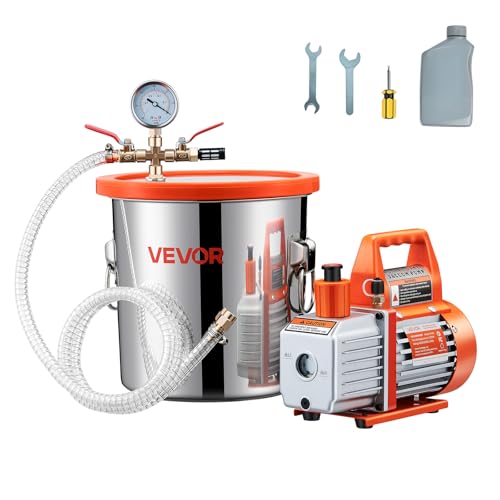
The VEVOR configuration emphasizes a 3.5 CFM pump and a 5 Pa ultimate vacuum, suitable for silicone, resin, wood stabilization, and general de-bubbling. It includes a tempered or durable chamber design with stainless steel integrity and a glass lid to monitor progress. The built-in cooling fan helps prevent overheating during longer degassing sessions, making it a solid choice for frequent, steady use. This option is best for buyers who need a dependable workflow with longer run times and reliable temperature management. A caveat is that long sessions may still require attention to venting and gauge stability, depending on ambient conditions.
VEVOR 3 Gallon Vacuum Chamber, Upgraded Lid
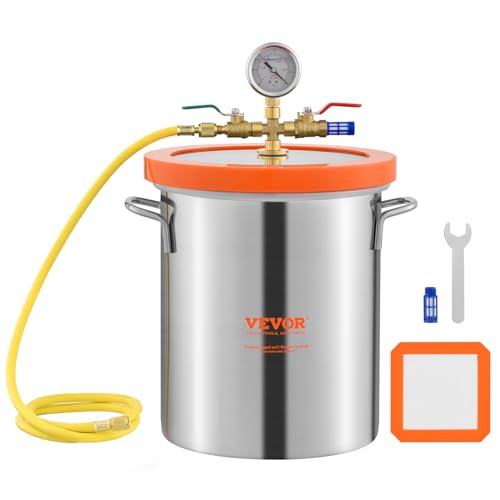
This version emphasizes a 3-gallon stainless steel chamber with a corrosion-resistant, upgraded tempered glass lid. It supports a max vacuum of about -29 inHg, and the design includes a leak rate around 5% over 12 hours in testing. This makes it a good pick for long-running projects in resin or silicone work where consistent, airtight sealing is essential. Choose this if you value long-term airtight performance and a sturdy stainless-steel body, but be aware of potential minor leaks if the lid seal is not properly seated after frequent use.
BACOENG 3 Gallon Tempered Glass Lid Vacuum Chamber
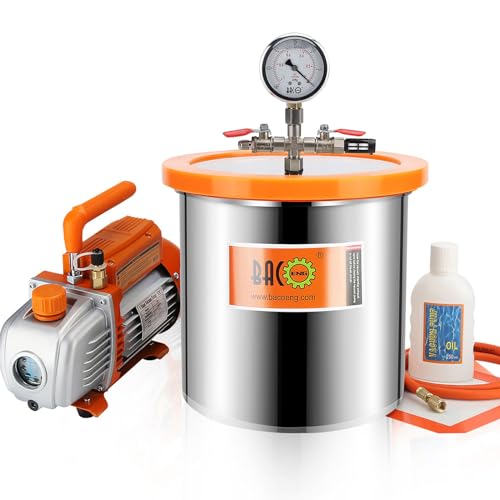
With a tempered glass lid and a stainless steel chamber, this BACOENG model provides a 3.6 CFM pump delivering -29.92 inHg, and a gasketed seal designed for durability across repeated uses. The tempered lid offers high visibility during degassing, which helps users adjust speed and duration precisely. Best for resin or essential oil projects where you want clear observation and a robust seal. A potential limitation is that the unit’s gasket life depends on usage frequency and cleaning; over time the gasket may require replacement to maintain airtight performance.
BACOENG 3 Gallon Vacuum Chamber Kit

This BACOENG kit emphasizes a 3.6 CFM vacuum pump paired with a 3-gallon stainless steel chamber and a direct 1/4″ SAE hose connection. The kit layout favors resin and silicone degassing while limiting noise. It is best for buyers who want a compact, ready-to-use package with a clear gauge range and direct hose compatibility. Limitation to note: the data suggests long-term gasket durability should be monitored given frequent cycling in active degassing tasks.
PB Motor Tech 3 Gallon Stainless Vacuum Chamber

The PB Motor Tech BMT unit features premium stainless steel construction, tempered glass lid for visibility, and glycerin-filled gauge for high precision (0.5 inHg accuracy). The design aims for silent operation with two silencers to reduce gas release noise, which is useful in workshop environments that require lower ambient sound. This option is best for buyers seeking precise vacuum control and a quieter degassing workflow. A limitation is that the silent features primarily address noise, not necessarily overall ease of use in extremely tight spaces or with very large batches.
Buying Guide: Key Purchase Considerations
- Chamber material: Stainless steel chambers resist corrosion and deformation, ideal for resin, silicone, and essential oils. Tempered glass lids provide visibility but can be more fragile than metal lids.
- Vacuum pump performance: Look for 3.5 CFM or similar ratings and a vacuum level near -29 to -30 inHg for effective degassing. Single-stage vs. multi-stage pumps affect deep degassing capability and heat buildup.
- Lid and seal: A gasketed silicone seal and a well-fitting lid are crucial for airtight operation. Gaskets should tolerate repeated use without significant degradation.
- Gauges and measurement: Glycerin-filled or oil-filled gauges with dual scales (inHg and bar) provide more stable readings during vibration. Accuracy around ±2.5% or better is desirable for precise degassing.
- Observability: Lids made of tempered glass or clear acrylic help monitor the degassing process without opening the chamber, reducing the risk of air ingress.
- Noise and heat management: Pumps with cooling or built-in silencers help maintain a comfortable work environment, especially for longer sessions.
- Compatibility: Ensure hoses and adapters match common sizes (1/4″ SAE, 1/2″ ACME) to avoid bottlenecks in workflow.
Frequently Asked Questions
- What can a 3 gallon vacuum chamber be used for?
– Resin casting, silicone degassing, wood stabilization, and essential oil processing are common uses, especially when space is limited. - Is a tempered glass lid better than a solid metal lid?
– A tempered glass lid offers visibility during degassing, which helps with process control, but it may be more prone to impact damage than metal. - Do I need a multi-stage pump for degassing?
– For most small-scale projects, a high-quality single-stage pump with good vacuum levels (around 5 Pa) is sufficient, but multi-stage pumps can achieve lower pressures and faster degassing for demanding tasks. - How important is the gauge accuracy?
– Gauge accuracy matters for precise degassing cycles and repeatable results; a glycerin-filled gauge with tight tolerances reduces drift during operation. - What maintenance is required for gaskets?
– Regular inspection and cleaning of gaskets extend airtight performance. Replace worn gaskets to maintain a strong seal.