Best 3 Ft Electric Baseboard Heaters for Small Rooms
Choosing the right 3-foot electric baseboard heater depends on room size, installation requirements, and safety features. This guide highlights five compact 3 ft baseboard heaters, ideal for bedrooms, offices, and small living areas. The top picks are selected for reliability, ease of installation, and consistent heat delivery. The buyer types best suited for each product are noted to help you compare options quickly.
| Product | Voltage / Wattage | Key Benefit | Best For |
|---|---|---|---|
| Cadet F Series 3 ft | 240/208V • 750/563W | Convection heat and universal wiring | Medium-sized rooms needing reliable warmth |
| King 3K1207BW | 120V • 750W | Crushproof element with safety cutout | Small to medium rooms with 120V supply |
| King 3K2407BW K Series | 240/208V • 750-563W | Aluminum ribbon fin element, full safety cutout | Mid-sized spaces requiring flexible wattage |
| Comfort Zone CZ600 | 1500W (2 heat settings) | Adjustable thermostat, whisper-quiet operation | Quiet spaces like bedrooms and offices |
| Cadet Baseboard Ul 120V | 120V • 500W | Remote control and simple floor mounting | Small rooms needing basic control |
Cadet F Series 3 ft Electric Baseboard Heater
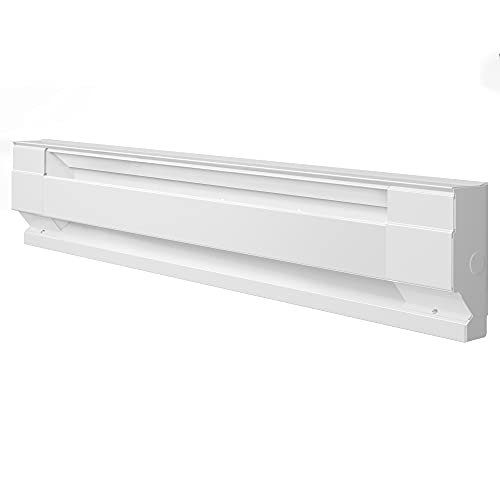
Prospective buyers: this Cadet model is best for users needing flexible wattage and easy wiring. It offers multi-watt capabilities (750/563 watts) and supports 240/208-volt circuits, making it suitable for apartments or homes with higher electrical capacity. The unit uses convection to distribute warmth, which helps maintain a steady temperature with minimal noise. A key caveat is that installation requires margin consideration for pre-punched knockouts and proper electrical supply planning.
King 3K1207BW 750-Watt 3-Foot Baseboard Heater

Best for 120-volt homes or spaces with standard household circuits. This unit emphasizes safety with a full-length safety cutout and a crushproof element, making it a practical choice for bedrooms or office corners where child safety and durability matter. Limitations include limited wattage options at a single voltage, so it may not meet higher heat needs in very cold climates.
King 3K2407BW K Series Baseboard Heater

The 3K2407BW K Series provides a flexible 750-563W range in 240-208V. This makes it well-suited for homes with higher power availability or for rooms that require supplementary corner heating. It uses an aluminum ribbon fin element and a full-length safety cutout, which enhances durability and safety. Choose this if you need adjustable heat output in a 3-foot form factor; otherwise, consider 120V options for simpler wiring.
King Electric 3K2407A 3 ft K Series Baseboard Heater

Best for homes needing durable 240/208V heating with robust safety features. The 3K2407A mirrors the 3K2407BW in build quality with an aluminum ribbon fin element and full-length safety cutout. It is a strong choice for multi-room layouts where 3-foot heaters must endure daily use. A potential limitation is higher installation complexity on 240V circuits that require professional electrical work.
King Electric 3K1207A 3 ft Baseboard Heater

Best for compact 3-foot installations with 120V circuits. The 3K1207A offers reliable heating with an aluminum ribbon fin element and full-length safety cutout. It is a suitable pick for small rooms and spaces where a straightforward 120V connection is already available. As a note, resistance to very large heat output means it is best paired with supplemental heating in extremely cold climates.
Buying Guide
Key considerations help buyers compare 3 ft electric baseboard heaters more effectively.
- Voltage and wattage: Match the heater to your electrical supply and climate expectations. 120V heaters are simple to wire in typical homes, while 240V units deliver higher heat output.
- Heat delivery method: Convection baseboards push warm air into the room. This often yields more even room warmth with minimal noise.
- Safety features: Look for full-length safety cutouts, crushproof elements, tip-over shutoffs, and stay-cool housings for safer operation in homes with children or pets.
- Wiring and installation: Check for universal wiring options, pre-punched knockouts, or floor-mount capabilities. Simpler installs reduce the time needed for professional electrical work.
- Thermostat control: Some units include built-in adjustable thermostats, while others can be paired with external thermostats for more precise control.
- Room size compatibility: For medium-sized rooms, select a heater within the 563–750W range at the appropriate voltage. For very small spaces, 500W models may suffice when paired with a well-insulated room.
Frequently Asked Questions
- What is the advantage of a 3-foot baseboard heater?
3-foot models fit compact rooms and hallway nooks, offering steady heat without occupying much wall space. - Should I choose 120V or 240V baseboard heaters?
Choose 120V for simple wiring and standard outlets; choose 240V for higher heat output in larger or colder spaces. - Are baseboard heaters noisy?
Most models operate quietly, using convection to move warm air with minimal sound. - What safety features matter most?
Tip-over switches, overheat protection, and stay-cool housings reduce risk during use and transport. - Can baseboard heaters be mounted on the floor or wall?
Many 3-foot units are designed for either floor mounting or wall installation depending on the model. - Is professional wiring required for 240V models?
Yes, 240V installations typically require a licensed electrician to ensure safe, code-compliant wiring.