Best 3/0-4 Cu Battery Cables for Power Systems
Answer: This guide highlights high-conductivity copper battery cables in 3/0 to 4/0 gauges, ideal for automotive, marine, solar, and inverter setups. The top picks emphasize pure copper conductors, flexible cores, and corrosion protection to support high-amperage loads. Each product is suited for different buyers: DIY electronics hobbyists, RV or marine owners, solar installers, and professional electricians seeking durable, maintainable power wiring. The following selections help you compare amps, flexibility, insulation, and end fittings to choose the best match for your system.
| Product | Gauge & Length | Best For |
|---|---|---|
| WindyNation 4/0 Red + Black Pure Copper Battery Cables | 4/0 AWG, 3 ft | High-amperage inverter setups for RVs, boats, and solar systems |
| MOOKEERF 4/0 Gauge Battery Cable (3 ft red + 3 ft black) | 4/0 AWG, 3 ft each color | Outdoor and marine applications with high conductivity needs |
| WindyNation 4/0 AWG 10 ft Red + Black, Includes Lugs & Heat Shrink | 4/0 AWG, 10 ft | All-in-one kit for fast installation and tidy wiring |
| Kimbluth 4/0 Gauge Battery Cable, 3 ft Red + 3 ft Black | 4/0 AWG, 3 ft each color | Automotive, solar, and marine power distribution |
| Spartan Power 3/0/4/0 AWG SpartanFlex Cable, 3 ft | 4/0 AWG, 3 ft | Custom-length power runs with high flexibility |
WindyNation 4/0 Red + Black Pure Copper Battery Cables

Best for: Inverter-heavy power systems in RVs, boats, or off-grid solar setups. These cables use 100% pure copper with ultra-flexible construction and tinned lugs with a corrosion-resistant closed-end design. They deliver high current with reduced voltage drop and improved longevity in harsh environments.
- Pure copper conductors for improved conductivity and lower resistance
- Tinned lugs with corrosion-protection features
- Ultra-flexible for easier routing in tight spaces
Caution: The kit is best used where 4/0 gauge wiring is required; not ideal for very short, low-current jumpers.
MOOKEERF 4/0 Gauge Battery Cable (3 ft Red + 3 ft Black)
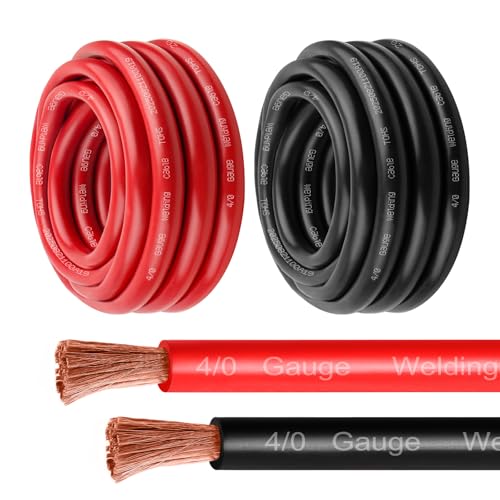
Best for: Outdoor and marine applications needing strong conductivity and temperature resilience. The cable uses stranded OFC copper with a PVC jacket that resists oxidation, high temperatures, solvents, and abrasion.
- High strand count provides flexible, dependable performance
- Wide operating temperature range suitable for marine environments
- Resistant to solvents and common automotive fluids
Caution: The rating notes 600V working voltage; ensure compatibility with your system’s voltage and insulation needs.
WindyNation 4/0 AWG 10 Feet Red + 10 Feet Black Kit

Best for: Do-it-yourself installers needing everything in one package to finish a clean, durable power run. The kit includes 4/0 copper cables, 10 cable lugs, and heat shrink for a complete setup.
- Fully annealed copper with high flexibility
- Includes lugs and heat shrink for quick assembly
- EPDM insulation provides solvent resistance and outdoor durability
Caution: Check the included lugs and tubing compatibility with your specific terminal sizes before ordering.
Kimbluth 4/0 Gauge Battery Cable, 3 ft Red + Black

Best for: Automotive, solar, and marine power distribution where high conductivity and corrosion resistance are priorities. The 99% OFC copper and a robust PVC jacket support reliable circuits and flexible routing.
- High-purity copper improves weldability and conductivity
- 90 mil PVC jacket adds flexibility and protection
- Twisted fine strands boost flexibility for tight installations
Caution: Ensure length requirements align with your layout to avoid excessive slack or tension on terminals.
Spartan Power 3 Foot 4/0 AWG SpartanFlex Cable

Best for: Projects requiring professional-grade, ultra-flexible cables for inverters, solar arrays, or high-amperage audio systems. SpartanFlex technology emphasizes durability and ease of installation while retaining 100% copper content.
- Made in the USA with flexible SpartanFlex design
- Premium cut and crimping for durable connections
- 100% pure copper wire for reliable conductivity
Caution: Shorter lengths like 3 ft may require careful routing to minimize bending radius and avoid sharp corners.
Buying Guide
What gauge should you choose? For high-current systems, 4/0 AWG is a common choice for short runs and inverter connections. If you need longer distances or tighter power distribution, confirm voltage drop calculations and consider longer lengths or multiple runs.
Why choose pure copper? Copper provides superior conductivity, lower resistance, and better long-term performance in heat and humidity. Avoid copper-clad aluminum for high-amperage paths where durability matters.
What about insulation and connectors? Look for flexible, abrasion-resistant jackets (PVC or EPDM) and corrosion-resistant lugs or heat-shrink for outdoor or marine use. Ensure lug size matches your terminal studs (commonly 3/8″ or 1/2″ in automotive and marine gear).
How to install safely? Pulllock or crimp connections must be secure to prevent arcing. Use heat shrink where appropriate. Keep cables away from heat sources and moving parts. Label runs for future maintenance.
FAQ
- Q: What is the main advantage of 4/0 AWG copper cables? A: They support high current with low resistance, ideal for inverters, solar arrays, and heavy electrical loads in vehicles and boats.
- Q: Are these cables suitable for marine environments? A: Many are PVC or EPDM-insulated with corrosion-resistant lugs, designed for outdoor and marine use; check the product notes for ventilation and salt exposure considerations.
- Q: Do these kits include everything needed for installation? A: Some kits include lugs and heat shrink, while others require purchasing lugs or tubing separately; review each listing to confirm included components.
- Q: How do I determine the correct length? A: Measure the distance between power sources and loads, add slack for routing, and consider future repositioning to avoid over-tight runs.
- Q: Can I mix brands for a single system? A: It’s generally acceptable if the cables share the same gauge, conductor material (OFC copper), and compatible insulation and terminals; ensure quality and compatibility across all components.
- Q: What safety steps are essential before connecting? A: Disconnect power, verify the system voltage, inspect insulation for damage, and secure connections with proper crimping or soldering per manufacturer guidelines.