Best 2×4 Parabolic Light Fixtures for Offices and Classrooms
When upgrading a ceiling lighting system, 2×4 parabolic troffers offer glare reduction, uniform illumination, and energy efficiency for commercial spaces. This guide highlights five high-quality options, spanning LED-ready and integrated designs, to help facility managers and designers compare features, performance, and installation considerations.
| Product | Brand | Key Benefit |
|---|---|---|
| Sunco 2×4 LED Ready Parabolic Troffer | Sunco Lighting | Glare-reducing parabolic louver; lamp-ready for flexible LED tube choice |
| Nonglare 2×4 45W Parabolic Troffer | Generic | Sharp light cutoff; bright white 5000 lumen output at 45W |
| CPANL 2×4 LED Flat Panel | Lithonia Lighting | Switchable CCT; damp location rated; long life |
| YXL 2×4 LED Troffer Light | YXL | Five CCT options; five brightness levels; dimmable |
| Stack 2×4 LED Troffer | Lithonia Lighting | Adjustable lumens; switchable CCT; durable center-basket design |
Sunco 2×4 LED Ready Parabolic Troffer Fixture

Sunco’s 2×4 LED Ready Parabolic Troffer is designed for standard 2×4 drop ceilings and features an 18-cell parabolic louver intended to soften direct glare. The louver helps create a comfortable, uniform light distribution ideal for offices, classrooms, and retail environments. This fixture is lamp-ready, allowing you to select compatible LED tubes to reach your preferred brightness and color temperature, while lamps are not included. Its dimensions fit common grid ceilings (approximately 48.1″ by 23.6″ by 4.7″), offering a retrofit-friendly solution for commercial spaces seeking clean lines and efficient, controllable lighting.
The product emphasizes glare reduction through its parabolic louver and non-integrated LED approach, giving facilities the option to customize lamp types and color rendering. It is UL Listed and RoHS compliant, aligning with typical building safety standards. For those upgrading from fluorescent systems, this fixture can enable a familiar grid aesthetic with modern LED efficiency and lower operating temperatures.
Nonglare 2×4 Parabolic Troffer, 45W

This Generic Nonglare model offers a sharp light cutoff to minimize glare while delivering a bright 5000 lumen output from a 45-watt LED design. The 2×4 footprint is a standard choice for classrooms, offices, and healthcare corridors. The fixture emphasizes glare control and uniform illumination, with a straightforward, low-profile install suitable for grid ceilings. While the description highlights aesthetics and efficiency, users should confirm compatibility with existing dimmers or controls and ensure they match their color temperature needs.
CPANL 2×4 LED Flat Panel by Lithonia
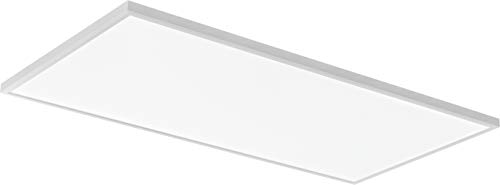
The CPANL flat panel from Lithonia Lighting combines a 2×4 form factor with a switchable color temperature (ranging across common white tones) and a flat panel design for even, dimmable illumination. It is rated for damp locations, IC, CSA, and DLC certifications, suggesting strong reliability in busy commercial environments. The long-life LEDs paired with an efficient driver support energy savings and reduced maintenance. A Triac dimming option enables smoother lighting control when used with compatible dimmers, reducing energy waste in spaces like garages or kitchens that require adjustable brightness.
YXL 2×4 LED Troffer Light

The YXL center basket troffer provides five selectable color temperatures (3000K, 3500K, 4000K, 5000K, 6500K) and five brightness levels, offering flexible illumination for offices, classrooms, and studios. The 0-10V dimmable driver supports precise daylighting and energy management. Its design emphasizes a smooth, shadow-minimized output with easy back-panel controls for quick field adjustments, making it suitable for spaces that require a fast setup and ongoing adaptability to changing tasks or occupant preferences.
Stack 2×4 LED Troffer by Lithonia

Lithonia’s Stack LED Troffer offers adjustable lumen output and switchable color temperatures across 3500K, 4000K, and 5000K options. The centerpiece is a wide center basket with a curved matte reflector that enhances diffusion and reduces glare, delivering high-quality illumination in offices, classrooms, and corridors. The fixture is DLC qualified, damp location listed, IC rated, and carries long LED lumen maintenance claims. This makes it well-suited for projects prioritizing energy performance, reliable maintenance cycles, and performance consistency in busy commercial settings.
Buying Guide: Key Considerations For 2×4 Parabolic Troffers
When selecting a 2×4 parabolic troffer, consider glare control, energy efficiency, and compatibility with existing ceilings and controls. A parabolic louver reduces direct glare while maintaining even illumination across work planes, which is essential in offices and classrooms where productivity and comfort matter. LED-ready configurations offer flexibility if you prefer a specific tube type or color temperature, though integrated LED options can simplify installation and reduce maintenance.
Color temperature options (CCT) affect space atmosphere and task performance. Warmer tones (3000K-3500K) are commonly used in break rooms and collaborative areas, while neutral to cool whites (4000K-5000K) suit offices and classrooms for better contrast and accuracy. Dimmability is another important factor for daylighting and energy savings; ensure compatibility with your dimmer system and building controls.
Look for certifications such as DLC, damp-location rating, and IC (insulation contact) approval. DLC and CSA listings indicate compatibility with energy programs and broader safety standards. A long rated life (L70) reduces maintenance costs in high-traffic spaces. Finally, assess installation: some fixtures offer simple retrofit with existing grids, while others are designed for quick mounting or direct mounting to ceilings. Consider whether you need wet or dry location suitability, ceiling grid compatibility, and ballast or driver requirements.
For facilities evaluating differing price-per-lumen scenarios, compare lumen output per watt, total lumens, and maintenance implications. Integrated LEDs tend to deliver consistent performance with fewer components to fail, whereas lamp-ready models can offer customization but may require ongoing part replacements. A careful balance of upfront cost, energy savings, glare control, and adaptability will guide the best choice for your space.