Best 290 Watt Solar Panel Options for Off-Grid Power and More
Looking for a high-efficiency solar panel around 290 watts to power an off-grid setup, RV, or tiny home? This guide highlights five strong choices that balance performance, durability, and portability. Each pick suits different buyers—from RV travelers needing foldable efficiency to home roof installations seeking reliable year-round energy. The following tables and sections help you compare capabilities, ideal use cases, and any trade-offs.
| Product | Brand | Power (approx.) | Best For |
|---|---|---|---|
| JJN Bifacial 425W Panel | JJN | 425W | Rooftop or off-grid with dual-side output |
| Callsun N-Type 400W | Callsun | 400W | RVs and vans needing reliable, shade-tolerant output |
| STAR 860W Bifacial Panels (2x 430W) | STAR | 860W (per pair) | Residential or farm-scale installations |
| GRECELL 100W Portable Panel | GRECELL | 100W | On-the-go charging for power stations |
| Renogy 200W Portable Panel | Renogy | 200W | Compact off-grid or camping power |
JJN Bifacial 425 Watt Solar Panel

Best for high-output rooftop systems and off-grid farms, this 425W bifacial panel uses a transparent backsheet to harvest light from the rear side, potentially boosting output by up to 25%. It employs 16BB N-type cells, offering improved shading tolerance and durability. The black aluminum frame resists corrosion, and the IP65/IP68 weather protections support outdoor installations.
- Best for: Homes, rooftops, farms, RVs with ample space and favorable sun exposure.
- Why selected: Strong single-panel output with bifacial gains and robust weather sealing.
- Caution: Bifacial gains depend on reflective surfaces and installation angle; real-world gains vary.
Callsun N-Type 16BB 400W Bifacial Panel

Best for RVs or compact off-grid systems where space is limited but steady power is needed. The Callsun 400W panel uses N-type 16BB cells and bifacial design to boost energy capture, especially in partially shaded conditions. Its dual-module parallel layout helps maintain output if part of the panel is shaded.
- Best for: RVs, vans, boats, or small off-grid cabins with shading concerns.
- Why selected: Shade-tolerant with bifacial gains and thoughtful shading resilience.
- Caution: Higher upfront cost typical for bifacial designs; performance depends on installation context.
STAR 860W Bifacial Panels (Two 430W Modules)

Best for larger off-grid homes or small-scale commercial setups where space allows. The pair of bifacial modules offer significant combined output with a long-term 30-year lifespan and ETL certification. The half-cell and high-density design provide better performance in limited space and improved shading tolerance.
- Best for: Residential farms, off-grid homesteads, or space-planned solar gardens.
- Why selected: High total power with efficiency-focused design; strong outdoor durability.
- Caution: Higher system footprint and wiring considerations for large installations.
GRECELL 100W Portable Solar Panel
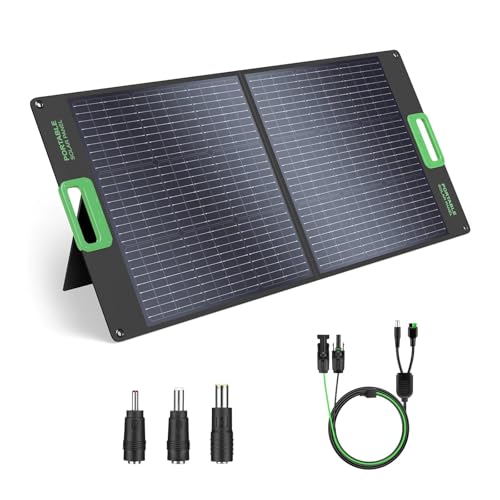
Best for travelers who need lightweight, compact charging for portable power stations. This foldable 100W panel offers up to 23.5% efficiency with a built-in smart charging chip that optimizes device charging while protecting against overcharging. Includes multiple connector options for compatibility with various power stations.
- Best for: RV trips, camping, emergency charging for portable power stations.
- Why selected: Excellent portability and quick setup with broad connector compatibility.
- Caution: Lower total power; best suited for supplementary charging rather than main power needs.
Renogy 200W Portable Solar Panel

Best for campers needing a balance of power and portability. The 200W panel uses 16BB N-type cells for improved efficiency and reduced hot spots. It folds compactly and includes a sturdy carry configuration with kickstands and IP68 waterproof connectors for outdoor use.
- Best for: RVs, camping, or compact off-grid setups requiring reliable daytime power.
- Why selected: High efficiency in a portable form factor with solid weatherproofing.
- Caution: May require additional panels for higher energy demands; not as compact as smaller 100W units.
Renogy 100W Solar Panel N-Type

Best for lightweight, lower-power setups where space and weight are critical. This 100W N-type panel uses 16BB cells for good efficiency and a robust build suitable for rooftops or vehicle installations, with a focus on long-term reliability in various climates.
- Best for: Small off-grid systems, roof mounting on compact homes, or emergency backup kits.
- Why selected: Reliable, efficient N-type design in a compact package.
- Caution: Limited power output; pair with additional panels to meet higher energy needs.
Buying Guide: Key Considerations For Your 290 Watt Solar Setup
When choosing solar panels around 290 watts, consider efficiency, mounting space, climate, and system goals. Bifacial panels can boost output when installed with reflective backdrops or white rooftops. N-type cells typically offer higher efficiency and better performance in warm conditions. Foldable portable panels are ideal for travelers, while fixed rooftop panels suit permanent installations.
- Power needs: Estimate daily energy usage and align panel wattage to meet or exceed it with some headroom.
- Space and weight: Fixed rooftop installations require structural assessment, while portable panels prioritize weight and foldability.
- Durability: Look for corrosion-resistant frames, IP ratings, and robust connectors for outdoor use.
- Shade tolerance: Bifacial designs and shading-tolerant cell configurations help in partial sun conditions.
- Compatibility: Ensure connectors and mounting hardware match your power station or inverter system.
Frequently Asked Questions
- What makes bifacial solar panels worth it? Bifacial panels generate energy from both sides, which can increase overall output in reflective environments.
- Are N-type cells better for hot climates? Yes, N-type cells generally have lower light-induced degradation and better performance at higher temperatures.
- Should I choose a portable panel or a fixed rooftop panel? Portable panels are ideal for mobility and emergencies; rooftop panels suit long-term, stationary energy needs.
- What is the importance of IP ratings? IP65/IP68 ratings indicate protection against water and dust, improving reliability in outdoor setups.
- Can I mix different brands in one system? Yes, as long as voltage, current, and connector types are compatible, but ensure balanced array design for even power distribution.