Best 24V Off Grid Solar System Kits for Reliable Power Anywhere
If you’re evaluating a 24V off-grid solar system, you’re likely seeking dependable power for cabins, RVs, or remote sheds. The top products below are designed to deliver steady 24V DC to AC conversions or battery storage for daily essentials. This guide highlights five strong choices, explaining who each is best for, and why they stand out. A quick buyer’s table follows to help you compare at a glance.
| Product | Best For | Key Strength |
|---|---|---|
| [Ultra] ECO-WORTHY 1200W 24V Kit | RV enthusiasts and tiny homes | High daily output with dual-axis tracker |
| SUNGOLDPOWER SGKT-3PRO Kit | Full off-grid households | All-in-one inverter, MPPT battery charging |
| ECO-WORTHY 9.36KWH Off Grid System | Home cabins and sheds | Large storage and parallel inverter option |
| ECO-WORTHY 7.168KWH RV Kit | RV and travel-focused users | Balanced kit with 4x200W panels |
| Renogy 200W N-Type Panel Kit | Small roof spaces and vans | High efficiency, compact size |
[Ultra] ECO-WORTHY 1200W 24V Kit
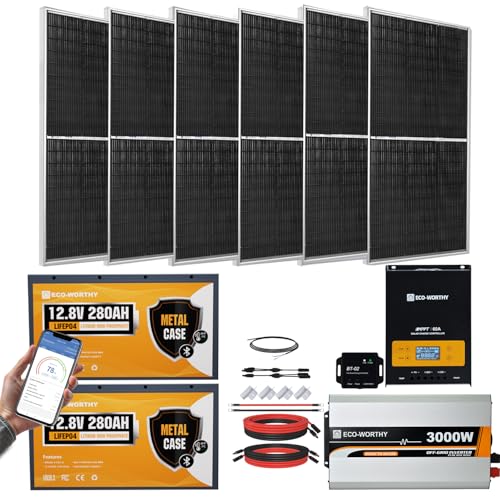
The kit targets high daily energy needs with a claimed 5.52KWH daily output under four hours of sun. It combines six 195W solar panels with dual 12.8V 280Ah lithium batteries, a 60A MPPT controller, and a 3000W pure sine wave inverter. This setup is best for off-grid travelers or small homes that require substantial daylight energy and secure battery storage. Choose this if you want robust AC 110V power for appliances like TVs, refrigerators, or air conditioners during sunny days. A potential limitation is dependence on adequate sun for peak performance; cloudy days reduce output.
Who this is best for: Tiny homes, travel trailers, RVs, cabins needing reliable daytime power with robust storage.
SUNGOLDPOWER SGKT-3PRO Kit

This all-in-one system combines a 3000W DC 24V inverter, 80A MPPT charging, and a 40A AC battery charging option, designed to keep devices powered during sun shortages or grid outages. It includes a LiFePO4 battery and four 200W panels. It’s best for households or cabins that want integrated power management with reliable switchover to battery power within milliseconds. Limitation to note: the inverter’s efficiency and performance depend on stable MPPT voltage input and battery health.
Who this is best for: Households needing seamless solar-to-battery-to-load transitions with robust backup capabilities.
ECO-WORTHY 9.36KWH Off Grid System

This complete kit emphasizes higher energy storage with 12x 195W panels (2340W) and a 10KW inverter, along with two 48V 100Ah lithium batteries. The system is designed for homes, sheds, and farms that require substantial daytime generation and the ability to power high-demand appliances. Real-time monitoring is available via a WiFi module. Best for: larger off-grid homes needing scalable power with strong safety certifications. A potential drawback is space requirements for all components and panels.
Who this is best for: Home, shed, or farm setups needing high daily energy and scalable parallel operation.
ECO-WORTHY 7.168KWH RV Kit

This RV-focused kit bundles four 200W panels with an 800W system, a 60A MPPT controller, and two 12.8V 280Ah lithium batteries. The 7.168KWH storage supports travel needs with a compact footprint. Best for mobile camping or caravans where space for panels is reasonable but storage is still critical. Limitation: total energy capacity may be lower than larger home systems, so plan for longer cloudy periods.
Renogy 200W N-Type Panel Kit

This compact 200W N-Type panel is designed for limited roof space on vans or small RVs. It delivers high efficiency at 25% cell efficiency with a 24V system, offering flexible installation for 12V or 24V battery configurations. Best for those with tight roof real estate who still want solid efficiency. Limitation: single-panel output may require multiple panels for larger loads or longer off-grid durations.
Buying Guide
What should you consider before buying a 24V off-grid system?
System voltage and battery type determine compatibility with your appliances and charging sources. For 24V systems, LiFePO4 batteries offer longer cycle life and safer chemistry, but ensure your inverter supports 24V input and 110/120V AC output if needed.
How much daily energy do you need?
Estimate daily consumption in watt-hours and compare to the kit’s stated daily output. For RVs and cabins, plan for 4–6 hours of productive sun daily, plus storage for night use or cloudy days. Inverter size should handle peak loads like AC units, microwaves, and water heaters.
Is expandable capacity important?
Many kits allow adding more panels or batteries or pairing multiple inverters. If you anticipate growing energy needs, choose systems with parallel operation support and clear upgrade paths.
What about monitoring and safety?
Remote monitoring via WiFi or Bluetooth helps track battery health and system performance. Look for BMS features that protect against overcharge, deep discharge, and short circuits, and verify certifications align with North American safety standards.
Which kit suits different lifestyles?
- Travel-focused or small spaces: compact kits with efficient panels and compact inverters (e.g., Renogy 200W with 24V compatibility).
- Full-time off-grid homes: larger storage and higher inverter capacity with monitoring (e.g., 9.36KWH or 10KW+ systems).
- RVs and cabins needing quick setup: all-in-one kits with integrated MPPT charging and simple installation (e.g., SUNGOLDPOWER SGKT-3PRO).
What are common trade-offs?
Higher daily output and more storage improve reliability but require more space and higher upfront cost. If space is limited, prioritize higher efficiency panels and strategic mounting to maximize sun exposure.
Short FAQ
- What is a 24V off-grid solar system best for? It suits setups where you want battery storage and a 24V DC/AC solution for reliable daily power in remote locations.
- Do I need a LiFePO4 battery with these kits? LiFePO4 offers longer life and safety advantages, but ensure your inverter and BMS support the chemistry.
- Can multiple kits be connected for more power? Yes, many kits support parallel operation or expansion, but check the manufacturer’s guidance for safe wiring.
- Is a high-efficiency panel worth it? Yes, higher efficiency panels generate more power in limited space, which is valuable for RV roofs and small installations.
- What maintenance is required? Regularly check connections, monitor battery health, and ensure inverters stay within rated temperatures to maintain performance.
- Which kit is easiest to install? All-in-one or beginner-friendly kits typically offer streamlined wiring and fewer components, reducing setup complexity.