Best 24V DC to DC Chargers for Dual Battery Systems in 24/12-Volt Setups
Answering the needs of travelers, RV owners, boaters, and fleet operators who require reliable 24V to 12V charging, this guide highlights five top 24V DC to DC chargers. These devices optimize alternator power, support multiple battery chemistries, and offer smart multi-stage charging for longevity. The best picks below suit dual-battery systems, mixed-voltage configurations, and mobile or off-grid setups. Each option is evaluated for compatibility, efficiency, and practical use cases so buyers can choose with confidence.
Summary of selected products
| Product | Best For | Key Benefit |
|---|---|---|
| Victron Orion XS 1400 | Heavy-duty dual-battery systems, mixed 12V/24V | Highest output in compact form with IP65 protection |
| Victron Orion-Tr Smart 24/24-Volt 17A | Dual battery setups needing Bluetooth monitoring | Smart, water-tight, Bluetooth-ready |
| Victron Orion-Tr Smart 24/12-Volt 20A | Flexible 24V to 12V charging | Balanced 24V/12V capabilities with isolation |
| RENOGY REGO MPPT DC-DC Charger 720W | Rugged, waterproof, off-road and marine use | IP67 waterproof, solar prioritization |
| VEVOR 650W MPPT DC-DC Charger 50A | Budget-friendly, solar-ready backup charging | Compact, efficient, versatile inputs |
Victron Energy Orion XS 1400: 12/24-Volt 50 Amp DC-DC Charger

The Orion XS 1400 is a compact yet powerful DC-DC charger designed to charge a house battery from the starter battery in mixed 12V/24V systems. It delivers full output even in hot environments and supports LiFePO4, lead-acid, and other common chemistries. The unit adapts with a smart 4-stage charging algorithm and engine running detection to prevent starter battery drain. This makes it ideal for RVs, boats, and dual-battery installations where space is at a premium and reliability is essential.
Best for: users needing a high-output, space-efficient charger that can handle 12V and 24V configurations with robust performance. Better for: environments where temperature could impact performance. Choose this if: you require high efficiency and compact enclosure with smart monitoring.
Caution: The unit may require adequate airflow and proper heat management in very tight engine bays or extremely hot climates to sustain peak output.
VEVOR DC to DC Charger with MPPT, 650W, 50A

This charger offers up to 50A and 650W with MPPT optimization, prioritizing solar input to reduce alternator load. It supports LiFePO4, Lead Acid, GEL, AGM, and Calcium batteries and includes two DIP switch keys for quick battery type selection. Ideal for RVs, off-grid vehicles, and boats that rely on solar-assisted charging or need a robust backup generator may appreciate its broad compatibility and solar-first approach.
Best for: buyers who want strong solar integration and broad battery compatibility at a practical price. Better for: solar-rich setups that want to minimize alternator strain. Limitations: while versatile, it may be bulkier than ultra-compact units and could require careful mounting for protection from the elements.
Victron Energy Orion-Tr Smart DC-DC Charger (Bluetooth) 24/12-Volt 20A

The Orion-Tr Smart DC-DC Charger provides intelligent, multi-stage charging with Bluetooth connectivity via the VictronConnect App. It is tailored for dual-battery systems where the alternator and start battery must effectively support a secondary battery. The unit is non-isolated and can function as a charger within a 24V system, making it suitable for vehicles, boats, or vessels with a dedicated house battery bank.
Best for: users who want smartphone monitoring and easy control. Better for: applications requiring a clean, compact installation with remote status checks. Limitation: non-isolated design may require careful electrical planning in certain installations to avoid ground loop issues.
Victron Energy Orion 24/12-Volt 70 Amp DC-DC Converter (Non-Isolated)
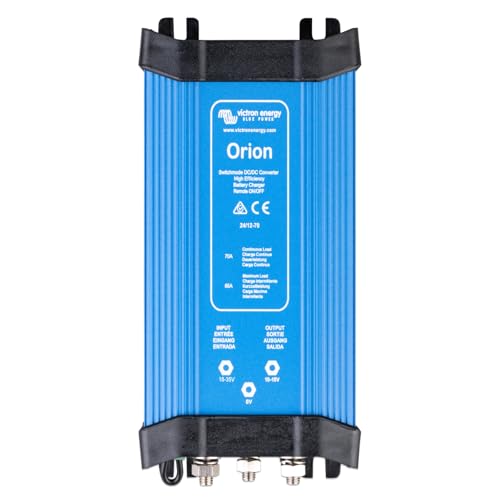
The Orion non-isolated 24/12-Volt converter delivers up to 70 amps with high efficiency, designed to convert 24V to 12V for charging a starter or accessory battery within a 24V system. A remote on/off connector allows operation with a low-power switch or the engine run/stop switch, reducing wiring complexity. It suits larger dual-battery systems where strong 12V output is required, such as auxiliary battery banks for campers or boats.
Best for: high-output 24V systems needing a robust 12V charging path. Better for: setups where remote control of the charger is desirable. Caution: ensure compatibility with the vehicle’s electrical architecture to avoid unintended power routing.
Buying Guide
Key considerations when selecting a 24V DC to DC charger vary by use case and vehicle type. This guide helps buyers compare features and make informed choices.
- Voltage compatibility: Confirm whether you need a 24V input with a 12V output or a bidirectional 12/24V capability. Some chargers support mixed systems, others are dedicated to one direction.
- Battery chemistry support: Check compatibility with LiFePO4, lead-acid, GEL, AGM, and calcium batteries. Ensure the charger can properly support your house and starter batteries.
- Output current and power: Higher amperage (e.g., 50A, 70A) charges faster but requires more space and heat management. Match the charger output to your battery bank size and usage patterns.
- Efficiency and heat: Look for high efficiency ratings and a design that handles heat well, especially in engine bays or exposed installations.
- Weatherproofing and IP rating: For marine or off-road vehicles, IP67/IP65 ratings offer protection against water, dust, and exposure to the elements.
- Smart features: Bluetooth or app-based monitoring helps track charging status, battery health, and voltage trends. Remote control can simplify daily use.
- Installation and wiring: Verify installation space, required cabling gauge, and whether a remote on/off feature is beneficial for your setup.
FAQs
- What is a DC-DC charger with MPPT used for in vehicles?
– It optimizes solar charging and alternator feeding to the house battery, improving overall charging efficiency when solar panels are used. - Can a DC-DC charger charge a 12V battery from a 24V system?
– Yes, many models are designed to convert 24V input to 12V output to support auxiliary or starter batteries. - Is Bluetooth monitoring necessary?
– Not necessary, but it provides convenient, real-time status and can help troubleshoot charging issues remotely. - Do I need an isolated DC-DC charger?
– Isolated models reduce potential ground loops in complex electrical systems, but non-isolated units are sufficient for correctly configured dual-battery setups. - What factors affect charger performance in hot environments?
– Heat dissipation, ambient temperature, and enclosure ventilation influence sustained output and efficiency.