Best 24V Battery Load Tester Options for Quick Vehicle Diagnostics
Looking for a reliable 24V battery load tester? This guide highlights five top options that cover 24V systems, including cars, trucks, motorcycles, and marine applications. Each pick targets different buyer needs—shop-owners, DIY enthusiasts, and professional technicians will find suitable choices for diagnosing battery health, alternator performance, and charging system integrity. Read on to compare capabilities, best-use scenarios, and practical cautions to help you choose wisely.
| Product | Voltage Range | Best For | Why It Stands Out |
|---|---|---|---|
| Associated Equipment 6024 | 12/24V | General automotive and light truck testing | Heavy-duty clamps, wide testing range, simple hand-held design |
| Kaiheng Battery Load Tester | 6/8/12/16/24V | Versatile, small shop use | Clear readouts, multiple voltage modes, easy clip connections |
| VDIAGTOOL BT500 | 6/12/24V | Comprehensive system diagnosis | SOH/SOC, broad battery compatibility, alternator/charging tests |
| Acclope BT60 PRO | 6/12/24V | Professional and DIY use | Advanced conductance, broad battery types, clear results |
| FOXWELL BT705 | 12/24V | Professional-grade testing | Clear results, detailed cranking/charging data |
Associated Equipment 6024 12/24V Battery Load Tester
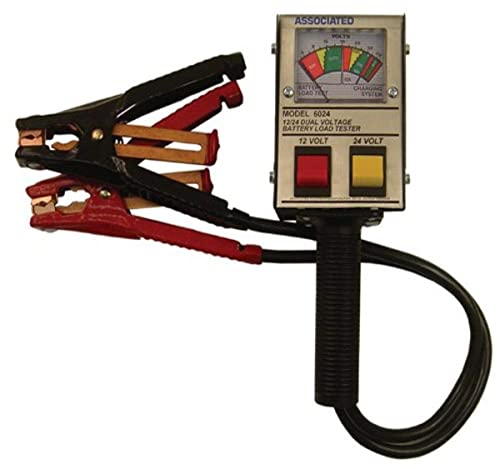
The Associated 6024 is a handheld 12/24V load tester with a 125 amp capacity. It tests batteries, alternators, and starters across a range of vehicles. It includes heavy-duty insulated safety clamps with 300 amp jaws and side terminal adapters. This model is best for technicians or DIYers who want a straightforward, robust tool for on-vehicle assessments. A potential limitation is that it relies on clamp-based testing, which may be less precise for some modern high-CCA batteries compared to more feature-rich testers.
Kaiheng Battery Load Tester (6/8/12/16/24V)

The Kaiheng tester supports 6–24V systems and features a 100 A fixed load for 12V batteries, with 50 A for 6V and 100 A load current. It uses copper clips with red/black grips to secure connections, and its test method simulates starter draw by applying a load for up to 10 seconds. Best for small shops or home garages needing a multi-voltage tool with straightforward operation. A caveat is the absence of more detailed SOH/SOC metrics in the base model.
VDIAGTOOL BT500 Car Battery Load Tester

BT500 stands out as a comprehensive diagnostic tool for 6V, 12V, and 24V batteries. It tests regular flooded, AGM flat, AGM spiral, GEL, and EFB types, and it provides voltage, resistance, State of Health (SOH), and State of Charge (SOC). It also functions as an alternator and cranking system analyzer. This makes it a strong choice for professionals needing broad compatibility and deeper diagnostics, though lithium and deep-cycle batteries are not supported.
Acclope BT60 PRO Car Battery Tester
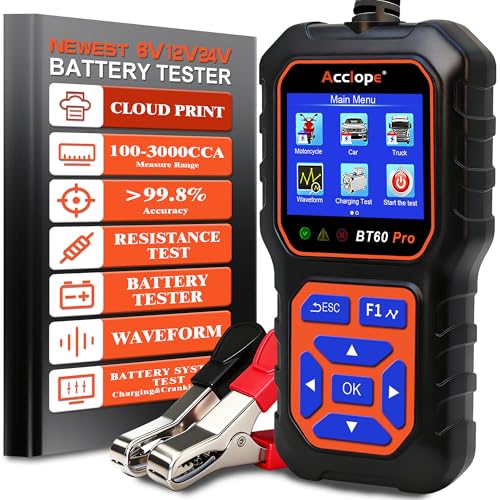
The Acclope BT60 PRO tests 6/12/24V batteries and covers lead-acid variants including AGM and GEL, plus LiFePO4 checks for voltage/health. It provides SOH, SOC, voltage, resistance, and CCA (varying by battery type). It’s designed for both DIY users and professionals who need fast, repeatable results. A limitation is lithium results may not provide precise CCA measurements, so plan for a different approach if you require exact CCA for LiFePO4 cells.
FOXWELL BT705 Car Battery Tester
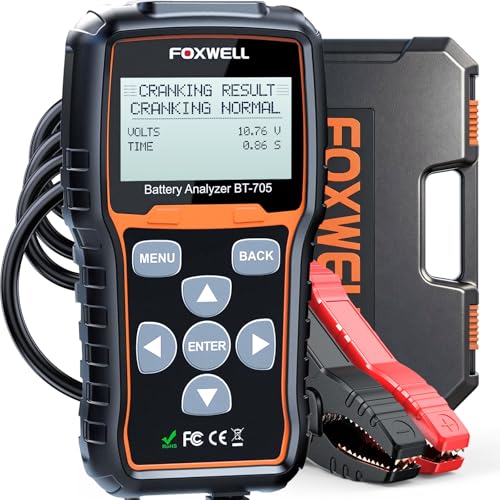
FOXWELL BT705 is a trusted 12V/24V load tester offering 100–2000 CCA testing, with readable results for voltage, internal resistance, State of Health, State of Charge, cranking performance, and alternator output. It provides clear “GOOD/REPLACE/CHARGE” prompts and a long test lead for one-person operation. It suits professional shops and serious DIYers who want precise, actionable data and a guided testing workflow. A potential drawback is a larger footprint and higher price versus entry-level models.
Buying Guide: Key Considerations for 24V Battery Load Testers
- Voltage range and battery types: Ensure the tester supports 24V systems and compatible lead-acid chemistries (Flooded, AGM, GEL, EFB). If you also encounter LiFePO4, verify how the device reports LiFePO4 readings.
- Load and accuracy: Look for testers with adequate load current for your battery size (e.g., 50–125 A for 12V/24V). Consider accuracy metrics and the ability to diagnose SOH and SOC where relevant.
- Testing scope: Decide if you need only a battery test or a full charging/alternator and cranking system diagnostic. Some models include start/stop cycling simulations and charging system checks.
- Ease of use: Features like clamp/clip connections, one-person operation, and clear on-screen prompts can save time in fieldwork or busy shops.
- Durability and safety: Heavy clamps, protective housings, and safety features matter for daily use in garages and on service calls.
- Data accessibility: Consider whether you need data recall, cloud reports, or simple pass/fail indicators for quick decision-making.
- Limitations: Some testers exclude lithium-specific CCA accuracy or deep-cycle battery testing; verify limitations before purchase.
Practical Quick-Compare Questions
- Which tester is best for a small shop with mixed 12V and 24V vehicles? The Kaiheng or FOXWELL BT705 offer broad compatibility and clear results.
- Who should choose the BT500 for 24V work? Professionals needing SOH/SOC data and broad battery compatibility.
- If budget is tight and you mainly test 24V truck or marine batteries, which is best? The Associated 6024 provides solid hand-held testing with robust clamps.
- For LiFePO4 and mixed chemistries, which tool provides best utility? Acclope BT60 PRO offers LiFePO4 checks (voltage/health) in addition to lead-acid testing.
Frequently Asked Questions
- What is a battery load tester used for? It assesses a battery’s ability to deliver current under load and helps diagnose the health of the battery, alternator, and charging system.
- Can these testers test 24V truck batteries? Yes, all listed models provide 24V testing capabilities suitable for trucks, RVs, and marine applications.
- Do testers measure exact CCA for all battery types? Some models measure CCA across supported chemistries; lithium results may be limited or reported as voltage/health rather than precise CCA.
- Is a high-end tester worth it for a DIYer? If you frequently service vehicles with varied battery chemistries, a feature-rich tester (SOH/SOC, charging system tests) offers valuable diagnostics.
- Are these testers safe for home use? Yes, when used as directed, with proper safety clamps and correct battery connections.
- Do these testers require a computer or app? Most provide on-device readouts; some offer cloud or memory features but do not require a separate app.