Best 24V Adjustable Power Supplies for DIY Electronics
The best 24V adjustable power supplies provide precise voltage control, reliable current delivery, and compatibility with a wide range of devices. This guide helps buyers find the right unit for hobbyists, tinkerers, and small-project builders. Each selection is chosen for versatility, built-in display clarity, and the ability to power multiple devices from a single source. Read on to compare options, see who each product is best for, and learn key buying considerations.
| Product | Voltage Range | Max Current | Output Type | Best For |
|---|---|---|---|---|
| Minidodoca 72W | 3V–24V | 3A | DC | Small electronics and lab projects requiring adjustable voltage |
| Wefomey 144W | 3V–24V | 6A | DC | multi-device setups; higher current needs |
| Wefomey 72W (3A) | 3V–24V | 3A | DC | compact benches or limited-load devices |
| DROK 480W | 0–24V | 20A | DC | larger loads; high-current labs and DIY rigs |
| Jesverty SPS-3010 | 0–30V | 10A | DC | bench power with precise CV/CC control |
Minidodoca 72W Adjustable Power Supply

This unit delivers 3V to 24V DC with a maximum of 72W and up to 3A. It includes a rotatable voltage knob and a real-time LED voltage display for quick verification. The 16 included tips support various devices, making it a versatile choice for hobbyists who work with radios, sensors, or small desktop electronics. Best for: compact projects and beginners who need straightforward voltage control with a visible readout.
Caution: The maximum current is 3A; exceeding device requirements can cause overheating or voltage drop under heavy loads. Use within the rated current to avoid damage.
Wefomey Universal 144W Power Supply
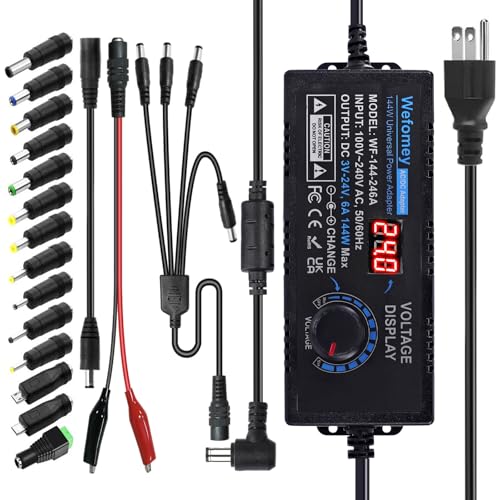
This adjustable supply covers 3–24V at up to 6A (144W) and includes 14 DC tips plus a polarity converter. The LCD readout helps monitor voltage to prevent accidental overvoltage. It’s well-suited for projects requiring more current, such as LED arrays or multiple small devices from a single source. Best for: more demanding bench setups that still require easy plug-and-play versatility.
Limitation: Current capability is 6A total; designs drawing more than 6A will need a higher-capacity supply or staged power delivery.
Wefomey 72W Adjustable Power Supply (3A)

This model offers a compact 3V–24V output with a maximum of 72W and 3A. The LCD display provides voltage feedback, and the 14 tips ensure compatibility with common devices. Best for: hobbyists needing a compact, reliable supply for smaller electronics and DIY projects.
Limitation: Like other 72W units, it may not sustain higher current for extended periods with power-hungry loads.
DROK 24V Power Supply with 20A Capacity

Designed for higher-demand projects, this DROK supply accepts 110V/220V input and provides a wide 0–24V output with up to 20A. It includes an LED display and cooling features, making it suitable for lab setups or machines that require stable, higher current. Best for: learners and makers running multi-device rigs or equipment that demands peak current. Caution: The current rating is fixed at or below 20A; plan loads accordingly to avoid overloading the supply.
Jesverty SPS-3010 Variable Bench Power Supply

The SPS-3010 offers 0–30V and up to 10A with a 4-digit LED display showing voltage, current, and wattage. It features auto CV/CC switching and coarse/fine adjustment for precise settings. Best for: precise bench work where voltage stability and accurate current control are essential. Limitation: Higher voltage range (up to 30V) may exceed devices designed strictly for 24V systems.
Buying Guide
What to check before buying
- Voltage range: Confirm the device you plan to power fits within the supply’s adjustable range (3–24V or up to 30V).
- Current rating: Match the maximum current to the device’s draw. If in doubt, choose a supply with a higher current rating than the load requires.
- Display and control: An LCD display and a smooth adjustment knob help maintain precise settings and protect sensitive electronics.
- Tips and connectors: A wide tip set increases compatibility with common devices; verify included connectors align with your equipment.
- Protection features: Look for current limiting, short-circuit protection, and a turn-off feature to prevent accidental damage.
Best use-case scenarios
- Small electronics projects: 3–9V range with moderate current (<2A) is typically sufficient; compact units like the Minidodoca are convenient.
- Multi-device benches: Higher current units with multiple tips and a splitter cable reduce the need for extra outlets and adapters.
- High-current lab or workshop tasks: 20A-capable modules (like DROK) support larger devices or simultaneous loads.
How to choose between models
- Budget versus capability: If you need higher current and more voltage options, a higher-wartage model provides room for expansion.
- Portability: Smaller 72W units are easier to move, while 144W or 480W units are more stationary but handle bigger tasks.
- Future-proofing: A 0–30V supply with CV/CC modes helps accommodate evolving projects beyond 24V.
Comparison at a glance
- Best for beginners and compact builds: Minidodoca 72W, SHNITPWR 72W variants.
- Best for higher current demand: Wefomey 144W and DROK 480W units.
- Best for precise bench testing: Jesverty SPS-3010 with high-resolution display and CV/CC control.
FAQ
- Q: Do these supplies regulate voltage automatically? A: Many models switch between constant voltage (CV) and constant current (CC) modes automatically based on load.
- Q: Can I power multiple devices from one adapter? A: Some units include a splitter or multiple tips to support several devices from a single source.
- Q: Is 24V enough for most hobby electronics? A: Yes for many projects, but some motors or high-power modules may require higher voltages or dedicated supplies.
- Q: How important is an LED voltage display? A: It helps verify real-time output, reducing the risk of applying the wrong voltage to a device.
- Q: Should I worry about overcurrent protection? A: Yes. A supply with overcurrent protection can automatically cut output to protect both the supply and the device.
- Q: What about connector compatibility? A: Check the included tips; mismatched connectors can prevent proper power delivery.