Best 240V Solar Power Systems for Home Backup and Off-Grid Use
Answering a buyer’s search for reliable 240V solar power systems, this guide highlights five top options suited for homes, cabins, and remote outbuildings. Each product is evaluated for 240V split-phase compatibility, energy storage, and ease of use. Ideal buyers include homeowners seeking reliable backup power, small farm operations, and off-grid enthusiasts aiming to run essential appliances with a 240V supply.Below is a quick comparison table of the highlighted products to help with quick scanning of capabilities and suitability.
| Product | Max Output (W) | Battery Capacity (Wh) | PV Capacity (W) | Best For |
|---|---|---|---|---|
| ECO-WORTHY 10KW Output 9.36KWH Kit | 10,000 | ~51,200 | 2,340 | High-demand loads, whole-home backup |
| ECO-WORTHY 10000W Complete Off-Grid Kit | 10,000 | ~32,200 | 10,620 | Large daily generation, scalable storage |
| ECO-WORTHY 10000W Off Grid System Kit (4 Panels) | 10,000 | ~16,100 | 4,720 | Compact off-grid solution |
| ECO-WORTHY 9.36KWH 2340W Kit | 9,360 | ~0 (battery not listed) | 2,340 | Budget-friendly 240V ready kit |
| 4,000 (expandable to 12,000) | 4,096 | Solar input varies by config | Portable, easy setup, 240V readiness |
ECO-WORTHY 10KW Output 9.36KWH Off Grid Kit

Best for: Homeowners needing substantial daily power and high-capacity battery storage. This kit combines a 2340W solar array with a 10kW inverter and 48V batteries for extended off-grid operation. The parallel-capable inverter supports up to six units, enabling scalable power for larger loads. Real-time battery monitoring via CAN/RS485 and a WiFi app adds convenience and control.
Why selected: High continuous output with scalable parallel operation is ideal for maintaining essential appliances during outages. The system is designed to meet safety certifications and includes advanced protection features.
Caution: Parallel expansion requires additional units and proper wiring; ensure compatibility with local electrical codes and professional installation when expanding output beyond a single kit.
ECO-WORTHY 10000W Complete Off-Grid Kit

Best for: Homes that want an all-in-one, scalable off-grid solution with robust monitoring. This kit includes 18 × 590W panels totaling 10,620W PV capacity and two 48V 314Ah LiFePO4 batteries, offering up to 32.2 kWh of storage and smart monitoring via Bluetooth, Wi-Fi, and PC connectivity.
Why selected: The integrated battery and inverter design emphasizes reliability, with parallel capability up to six units for higher demand. It also provides a clear upgrade path for larger energy needs.
Caution: Higher PV capacity requires ample space for installation and appropriate structural support; check roof or ground mounting constraints in your area.
ECO-WORTHY 10000W Off Grid Kit With 4 Panels

Best for: Small to mid-size homes seeking a more compact off-grid solution with efficient LiFePO4 storage. The kit combines 4 × 590W solar panels (total PV ~2360W) and a 48V 314Ah battery to deliver around 10 kW of continuous power via a 120V/240V split-phase inverter.
Why selected: The upgraded 590W panels and robust battery management provide dependable daily performance with a practical footprint for limited spaces.
Caution: Output and storage capacity are lower than larger kits; evaluate seasonal sun and daily load to avoid shortfalls during cloudy periods.
ECO-WORTHY 9.36KWH 2340W Solar System Kit
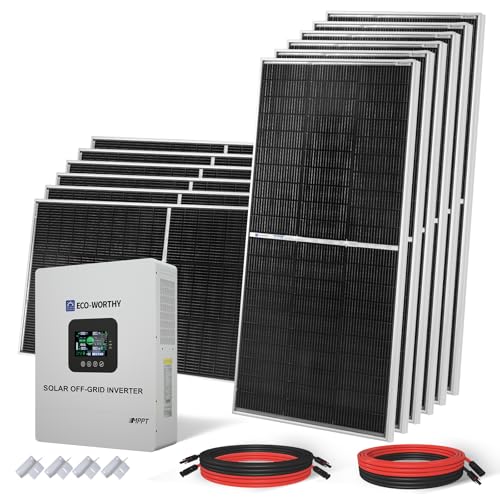
Best for: Budget-conscious buyers who want a complete 240V-capable off-grid setup without extensive expansion plans. The kit targets about 9.36 kWh daily output with a 2340W solar array and durable N-Type 195W panels offering high efficiency and longevity.
Why selected: Combines a realistic daily energy target with a modular inverter design. It suits homes seeking a straightforward build with reliable performance.
Caution: Battery data is not specified in the feature list; plan storage needs based on expected outages and appliance use to avoid under-provisioning.
EF ECOFLOW Delta Pro 3 With 400W Panel

Best for: Users needing a premium portable solar generator with 120V/240V outputs and strong expandable capability. It is suited for home backup, RV, and mobile use where quick deployment matters.
Why selected: Provides robust 120V/240V AC output, large expandable battery capacity, and versatile charging options. It’s a versatile option for those who want a reliable off-grid or hybrid setup with easy expansion paths.
Caution: While highly capable, it may require additional modules to reach the same continuous output as larger fixed kits; plan for potential modular expansion if high-load appliances are used concurrently.
Buying Guide: 240V Solar System Essentials
- System type: Choose between off-grid kits (with battery storage) and grid-tied/backup hybrids. Off-grid is best for remote locations with no utility access, while Grid-tied kits can reduce reliance on the grid.
- Output needs: Match continuous power (W) to essential appliances. If you expect high-load devices like air conditioners, a 240V split-phase inverter and a high-capacity battery bank are important.
- Battery chemistry and capacity: LiFePO4 batteries are common for safety and longevity. Capacity (Wh) determines how long you can run essentials during outages. Consider parallel expansion if future growth is planned.
- Solar array size: PV capacity (W) should align with daily energy goals and available sun. More panels increase daily generation but require space and mounting considerations.
- Expansion and parallel capability: Some inverters support paralleling multiple units to scale output. Verify compatibility and wiring requirements for safe expansion.
- Monitoring and connectivity: Real-time status via Bluetooth, Wi-Fi, or PC helps manage charging, discharging, and energy consumption. Look for systems with robust monitoring interfaces.
- Installation considerations: Check space for panels (roof or ground), mounting hardware, and weather exposure. Ensure compliance with local electrical codes and safety standards.
- Maintenance and service: Battery aging affects capacity. Plan for periodic checks and potential battery replacements over time.
- Budget vs. needs: Higher capacity systems deliver more reliability but at higher upfront costs. Prioritize the essential features needed for reliable daily operation.
FAQ
- What does 240V split-phase mean for these kits?
Split-phase 240V means the system can safely supply common home appliances that require 240V, with two hot legs delivering balanced power.
- Can I expand a kit later?
Yes, several inverters support parallel expansion, but you must ensure compatibility and proper wiring per the manufacturer’s instructions.
- Are these kits suitable for daily use?
Many kits are designed for regular operation and backup power, but check continuous load ratings and battery capacity to match your daily energy needs.
- What maintenance is required?
Regular inspection of panels, wiring, and inverter connections; monitor battery health and replace aging batteries as needed to maintain performance.
- Do these systems require professional installation?
For safety and code compliance, professional installation is recommended, especially for wiring, mounting, and integration with existing electrical panels.
- Which kit is best for a cabin with limited sun?
Choose a compact, efficient kit with higher battery storage and a reliable inverter, prioritizing units known for efficiency and safety certifications.