Best 240V Level 2 Chargers for Home EV Charging
Choosing a 240V Level 2 charger for home use involves balancing speed, installation needs, and smart features. This guide highlights five well-rounded options, all designed to deliver reliable Level 2 charging for commonly used EVs. Each model offers different amperage, wiring needs, and connectivity to help you pick the right fit for your garage, driveway, or carport.
Summary Of Selected Products
| Product | Brand | Amperage / Power | Plug Type | Key Features | Amazon Link |
|---|---|---|---|---|---|
| EVIQO Level 2 EV Charger 40 Amp | EVIQO | 40A / 9.6 kW | NEMA 14-50 plug | Enhanced Wi‑Fi; 6–40A control; IP66 housing; app-based scheduling | https://www.amazon.com/dp/B0DD7KW73M?tag=infinitepower06-20 |
| AIMILER Level 2 EV Charger 32A | AIMILER | 32A | NEMA 14-50P plug | ETL listed; adjustable current; app control | https://www.amazon.com/dp/B0CG8D445Q?tag=infinitepower06-20 |
| EVIQO EV Charger Level 2 48A | EVIQO | 48A / 11.5 kW | Hardwired (wall mount) | Up to 48A; strong endurance; Wi‑Fi app | https://www.amazon.com/dp/B0D1XLRC5D?tag=infinitepower06-20 |
| EMPORIA Level 2 EV Charger | EMPORIA | 48A (hardwired) or 40A (NEMA) | NEMA 14-50 plug / hardwired | UL listed; ENERGY STAR; long 25ft cable | https://www.amazon.com/dp/B09ZNN3JB7?tag=infinitepower06-20 |
| Lectron Level 2 EV Charger | Lectron | 40A | NEMA 14-50 plug | ETL certified; IP65; 16 ft cable | https://www.amazon.com/dp/B0BXP2JB64?tag=infinitepower06-20 |
Note: The table lists a mix of plug-in and hardwired configurations, along with certifications and typical cable lengths to help you compare suitability for your installation.
EVIQO Level 2 Charger — 40 Amp, 9.6 kW

The EVIQO 40A Level 2 charger delivers up to 9.6 kW charging and is designed for 240V circuits with a NEMA 14-50 receptacle. It features an enhanced Wi‑Fi antenna and a smart app for start/stop control, scheduling, and consumption tracking. The unit is UL and ETL certified and includes a rugged NEMA 4/IP66 housing for weather resistance. The device supports remote firmware updates and allows 1A-step current adjustments from 6A to 40A, enabling off-peak charging strategies. A fault reset button helps quickly clear issues in the field.
AIMILER Level 2 EV Charger — 32A

AIMILER’s 32A Level 2 charger uses a NEMA 14-50 plug with J1772 compatibility and ETL listing. It supports adjustable amperage (through the app and a physical control), providing up to 32A when connected to a suitable circuit. The product notes emphasize compatibility with many North American EVs and how to handle adapters for certain models. It claims rapid charging relative to Level 1 and includes safety certifications such as UL and FCC listed. The design focuses on ease of use and flexible installation, including guidance on adapter usage.
EVIQO 48A Level 2 Charger — Gen 2

This hardwired, 48A Level 2 charger is intended for wall mounting in home garages. With 11.5 kW charging capacity, it targets faster charging for households with higher electric loads. The Gen 2 model passes UL and ETL certifications and includes robust IP66-rated protection and a strong Wi‑Fi connection for the companion app. Features include 6–48A current adjustment, scheduling, and cost tracking. It emphasizes remote firmware updates and a durable design suitable for varying weather conditions where the unit is installed outdoors or in a sheltered area.
EMPORIA Level 2 EV Charger
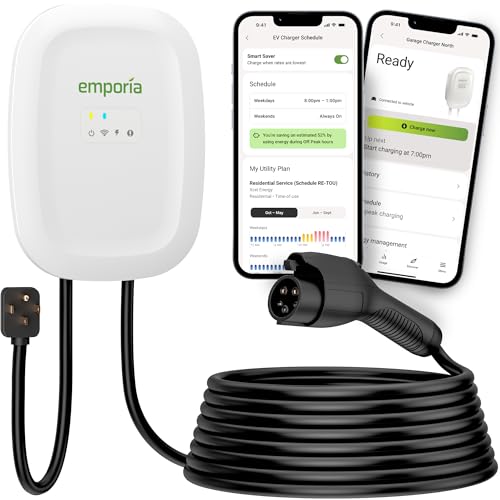
EMPORIA’s Level 2 charger supports a 48A hardwired option or 40A through a NEMA 14-50 connection, offering versatile installation configurations. It is UL listed and ENERGY STAR certified, signaling compliance with stringent efficiency and safety standards. The charger is designed for plug-and-play or hardwired setups and includes a 25-foot cable. EMPORIA emphasizes safety certifications, robust construction, and professional installation recommendations to maximize performance and safety in residential settings.
Lectron Level 2 EV Charger — 40A

Lectron offers a 40A Level 2 charger with a NEMA 14-50 plug and a 16-foot extension. It is FCC and ETL certified (UL2594), with IP65-rated protection for dust and water resistance. The charger aims for straightforward, portable use and compatibility with J1772 EVs/PHEVs. Its design emphasizes safety, efficiency, and portability, making it suitable for users who need to move or store the unit or repurpose it for multiple locations.
Buying Guide: Key Purchase Considerations
- Amperage and charging speed: Higher amperage (40–48A) provides faster charging but requires a dedicated circuit (typically 60–80A for hardwired 48A setups) and proper electrical service. If your vehicle supports 7–11 kW charging, a 32–40A unit is often a practical balance for many homes.
- Plug-in vs. hardwired: Plug-in NEMA 14-50 options are easier to install and relocate, but hardwired Level 2 chargers can deliver consistent performance and may be preferred for long-term, fixed installations.
- Wiring and electrical panel capacity: Check your main service panel and available circuits. Upgrading may be needed to support Level 2 charging, especially for higher amperage models.
- Certifications and safety: Look for UL, ETL, FCC, and ENERGY STAR certifications. These indicators help ensure compliance with safety and efficiency standards and may affect rebates.
- Smart features and app control: Wi‑Fi connectivity, remote start/stop, scheduling, and energy tracking help optimize charging times and monitor costs. Ensure compatibility with your home network and smartphone.
- Cable length and connector: Cable length (e.g., 16–25 feet) impacts placement flexibility. J1772 connector compatibility is the standard for most North American EVs; Tesla vehicles may require adapters.
- Installation considerations: Outdoor-rated housings and IP ratings matter if the charger will be exposed to weather. Consider professional installation for safe electrical work and warranty validity.
- Cost vs. incentives: Many Level 2 chargers are rebate-eligible or qualify for federal tax credits. Confirm eligibility based on your location and device certifications before purchasing.
- Future-proofing: If you anticipate upgrading vehicles or adding more EVs, a charger with adjustable amperage and firmware updates can extend the useful life of your investment.