Best 240 Volt Time Clock Selections for Easy Power Scheduling
Answer: A 240 volt time clock is ideal for controlling high-powered outdoor and indoor equipment like pool pumps, water heaters, and large fans. This guide highlights five reliable options, each suited to different needs—from heavy-duty outdoor timers to compact indoor models. Choose based on load capacity, programming flexibility, and installation environment. The top picks below include a mix of mechanical and digital timers to fit 240V circuits and maximize energy efficiency.
Summary table of chosen products
| Product | Voltage & Max Load | Programming | Best For | Notes |
|---|---|---|---|---|
| BN-LINK Pool Timer | 120-277 VAC, up to 40A | 24-Hour dial, 96 pins | Pool pumps, heaters, and spa equipment | ETL Listed; weatherproof shell |
| JKLESA T104 Mechanical Time Switch | 208-277 VAC, up to 40A | 24 hours, 12 on/off | Outdoor lighting, pool-related devices | Manual override |
| SURAIELEC Digital Pool Timer | 120-277 VAC, up to 40A | 7-day, up to 20 ON/OFF | Flexible weekly schedules | Rechargeable backup battery |
| SURAIELEC Mechanical 240V Timer | 240V, up to 3HP (40A) | 24-Hour, 12 on/off | High-load pool/heater devices | AC contactor upgrade option |
| NSi TORK TU40 Timer | 120-277 VAC, 40A | 24-Hour, repeatable | General-purpose 24-hour control | Universal, easy setup |
BN-LINK Pool Timer, Outdoor Mechanical Timer Box

Best For: Pool pumps, water heaters, and spa equipment in outdoor environments. This timer is designed for heavy-duty loads with 24-hour cycles and a real-time clock.
- 40A resistive load at 120-277 VAC; suitable for high-power devices.
- Daily repeat cycle with 96 pins (15-minute increments) for up to 48 programs per day.
- Durable PC shell with weather resistance; good for outdoor use in cold or hot weather.
Caution: After a power failure, you must rotate the dial to reset the current timer.
T104 Mechanical Time Switch 208-277 VAC
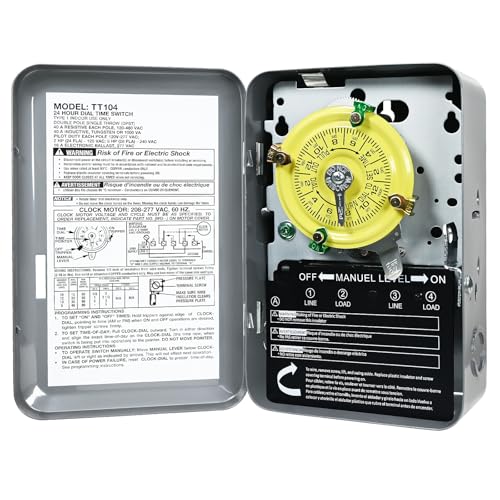
Best For: Outdoor or indoor 240V installations needing a robust mechanical timer with a manual override for quick adjustments.
- 208-277 VAC, 60Hz, DPST, up to 40A per pole.
- 12 ON/OFF cycles per day with 15-minute intervals; manual override available.
- Durable mechanical design suitable for outdoor settings.
Limitation: Minimum ON/OFF interval is one hour, which may not fit very short control needs.
SURAIELEC Digital Pool Timer

Best For: Property owners needing flexible weekly programming and battery-backed time retention.
- 40A, 120-277 VAC; supports pool pumps, water heaters, and lighting.
- Up to 20 ON/OFF settings; 7-day scheduling with DST support.
- Rechargeable backup battery preserves time and settings during outages.
Limitation: Battery back-up requires periodic charging; ensure battery is maintained for continuous operation.
SURAIELEC Mechanical Pool Timer

Best For: High-load pool equipment and 240V systems that require reliable mechanical control with simple timing.
- 40A 240V, 3HP capacity; designed for high-load pumps, lights, and heaters.
- AC contactor upgrade option enhances current capacity and longevity.
- 25+ years of industry presence reflected in durable design; 24-hour cycle with 12 on/off cycles.
Limitation: Mechanically driven with a dial, which may be less precise than digital timers in some settings.
NSi TORK TU40 Timer

Best For: General-purpose 24-hour control across residential or light commercial loads on 120-277V circuits.
- 40A universal timer with 24-hour programming and repeatable cycles.
- Easy to set up with captive tabs; automatic voltage detection helps with various loads.
- Suitable for pumps, signs, lamps, fans, and more in day-to-day settings.
Caution: Ensure compatibility with permanent wiring standards for outdoor installations; verify enclosure ratings for weather exposure.
Buying Guide
What should you consider when choosing a 240V time clock?
- Load capacity: Match the timer’s amperage and horsepower rating to your device. For large pool pumps and heaters, pick models rated at 40A or higher.
- Voltage compatibility: Ensure the timer supports your supply voltage (208-277 VAC, 240V, or multi-volt ranges).
- Programming flexibility: Decide between mechanical dials (reliable, simple) and digital timers (more program slots, DST, backups).
- Outdoor vs indoor use: Weatherproof housings and temperature tolerance protect timers in harsh environments.
- Backup and retention: Some digital timers offer battery backups; mechanical models rely on continuous supply and manual resets after outages.
- Mounting and enclosure: Check whether the timer fits your box, has a standard NEMA enclosure, and is easy to wire in.
FAQ
- What is the difference between mechanical and digital 240V timers?
Mechanical timers use a dial and pins for scheduling; digital timers use electronic clocks and more flexible programming. - Can a 240V timer control a 3HP pool pump?
Yes, if the timer is rated for 40A at 240V and supports the load type; verify motor start requirements and wiring practices. - Do all 240V timers support outdoor installation?
Not all; choose models with weatherproof enclosures or suitable housings for outdoor use. - What happens after a power outage?
Mechanical timers may require dial adjustment; digital timers may retain settings with a backup battery.