Best 240 Volt Double Pole Thermostats for Electric Heaters
Answering the common search for reliable 240-volt double-pole thermostats, these models fully disconnect power and are best for cold climates, high-load baseboard heaters, and safety-conscious installations. Ideal buyers include homeowners upgrading electric baseboard systems, property managers seeking durable line-voltage controls, and contractors needing straightforward, hard-wired thermostats. The selections below emphasize non-programmable, mechanical options with strong safety features and easy wiring. A quick comparison table follows to help you choose at a glance.
| Product | Best For | Key Benefit |
|---|---|---|
| Cadet Double Pole Mechanical Wall Thermostat (T522-W) | Baseboard heaters requiring reliable off/on control | Double pole with positive off position |
| Stelpro SWT2F Double-Pole Line Voltage Thermostat | Colder climates needing full power disconnect | Precise dial, 50–90°F range |
| Cadet F Series BTF2W | Cadet baseboard systems with 240/120/208/277 compatibility | Easy end-mount installation |
| Dr. Infrared Heater DR-001 Thermostat | High-wattage, multi-volt installations | Four-wire compatibility with wide wattage range |
| Honeywell TL7235A1003 Line Volt Pro | Non-programmable digital control needs | Backlit display and clear heating indicator |
Note: The table highlights versatility, safety, and ease of installation. Each selected model is a practical choice for typical American homes and small commercial settings that rely on line-voltage heating elements.
Cadet T522-W Double Pole Mechanical Thermostat

The Cadet T522-W uses a double-pole (4-wire) design with a positive off position, providing full power disconnection for safety. It easily replaces most line-voltage wall thermostats and uses color-coded wires for straightforward wiring. Best for: homeowners upgrading standard line-voltage controls and installers seeking a reliable, simple replacement for existing units. Caution: ensure the unit’s electrical box can accommodate a standard wall-mount thermostat and that wiring matches color codes.
Stelpro SWT2F Double-Pole Line Voltage Thermostat

The Stelpro SWT2F is designed for 120–277V systems with a robust 22A rating, suitable for baseboards, fan-forced units, and some commercial heaters. It offers a precise dial with a 50–90°F range, supporting hands-on adjustments. Best for: installations needing full power shutoff and dependable mechanical control in varied climates. Limitation: single tone mechanical controls may be less precise than digital options in some settings.
Cadet F Series BTF2W Double Pole Baseboard Thermostat

The Cadet BTF2W is built for Cadet F series baseboard heaters, supporting 240/208/120V operation with a 22A rating and a 40ºF to 85ºF range. It installs easily on either end of the heater, reducing wiring needs. Best for: Cadet baseboard setups needing a simple, end-mounted double-pole control. Caution: only compatible with Cadet F series baseboards; mixing with other heater models may require additional adapters.
Dr. Infrared Heater DR-001 Wall Thermostat
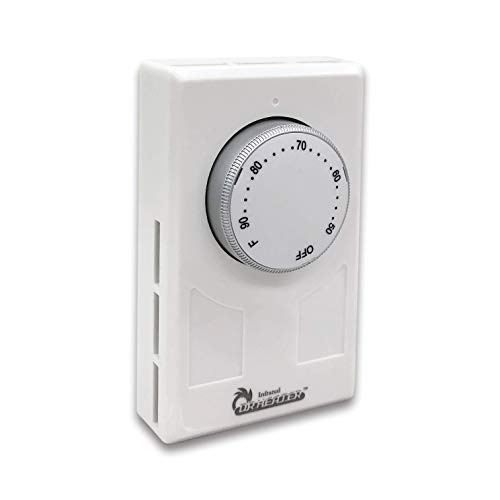
The DR-001 supports 120–277V with a high wattage ceiling (3360W at 120V to 7756W at 277V) and includes both C and F control dials for flexible operation. It sits flush against the wall, offering a clean, space-saving installation. Best for: high-wattage, multi-volt setups where a flush-mount, dual-dial thermostat is desired. Limitation: ultra-high wattage ratings require careful wiring planning to avoid overloading circuits.
Honeywell TL7235A1003 Line Volt Pro Non-Programmable

The Honeywell TL7235A1003 provides an on-demand backlight for easy reading in dim conditions and a heating indicator to confirm operation. It is a non-programmable digital option suitable for straightforward line-voltage control. Best for: spaces needing a clear, simple digital readout without programming. Consideration: some users may prefer a mechanical dial over a digital readout in hot environments or harsh settings.
Buying Guide
What should I consider when choosing a 240V double-pole thermostat?
- Voltage and amperage rating: Ensure the unit supports your heater’s voltage (120–277V range) and current (typically 22A for baseboards).
- Pole configuration: Double-pole models fully disconnect power, offering better safety and energy efficiency, especially in cold climates.
- Installation compatibility: Check if the thermostat mounts on a standard wall box or directly to the heater end, and verify wiring compatibility with your existing setup.
- Control type: Mechanical (manual dial) vs. digital. Mechanical tend to be robust and simple; digital can provide backlighting and indicators but may require power for the display.
- Temperature range and precision: Look for a suitable range (e.g., 40–90°F or 50–90°F) and the ease of dialing the setting.
- Safety features: Positive off positions and full disconnection reduce accidental heating and improve occupant safety.
Which features drive best value?
- Full power disconnection (double-pole) is a top safety feature, particularly in damp or enclosed spaces.
- Ease of wiring and color-coded wires reduce installation time and errors.
- Durable housing and compatibility with existing baseboard systems save future rework costs.
What about installation considerations?
- Confirm circuit capacity and wire gauge to handle the thermostat’s maximum current.
- Plan for flush-mount vs. end-mount options based on heater layout and wall space.
- If replacing a single-pole unit, verify if your system benefits from upgrading to a double-pole model.
FAQ
- What is a double-pole thermostat? Answer: A double-pole thermostat disconnects both hot wires, providing full isolation of the circuit for safety and efficiency.
- Can these thermostats work with any 240V baseboard heater? Answer: They are designed for line-voltage systems and may vary by voltage range; check the product’s compatible voltages before purchasing.
- Is a digital display necessary for a 240V thermostat? Answer: Not necessary; many reliable mechanical models are slightly lighter on features but highly durable and easy to use.
- Do I need professional installation? Answer: If you are not comfortable with high-voltage wiring, consult a licensed electrician to ensure safety and code compliance.
- What safety features should I look for? Answer: Look for a positive off position, full power disconnection (double-pole), and robust wiring connections.
- Are there compatibility notes for baseboard brands? Answer: Some units are designed to pair with specific baseboard lines; verify brand compatibility in product details.