Best 240 Volt Charging Station Options for Home EV Labs and Busier Garages
Answering the demand for reliable 240-volt charging, these 5 options cover wall-mounted, plug-in, and multi-device charging stations. Ideal buyers include homeowners seeking overnight EV charging, renters with a wall outlet limitation, and tech-minded users who want Wi‑Fi control and app insights. The following table summarizes the picks to compare at a glance.
| Product | Type | Output (A) | Typical Use |
|---|---|---|---|
| EVIQO Level 2 Charger (40A) | Wall-mount Plug-in | 40 | Most non-Tesla EVs; fast nightly charge |
| AIMILER Level 2 Charger (32A) | Plug-in Portable | 32 | Flexible home charging; portable |
| EVIQO Level 2 Charger (48A) | Hardwired | 48 | Higher-power setups; larger home installs |
| NexCyber Level 2 Charger (32A) | Plug-in Portable | 32 | J1772 compatibility; easy install |
| Kioson 12-in-1 Charging Station (200W) | Multi-Port USB-C/USB-A | 200 | Multiple devices; desk or office setup |
EVIQO Level 2 EV Charger, 40 Amp 240V (J1772)

The EVIQO 40A wall-mount plug-in charger recharges most EVs overnight on a dedicated 50A/240V circuit. It uses a J1772 connector for non-Tesla EVs and can function as a Tesla Level 2 charger with an adapter. Best for homeowners who want a simple install and WiFi-based control via a 2.4 GHz network. Caution: requires a NEMA 14-50 outlet and verification of vehicle connector type and electrical setup.
AIMILER Level 2 EV Charger (32A), 25ft

The AIMILER charger is a portable 32A EVSE with a J1772 connector and a 25-foot cable. It supports 240V operation with a NEMA 14-50 plug and can be controlled via an app. Best for renters or users who need a flexible, plug-in solution without permanent hardwiring. Limitation: some vehicles may charge slower if a 110V adapter is used or if the wrong EV adapter is employed.
EVIQO Level 2 EV Charger, 48 Amp 240V (Hardwired)

The 48A EVIQO charger is designed for hardwired installations on a dedicated 60A/240V circuit. It unlocks up to 50A output with DIP switches for higher-demand setups. Best for homes needing faster charging with a fixed installation. Caution: installation requires a licensed electrician, and adapter usage for Tesla/NACS is not included.
NexCyber Level 2 EV Charger, 32A, WiFi App
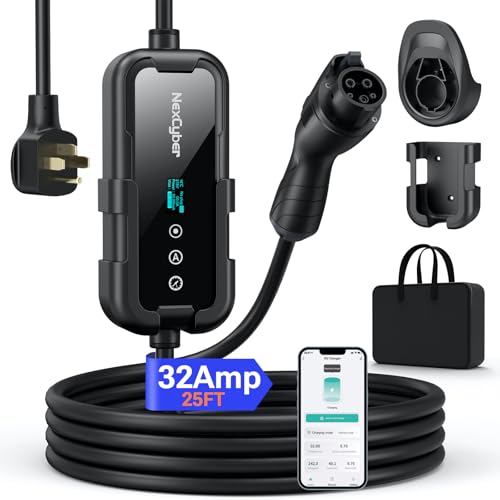
The NexCyber 32A charger uses a J1772 connector and a 25-foot cable, with WiFi app control for monitoring and managing charging. It can be used with a NEMA 14-50 plug and is suitable for garages seeking a portable, app-enabled option. Best for users who want a balance of cost, portability, and smart features. Limitation: some vehicles may require an adapter to work with Tesla or specific NACS setups.
Kioson 12-in-1 Charging Station, 200W

Kioson’s 12-in-1 charging station combines 4 AC outlets with 8 USB ports (4 USB-C, 4 USB-A) delivering up to 200W total. It supports high-demand devices in an office or home setup. Best for households with multiple devices needing simultaneous charging. Caution: not a dedicated EV charging station; use for electronics charging rather than EVs.
Buying Guide: What to Consider Before Buying a 240V EV Charging Station
- Power needs: Choose 32–48A for most mid-range EVs; consider 48A for faster overnight charging on larger batteries.
- Install type: Plug-in units are easier for renters; hardwired systems often deliver steady performance and higher current.
- Adapter compatibility: Confirm J1772 compatibility and whether Tesla or other brands require adapters.
- Location and weather: For outdoor use, ensure IP ratings and weatherproofing (IP66/NEMA 4) for durability.
- Smart features: WiFi/app control helps track usage, reminders, and cost; verify 2.4 GHz network compatibility.
- Circuit requirements: Ensure a dedicated circuit and correct breaker size (20–70A depending on model) per NEC guidelines.
- Portability vs. permanence: Plug-in models offer flexibility; hardwired models suit long-term installations with minimal moving parts.
- Safety certifications: Look for UL/ETL listings and compliance with SAE J1772 and related standards.
- Future-proofing: If planning higher power or more vehicles, consider models with easy AMP adjustments and expandable circuits.
Frequently Asked Questions
- What is a 240-volt charging station? A charging device that uses a 240V circuit (often 40–60A) to charge electric vehicles faster than standard 120V outlets.
- Do all EVs use the same connector? Most North American EVs use J1772, with Teslas able to charge via adapter. Check your vehicle’s connector type first.
- Is a hardwired installation safer than plug-in? Both are safe when installed correctly, but hardwired units typically sustain higher currents and are less prone to plug wear.
- Will a higher amperage charger always be faster? Generally yes, but charging speed also depends on the vehicle’s onboard charger and battery state.
- Can I use an EV charger outdoors? Yes, if the unit has weatherproofing (IP66 or NEMA 4) and is rated for outdoor installation.
- Do these chargers require a professional install? Some models are plug-in and do not require a professional, while hardwired units typically require an electrician.