Best 240 Volt Battery Charger Solutions for Home and Auto Use
Finding a 240 volt battery charger that fits your car, boat, or EV charging needs can be challenging. This guide highlights five highly capable 240V-capable or dual-voltage chargers, focusing on safety, efficiency, and compatibility with common battery chemistries. Whether you’re maintaining a fleet of vehicles or keeping your recreational gear charged, these options cover automotive, marine, and light electric-vehicle charging needs.
Summary of Selected Products
| Product | Brand | Input Voltage | Battery Types | Notes |
|---|---|---|---|---|
| Battery Charger 120 To 240 Volt AC | Part Synergy | 120-240V | AGM, Calcium, EFB, Flooded Lead-Acid, Gel, Lithium-Ion | 7.1 x 3.6 x 2.3 in; 10 A |
| Smart Battery Charger Maintainer (110-240V) | Haofy | 110-240V | Car, Truck, Motorcycle, AGM | 12V/8A or 24V/4A; LCD |
| YONHAN 15A Battery Charger | YONHAN | Typically 110-240V input | Lead-Acid, LiFePO4, AGM, Gel, SLA | 9-stage, temp compensation |
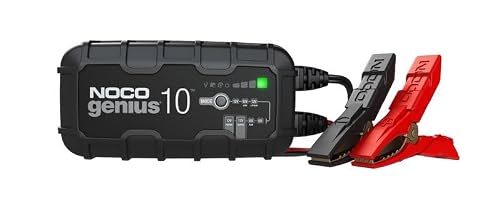
| NOCO GENIUS10 | NOCO | Typically 110-120V (North America) | Lead-Acid, LiFePO4 | 10A, 6V/12V; smart, desulfator |
| AIMILER Level 2 EV Charger | AIMILER | 240V (NEMA 14-50P plug) | All North America J1772 EVs | 32A, 7.68kWh, APP control |
Note: The table focuses on input range and battery compatibility to help you compare how each unit aligns with a 240V electrical setup and your battery needs.
Battery Charger 120 To 240 Volt AC
This charger supports 120 to 240 volts with a 9-step automatic cycle and a 10-amp charging current. It accepts multiple battery chemistries including AGM, calcium, EFB, flooded lead-acid, gel, and lithium-ion. It provides charging at both 6V and 12V, making it versatile for motorcycles, cars, and small boats. The compact form factor fits in tight spaces, while the automatic cycle helps stabilize charge without constant supervision.
Smart Battery Charger Maintainer for Car

This universal charger/maintainer covers cars, trucks, and motorcycles, with automatic charging cycles from fast charge to trickle. It supports 12V 8A or 24V 4A operation and includes a mode switch for charging or repair. Built-in protective features guard against reverse polarity, sparks, overcharging, over-current, open circuits, short circuits, and overheating. An integrated cooling system with a heatsink enhances reliability during extended charging sessions.
YONHAN 15A Battery Charger
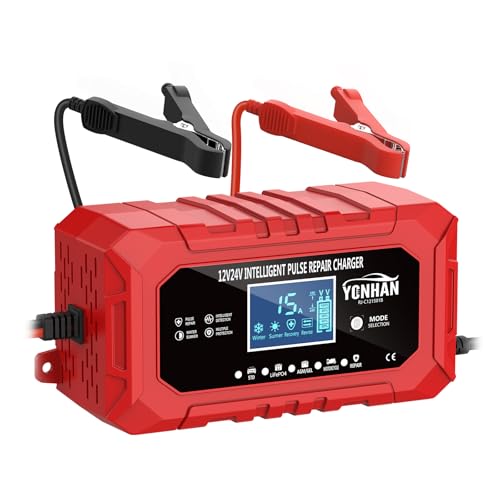
YONHAN’s 15A charger provides a robust, 9-stage charging process with temperature compensation to optimize performance across weather conditions. It works with 12V and 24V lead-acid and LiFePO4 batteries, covering cars, trucks, motorcycles, boats, lawnmowers, and more. The system includes advanced sulfation and acid stratification detection to boost battery life, though it notes it cannot revive completely dead batteries. Safety protections guard against common charging hazards.
NOCO GENIUS1

NOCO GENIUS1 functions as a 1A 6V/12V smart charger, maintainer, trickle charger, and desulfator with overcharge protection and temperature compensation. It supports a range of lead-acid and lithium batteries, including AGM, Gel, SLA, VRLA, and LiFePO4. Its compact design prioritizes precision charging, automatically adjusting for ambient temperature to avoid overcharging in heat and undercharging in cold environments.
NOCO GENIUS10

NOCO GENIUS10 amps up charging with 10A capability while remaining compact. It covers 6V and 12V lead-acid and LiFePO4 batteries, delivering a complete charging solution that includes maintenance, trickle charging, and desulfation. The thermal sensor ensures charging adapts to temperature, protecting both the battery and charger during operation.
AIMILER Level 2 EV Charger

AIMILER’s Level 2 EV Charger delivers 32A charging at 240V, with a 25-foot cable and J1772 compatibility. It’s ETL listed and designed for home Level 2 charging, offering faster replenishment for EVs compared to Level 1 options. The device emphasizes safety compliance with multiple standards and supports smart operation via a connected app. It’s ideal for households seeking rapid, reliable EV charging at home.
Buying Guide: Key Purchase Considerations
When selecting a 240V-capable charger or a dual-voltage option, consider the following:
- Input voltage and compatibility: Ensure the charger supports your mains supply (240V in many regions) and any needed adapters for dual-voltage operation.
- Battery type compatibility: Verify the charger handles the battery chemistries you use (lead-acid, AGM, Gel, LiFePO4, etc.).
- Charging power and circuit requirements: Higher amperage (e.g., 32A) demands appropriate circuit capacity and wiring. For EV charging, confirm the unit aligns with your vehicle’s acceptance rate.
- Safety features: Look for reverse polarity protection, overcharge limits, short-circuit protection, overheating safeguards, and thermal compensation to protect both battery and charger.
- Maintenance vs. charging mode: Some devices function as maintainers, which are ideal for long-term battery health; others are quick-charge oriented.
- Connectivity and smart features: Apps or LCD displays can help monitor status, temperature, and charging cycles, improving user experience and battery health management.
- Portability and installation: Consider size, weight, and whether the charger is wall-mounted or portable. For Level 2 EV charging, confirm the plug type and cable length.
- Compatibility with vehicle types: EV chargers require J1772 compatibility for most American EVs, while some units provide broader support with adapters.
In summary, a 240V-capable charger or dual-voltage model offers versatility across various battery systems and vehicle classes. When evaluating options, prioritize safety credentials, battery compatibility, and the charging speed that best fits your daily routines and electrical capacity. The right charger should balance performance, durability, and ease of use within your home or workshop environment.