Best 24V to 240V Inverter Options for Off-Grid Power
If you’re shopping for a reliable 24V to 240V inverter, you’re looking for a device that combines inverter power, battery charging, and transfer switching. This guide highlights five top options, explains who they’re best for, and shows why one might suit your off-grid or backup needs better than another. It’s ideal for campers, tiny homes, remote cabins, or any setting where a 24V battery bank feeds a 120/240V AC load.
Buyer types:
– Off-grid homeowners and RV users who need high continuous power and robust surge handling.
– Solar enthusiasts seeking strong integration with battery banks and charging control.
– Builders wanting reliable split-phase output for both 120V and 240V appliances.
Below is a quick comparison table of the featured models to help your initial narrowing.
| Product | Continuous Power | Output | Key Benefit |
|---|---|---|---|
| Ampinvt 5000W Peak 15000W Pure Sine Wave Inverter (24V to 120/240V) | 5000W | 120/240V Split Phase | Strong all-in-one inverter with adjustable charging |
| Ampinvt 5000W Peak 15000W Pure Sine Wave Inverter (DC 24V to 120/240V) | 5000W | 120/240V Split Phase | Integrated battery charger and transfer switch |
| WZRELB 4000W Split Phase Pure Sine Wave Inverter | 4000W | 120/240V Split Phase | High surge for demanding loads, LCD control |
| ZLPOWER 6000W 24V Pure Sine Wave Inverter (Split Phase) | 6000W | 120/240V Split Phase | High power, multi-battery compatibility, LCD |
| Ampinvt 6000W Peak 18000W Pure Sine Wave Inverter (24V to 120/240V) | 6000W | 120/240V Split Phase | High surge, comprehensive charging options |
Ampinvt 5000W Peak Inverter With Battery Charger

This 24V-to-120/240V pure sine wave inverter integrates an inverter, battery charger, and AC auto-transfer switch. It’s best for users needing a robust off-grid setup with reliable night-to-day power transitions and a variety of battery types (SLA, AGM, GEL, Li-ion). The adjustable charging current (0–35A) lets you tailor charging to your battery bank. A potential limitation is that the device’s full loading and efficiency can depend on battery condition and wiring quality.
Ampinvt 5000W Peak Inverter With Charger (DC 24V)

This model mirrors the first Ampinvt option with a focus on a high-efficiency transition and the same battery compatibility. It’s well-suited for larger off-grid cabins or workshops that require steady AC power with an integrated charging function. Best for users who value precise control over charge current and a robust pure sine wave output. Caution: ensure a suitable battery bank and proper safety protections to manage high surge loads.
WZRELB 4000W Split Phase Inverter

This 24V DC to 120/240V AC unit provides 4000W continuous power with a generous 8000W surge. It’s best for medium-sized loads and environments where two 120V circuits are useful, plus a 240V hardwired option. The LCD display helps monitor battery status and output health. If you run heavy inductive loads, verify that your wiring and breakers are sized to handle combined loads across both circuits.
ZLPOWER 6000W Inverter With LCD And Charger
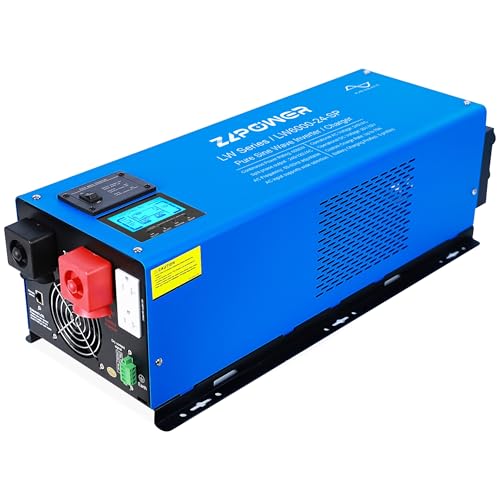
With a 6000W continuous rating and an up to 18000W surge, this split-phase inverter is designed for larger off-grid systems. It supports multiple battery chemistries and has an LCD to monitor charging and operation. Best for users who want a strong, scalable option that can be paired with larger battery banks. Limitation to watch: higher power systems demand rigorous thermal management and properly sized cables.
Ampinvt 6000W Peak 18000W Inverter With Charger

This higher-capacity Ampinvt model provides 6000W continuous and 18000W surge, along with a built-in battery charger. It’s best for large off-grid setups or RVs that power multiple high-draw appliances simultaneously. If your system uses Li-ion or advanced lead-acid chemistries, ensure compatibility with charging profiles. A limitation is that maximum efficiency can vary with load distribution and battery health.
Buying Guide: How to Choose a 24V To 240V Inverter
- Power needs: match continuous power to your typical load plus a safe margin for surges. If you run air conditioning or power tools, lean toward models in the 4000–6000W continuous range.
- Output type: split-phase 120/240V is essential for multi-circuit homes and workshops. Confirm the device can deliver both 120V and 240V as required.
- Battery compatibility: check supported chemistries (SLA, AGM, GEL, Li-ion). Ensure the battery type aligns with your bank and charging profiles.
- Charging control: adjustable charging current and transfer switching help integrate with solar charging or grid charging. Look for a device with automatic transfer and a programmable charger.
- Efficiency and cooling: higher efficiency reduces heat; ensure adequate ventilation. Off-grid installations should plan for cooling and air flow in enclosed spaces.
- Monitoring: LCD displays and remote control options aid in real-time status checks and troubleshooting.
- Safety: verify protections such as overload, short-circuit, reverse polarity, and automatic shutdown in fault conditions.
Frequently Asked Questions
- What does “pure sine wave” mean for these inverters?
Pure sine wave outputs mimic utility power and are better for sensitive electronics and appliances. - Can I use these inverters with lithium batteries?
Yes, most models support Li-ion, but confirm the charger settings and battery chemistry compatibility. - Do these inverters include automatic transfer switches?
Many models pair inverter and AC charger with transfer switching, which helps switch between grid and battery modes automatically. - What should I consider for safety and installation?
Use properly rated gauge wiring, correct fusing/breakers, ventilation, and follow the manufacturer’s wiring diagrams. - How do I size the charger current?
Choose charging current based on your battery capacity and recommended charging rate (e.g., C/10 or higher for lead-acid, lower for LiFePO4 until manufacturer guidance). - Is the surge rating important?
Yes. A higher surge rating protects against short-term startup spikes from motors and compressors.